Quick answer: You can eat Mediterranean on a budget by building meals around the cheapest staples in the diet: dried or canned beans and lentils, eggs, oats, canned tuna and sardines, frozen vegetables, seasonal produce, and one good bottle of olive oil. With a simple weekly plan, about $50 a week covers one person. The full grocery breakdown and a week of meals are below.
Get the free $50 grocery list ↓
You can eat Mediterranean for around $50 a week by building meals on inexpensive staples like dried beans and lentils, canned fish, eggs, oats, frozen vegetables, and olive oil instead of specialty imports. The foundation of this way of eating is naturally cheap; the marketing is what makes it feel expensive.
You’ve tried the $15 olive oil. The specialty grain you found at Whole Foods. The imported sardines that cost $6 a tin.
You spent $80 on ingredients for three Mediterranean recipes, made them once, and watched half of it expire before you could use it again.
This is how most people approach Mediterranean eating, recipe first, shopping second, budget last. And it’s exactly why it feels expensive and unsustainable.
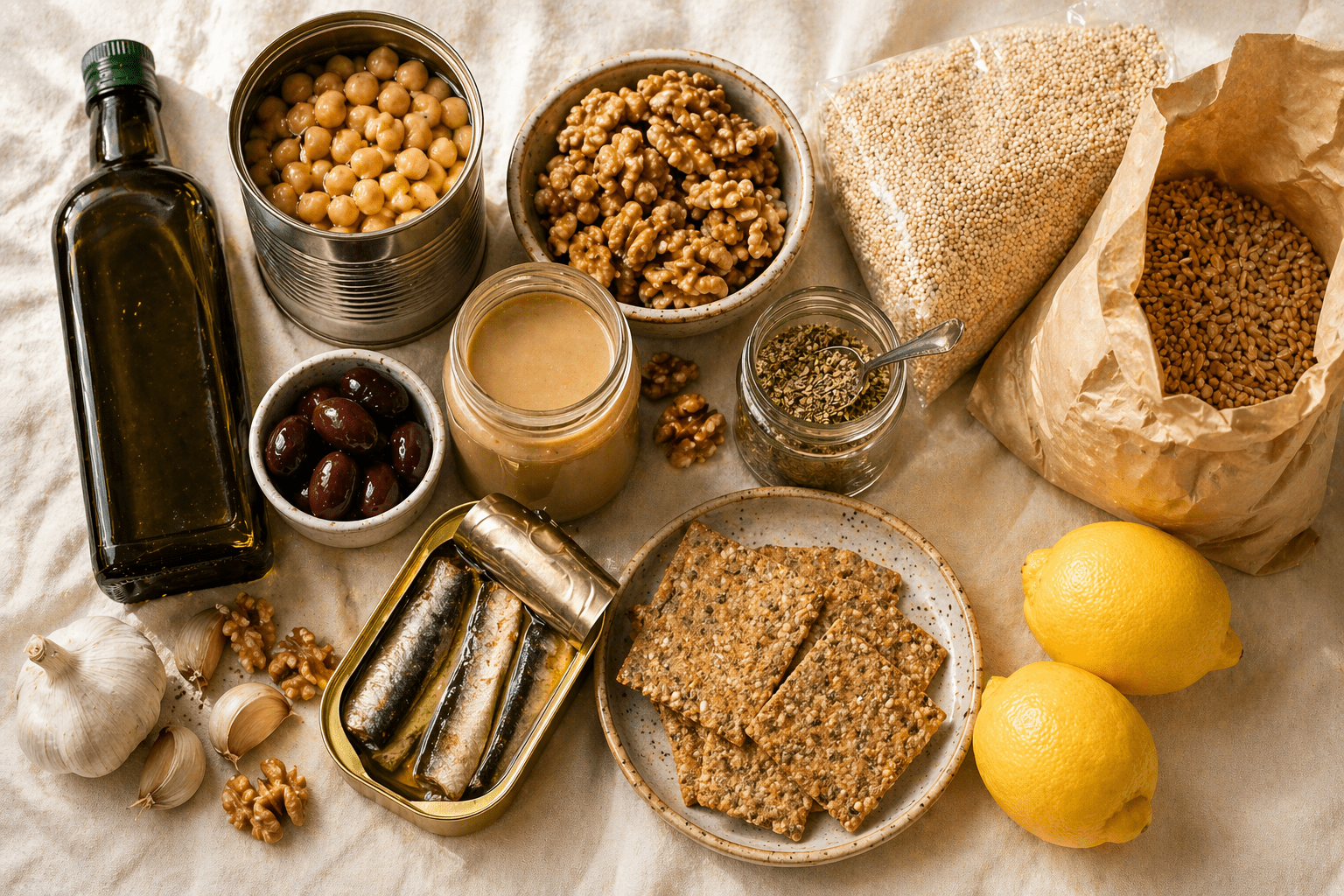
Here’s what nobody tells you: the foundation of Mediterranean eating is built almost entirely on the cheapest foods available. Canned legumes. Dried grains. Eggs. Frozen vegetables. A bottle of olive oil that lasts weeks.
The expensive version of Mediterranean eating exists, but it’s not the real version. The real version has been feeding families across Greece, Italy, and North Africa on working-class budgets for centuries.
This is how to do it for $50 a week.
Shopping this week? Get the free printable $50 grocery list further down.
Why Mediterranean Eating Has a False Reputation for Being Expensive
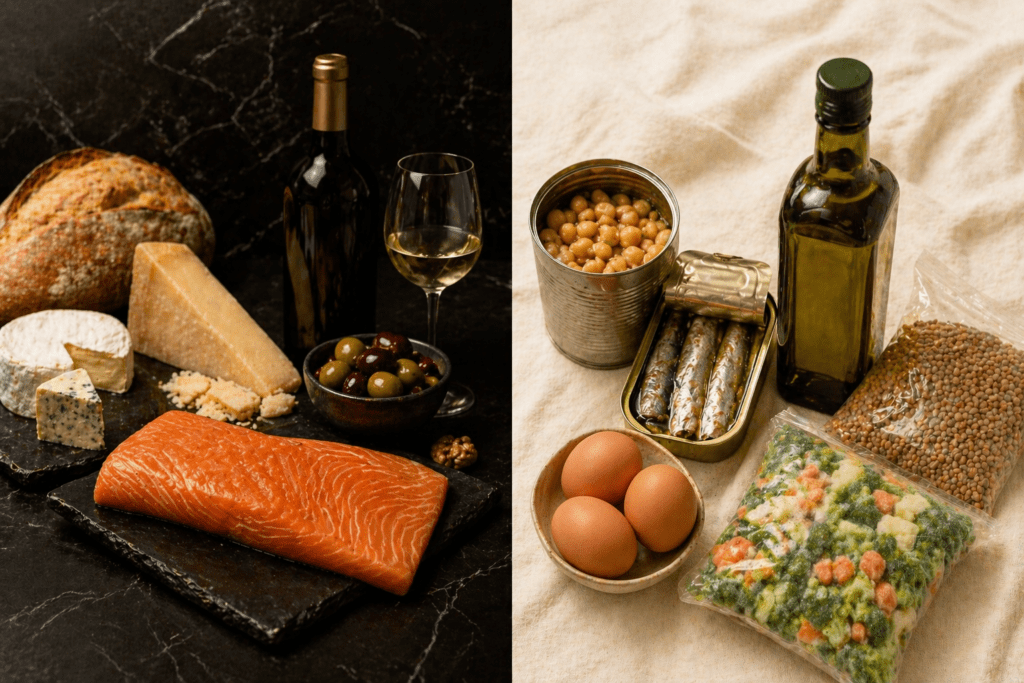
The misconception comes from how Mediterranean food gets marketed in the US, upscale restaurants, premium imported products, specialty grocery stores.
The actual Mediterranean diet as it’s traditionally eaten is one of the most budget-friendly dietary patterns in existence. It’s built around:
- Dried and canned legumes, some of the cheapest protein sources available
- Whole grains bought in bulk, pennies per serving
- Eggs, complete protein at roughly $0.25 each
- Frozen and canned vegetables, nutritionally identical to fresh at a fraction of the cost
- Olive oil, expensive upfront but costs $0.50–$1 per meal when spread across daily use
- Seasonal fresh produce, inexpensive when bought in season
The expensive items (fresh fish, imported cheeses, specialty grains), are additions to the foundation, not the foundation itself. You can eat genuinely Mediterranean without any of them.
The $50 Weekly Mediterranean Budget Breakdown
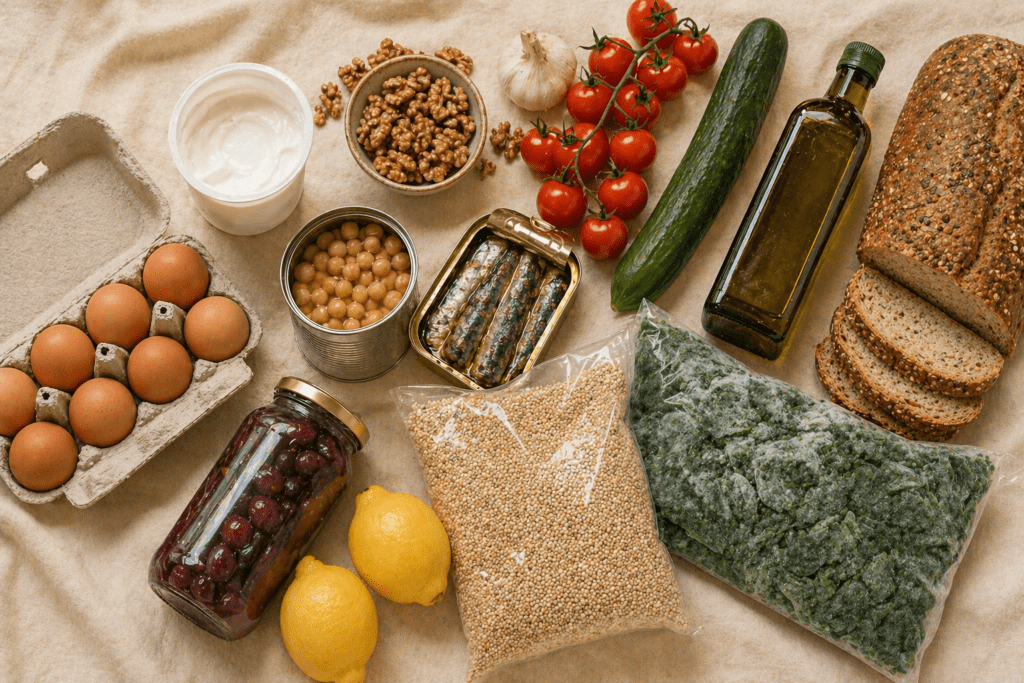
Here’s exactly how $50 breaks down across a full week of Mediterranean eating for one person. Adjust quantities for your household size.
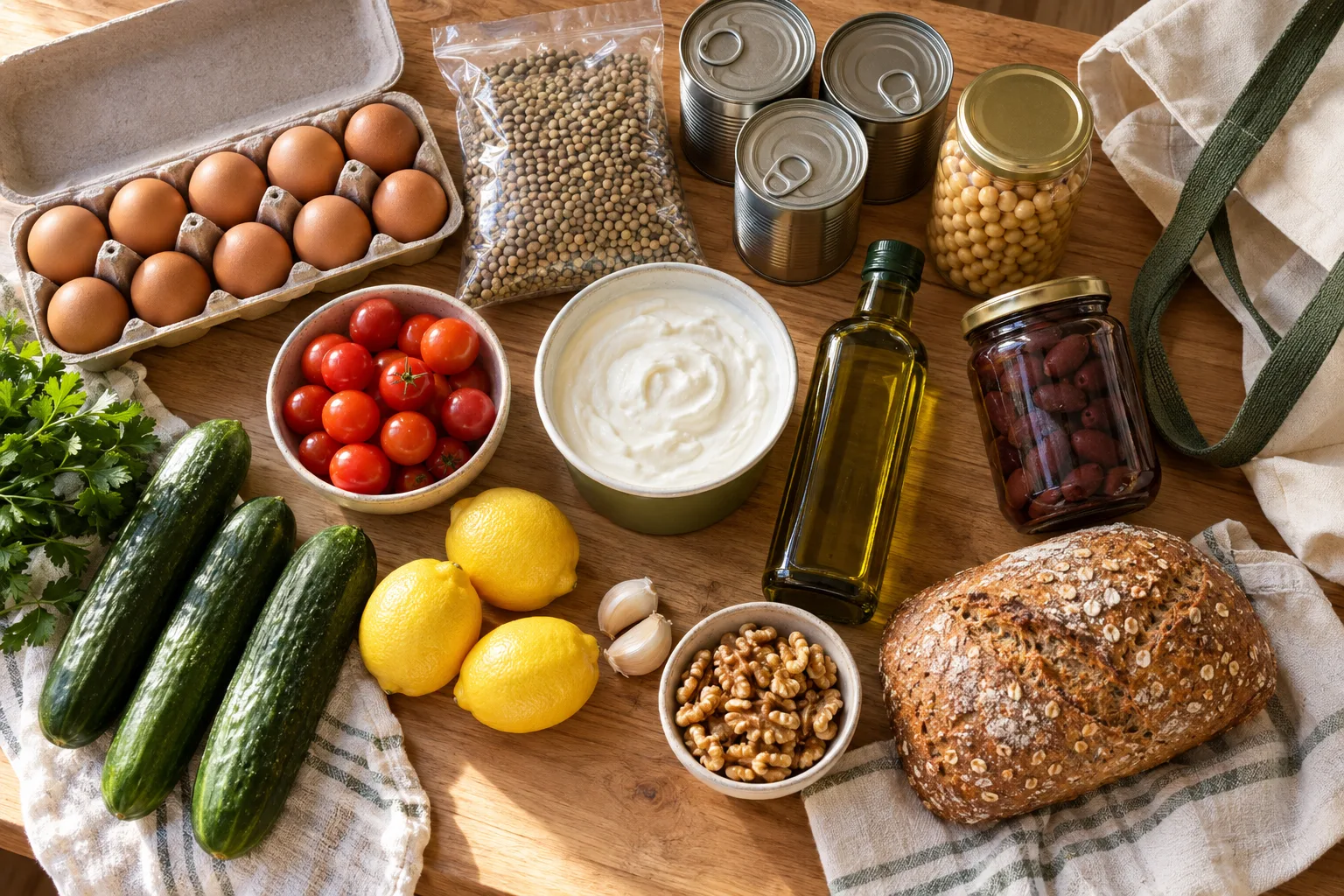
The Pantry Foundation, Buy Monthly Not Weekly ($15–20 one-time, then replenish)
These items are bought once and last weeks to months:
Extra virgin olive oil, $8–12 per bottle Lasts 2–3 weeks with daily use. Cost per meal: approximately $0.50. Non-negotiable. This is the foundation of everything.
Tahini, $5–8 per jar Lasts 4–6 weeks. Used in dressings, sauces, and as a spread. Cost per use: under $0.50.
Dried oregano and za’atar, $3–5 total Lasts months. These two spices transform simple ingredients into Mediterranean food.
Canned whole tomatoes, $1.50 per can, buy 3–4 Base of soups, stews, and sauces. $4–6 for a month’s supply.
Dried lentils, $2 per bag One bag makes 6–8 servings. Your cheapest complete protein source at roughly $0.25 per serving.
Weekly Fresh and Pantry Shopping, $30–35 per week
This is what you buy each week to build complete Mediterranean meals:
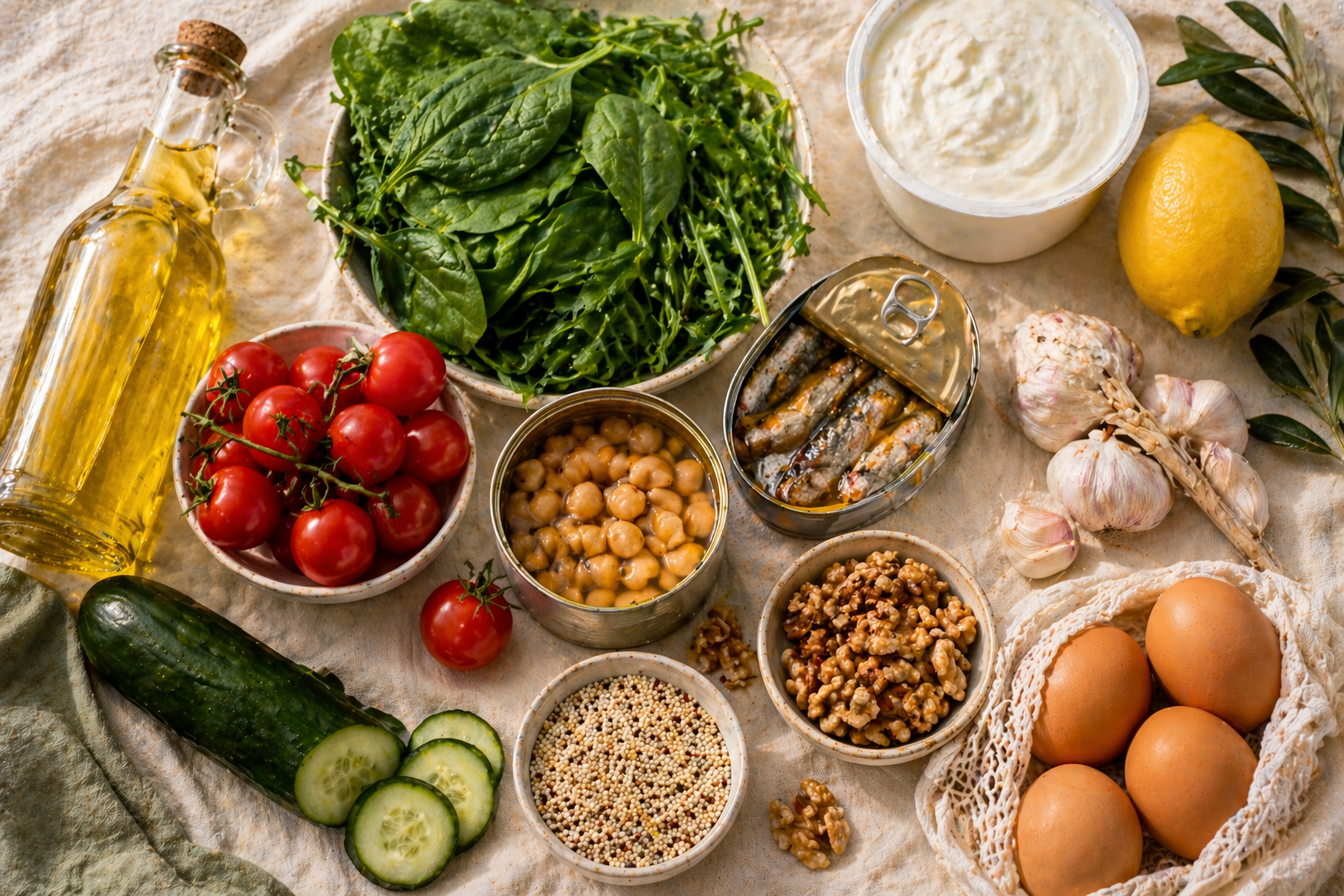
Proteins:
- Eggs, $4–6 per dozen. At 2 eggs per meal that’s 6 complete protein servings per dozen.
- Canned chickpeas, $1.50 per can, buy 3 cans = $4.50. Protein and fiber in one ingredient.
- Canned sardines or mackerel, $2–3 per can, buy 2–3 = $5–6. Identical omega-3 to fresh fish.
- Plain full-fat Greek yogurt, $5–6 for large container. 6–8 servings of high protein breakfast or snack.
Vegetables:
- Frozen spinach, $2–3 per bag. Nutritionally identical to fresh, lasts weeks.
- Fresh cherry tomatoes, $3–4 per pint. Versatile, no chopping required.
- Cucumber, $1–2 for 2–3 cucumbers. Essential for Mediterranean salads.
- Frozen broccoli or mixed vegetables, $2–3 per bag. Roasts perfectly from frozen.
- Garlic, $1–2 per head. Lasts weeks. Used in virtually every dish.
Grains:
- Quinoa, $4–6 per bag, lasts 3–4 weeks. Cook once, use all week.
- Whole grain bread or pita, $3–4 per loaf. For eggs, hummus plates, and quick meals.
Healthy fats:
- Walnuts, $5–7 for a small bag. Used daily in yogurt, salads, and snacks.
- Kalamata olives, $3–4 per jar. Lasts 2 weeks. Instant Mediterranean flavor.
- Lemons, $2–3 for a bag of 4–6. Used constantly in dressings, over fish, in tahini sauce.
Total weekly spend: approximately $40–50
What a Full Week of $50 Mediterranean Eating Looks Like
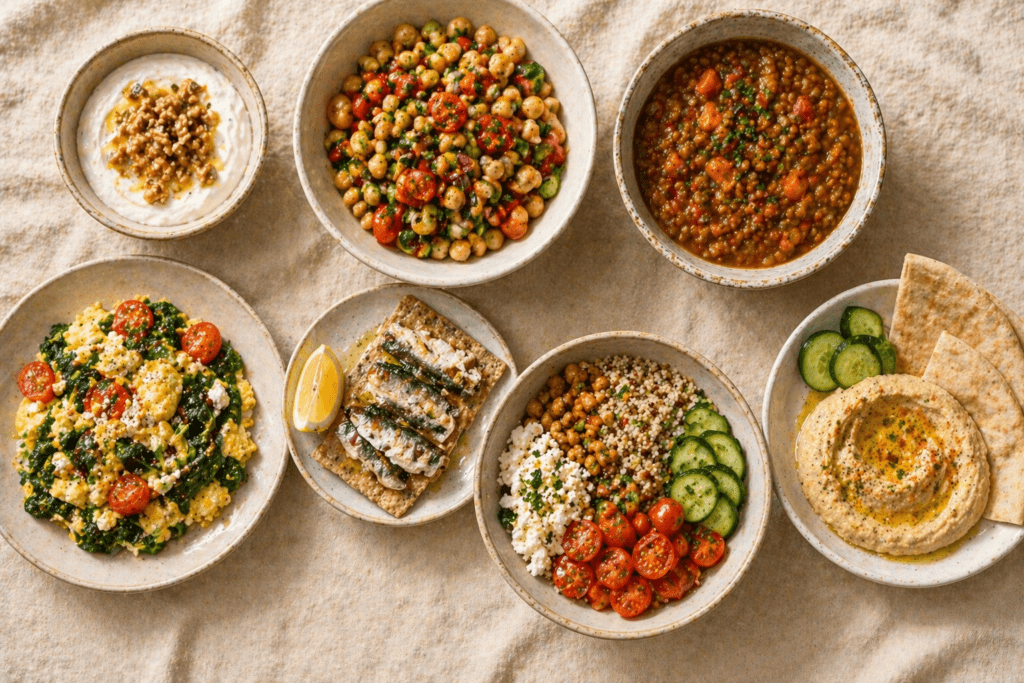
Here’s exactly how these ingredients combine across 7 days, no recipes, just assembly.
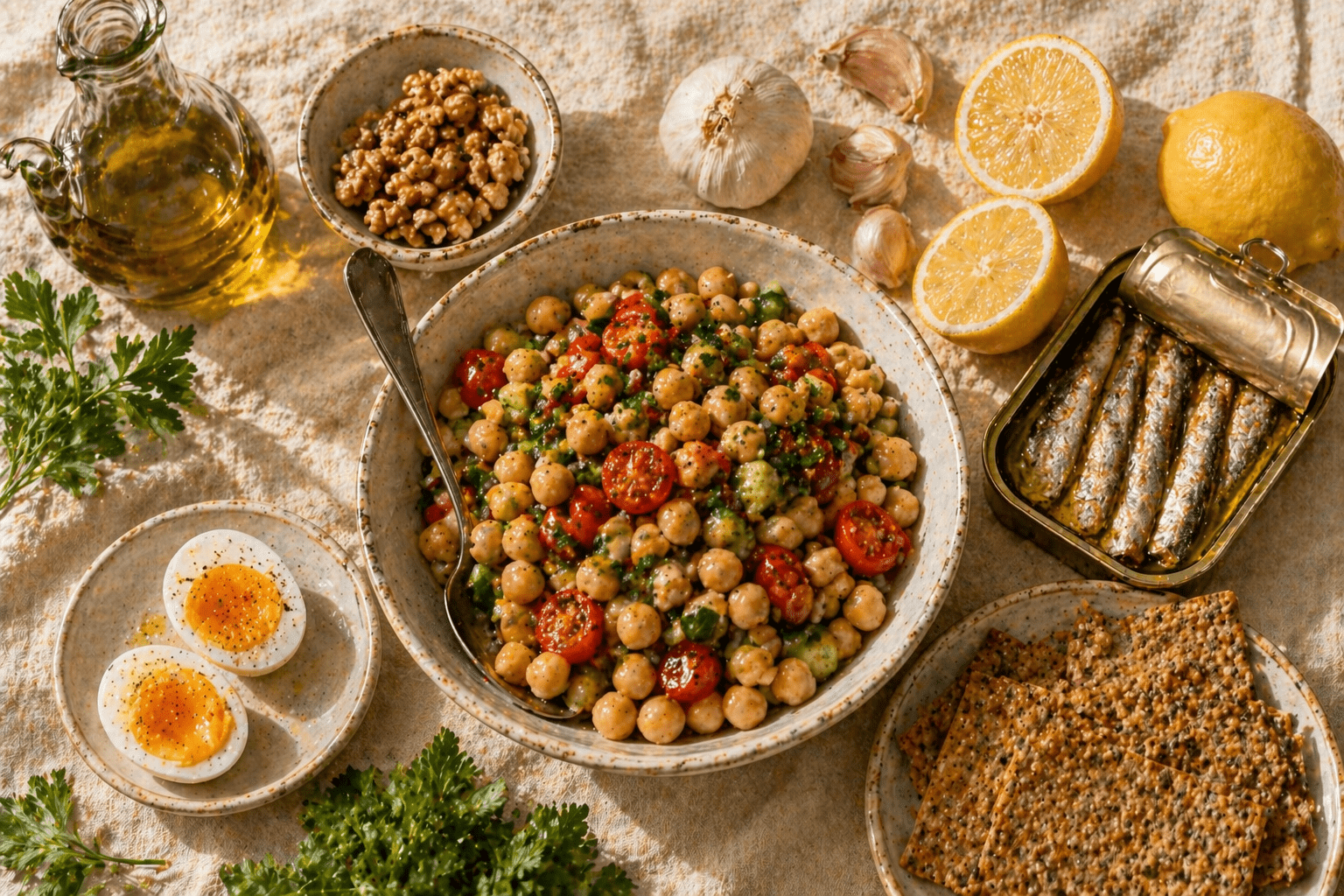
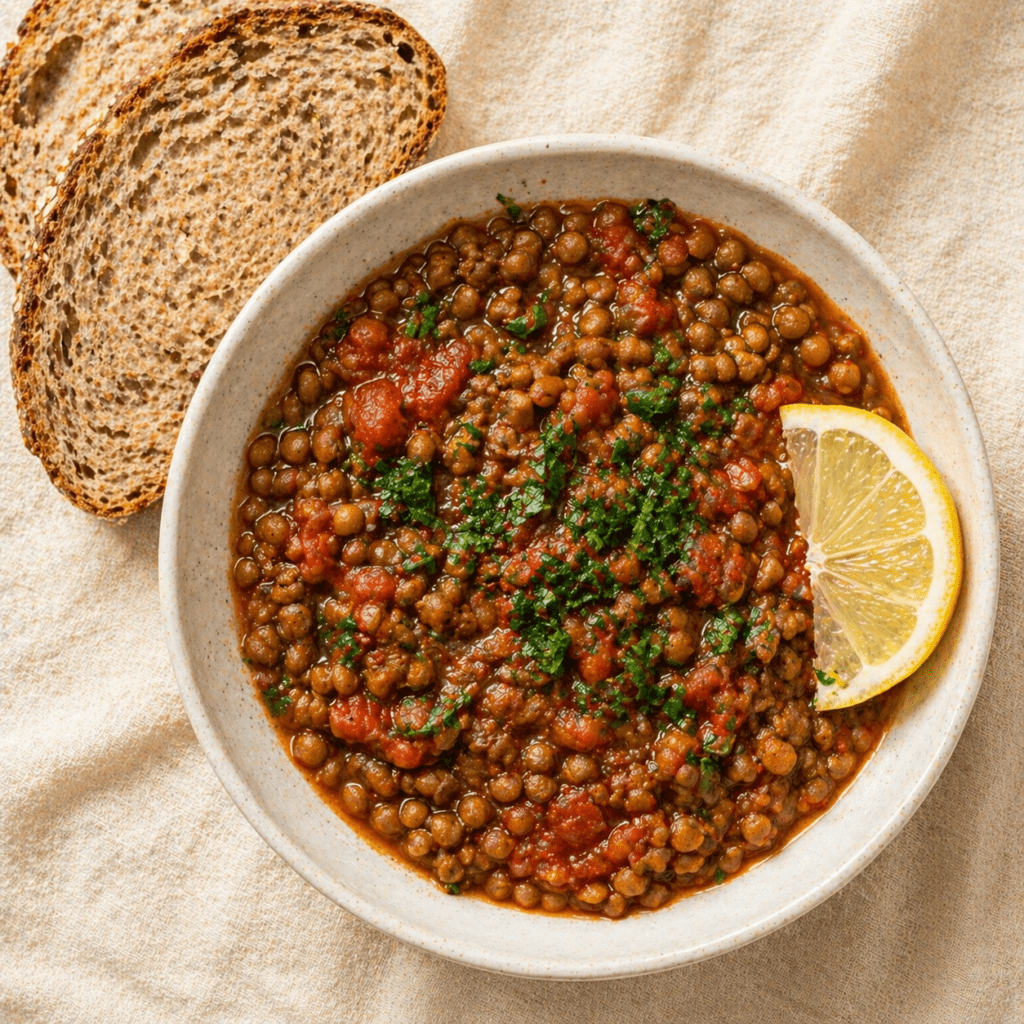
Monday Breakfast: Greek yogurt + walnuts + frozen berries (thaw overnight), $1.20 Lunch: Chickpea salad with cucumber, olive oil, lemon, oregano, $1.50 Dinner: Lentil stew with canned tomatoes, garlic, za’atar, olive oil, $1.80 Snack: Whole grain crackers + sardines + lemon, $1.50 Daily total: ~$6
Tuesday Breakfast: 2 eggs scrambled with frozen spinach and olive oil, $1.00 Lunch: Quinoa bowl with chickpeas, cherry tomatoes, tahini dressing, $1.80 Dinner: Sardines on whole grain toast with olive oil and garlic, $2.00 Snack: Greek yogurt with walnuts and honey, $1.20 Daily total: ~$6
Wednesday Breakfast: Greek yogurt + walnuts + honey, $1.20 Lunch: Lentil soup from Monday’s leftovers + whole grain bread, $0.80 Dinner: Egg scramble with roasted frozen vegetables + olive oil + za’atar, $1.50 Snack: Cucumber slices + homemade hummus (blend chickpeas + tahini + lemon), $1.00 Daily total: ~$4.50
Thursday Breakfast: 2 eggs + cherry tomatoes + olive oil, $1.20 Lunch: Quinoa bowl with sardines, kalamata olives, cucumber, olive oil, $2.00 Dinner: Chickpea and tomato stew with garlic and oregano, $1.80 Snack: Walnuts + apple, $0.80 Daily total: ~$5.80
Friday Breakfast: Greek yogurt + frozen berries + chia seeds, $1.50 Lunch: Homemade hummus plate, chickpeas, olive oil, pita, cucumber, olives, $2.00 Dinner: Lentils with roasted frozen broccoli + olive oil + lemon, $1.80 Snack: Sardines on crackers, $1.50 Daily total: ~$6.80
Saturday Breakfast: Oatmeal with walnuts + honey + chia seeds, $0.80 Lunch: Big Mediterranean salad, cherry tomatoes, cucumber, olives, feta if budget allows, olive oil and lemon, $2.50 Dinner: Egg fried quinoa with frozen vegetables + garlic + olive oil, $1.80 Snack: Greek yogurt with walnuts, $1.20 Daily total: ~$6.30
Sunday Breakfast: 2 eggs any style + whole grain toast + olive oil, $1.20 Lunch: Lentil and chickpea soup with canned tomatoes and garlic, $1.50 Dinner: Quinoa with sardines, cherry tomatoes, kalamata olives, olive oil, lemon, parsley, $2.50 Snack: Walnuts + dates or dried fruit, $1.00 Daily total: ~$6.20
Weekly total: approximately $41.80
Where to Shop for the Best Mediterranean Prices
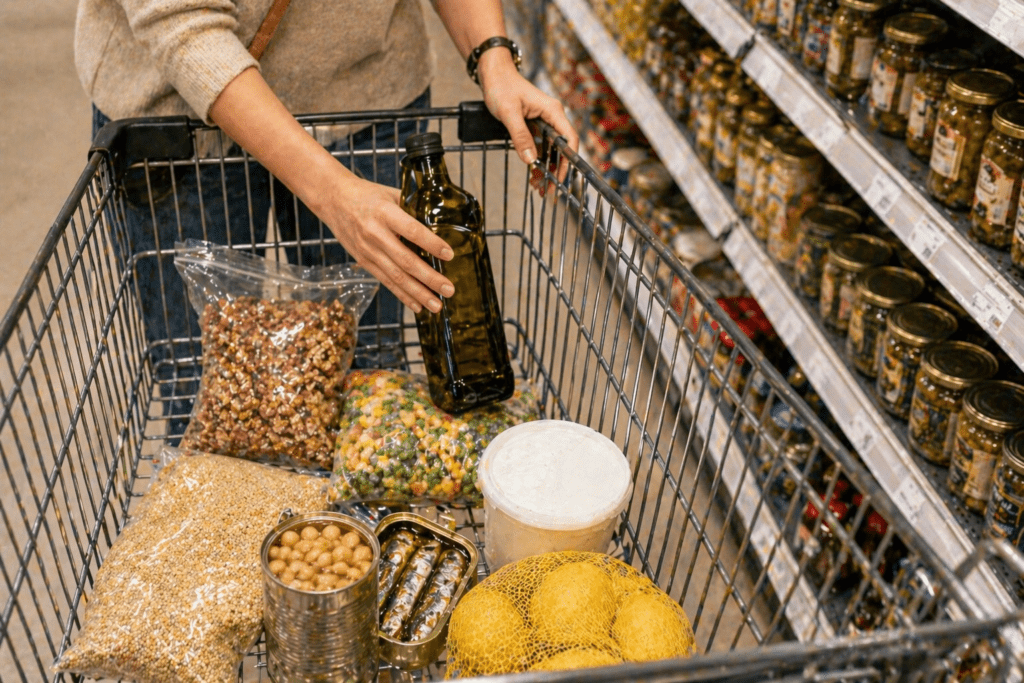
Not all grocery stores are equal for Mediterranean staples. Here’s where to find the best prices on each item:
Aldi, best overall for Mediterranean budget eating. Their olive oil, canned chickpeas, eggs, Greek yogurt, frozen vegetables, and walnuts are consistently the lowest price of any mainstream grocery store. If there’s an Aldi near you it should be your primary Mediterranean shopping destination.
Walmart, strong on canned goods, dried grains, and frozen vegetables. Their Great Value canned chickpeas and lentils are $0.98 per can. Quinoa in bulk bags is significantly cheaper than specialty stores.
Costco or Sam’s Club, if you have access, buy olive oil, walnuts, and Greek yogurt here. The per-unit cost is significantly lower and all three are used frequently enough to justify bulk buying.
Food pantries, as several people pointed out in our Mediterranean pantry community discussion this week, food pantries regularly stock canned chickpeas, lentils, beans, canned fish, and walnuts. These are exactly the Mediterranean staples that show up most frequently in food assistance programs.
Amazon Subscribe and Save, for pantry items like tahini, canned sardines, dried oregano, and za’atar, setting up a monthly Subscribe and Save order gets you 5–15% off and free shipping. Once your pantry foundation is built this is the easiest way to maintain it.
A note on food pantries. This tip came directly from a community discussion that reminded me how often Mediterranean staples show up in food assistance programs. If you have access to a local food pantry, Gleaners, Forgotten Harvest, or similar organizations in your area, canned chickpeas, lentils, beans, canned fish, and walnuts show up regularly. These are exactly the Mediterranean foundation items that make this way of eating accessible at any budget level.
For a complete list of recommended products with quality and price in mind, read: Mediterranean Pantry Essentials: The 15 Staples That Make Healthy Eating Automatic
The 5 Biggest Budget Mistakes Mediterranean Beginners Make
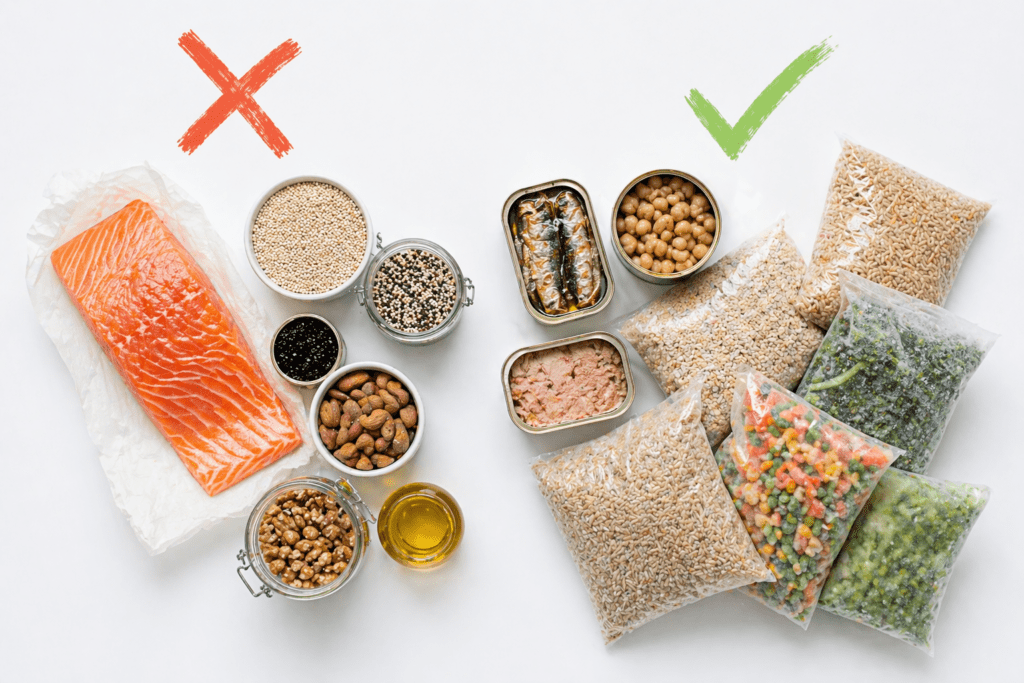
Mistake 1: Buying fresh fish instead of canned Fresh salmon costs $10–15 per pound. Canned wild salmon costs $3–4 per can with identical omega-3 content. For daily Mediterranean eating, canned fish is the answer. Save fresh fish for special occasions.
Mistake 2: Buying specialty grains at full price Farro and quinoa at Whole Foods can cost $8–12 per bag. The same grains at Walmart, Aldi, or on Amazon are $4–6. Buy the same ingredient at half the price.
Mistake 3: Shopping recipe by recipe Buying specific ingredients for specific recipes means you’re constantly buying small quantities at full price. Build the pantry foundation once, then shop to replenish what ran out. This is the single biggest shift that reduces weekly food spending.
Mistake 4: Buying fresh when frozen works just as well Frozen spinach, broccoli, peas, and mixed vegetables are nutritionally identical to fresh and cost 40–60% less. For cooked dishes there is no meaningful difference. Use frozen for everything cooked and save fresh for raw salads.
Mistake 5: Skipping olive oil to save money Olive oil feels expensive upfront at $8–12 per bottle. But at $0.50 per meal it’s one of the cheapest ingredients in your kitchen when spread across daily use. And it’s the most important ingredient for both flavor and the anti-inflammatory benefits of Mediterranean eating. Don’t skip it, buy it and use it generously.
Free printable
Get the $50 grocery list as a printable
The full checklist with prices, plus a 7-day meal map that turns this one shopping trip into a week of meals. Print it or keep it on your phone at the store.
Free. No spam. Unsubscribe anytime.
How to Make $50 Feed Two People
The weekly shopping list above is designed for one person. For two people the math doesn’t double. It increases by roughly 60–70% because many items like olive oil, tahini, spices, and grains scale very efficiently.
For two people budget: $70–85 per week
The main additions for two people:
- Double the eggs ($8–10 for two dozen)
- Double the canned fish ($10–12 for 4–6 cans)
- Double the Greek yogurt ($10–12 for two large containers)
- Double the fresh vegetables ($8–10 extra)
Everything else (olive oil, grains, legumes, spices), scales slowly because they’re already bought in quantities that last beyond one week.
For a complete guide to building your Mediterranean kitchen foundation, read: Mediterranean Diet Grocery List for Beginners
The Investment That Pays Off Every Week
The first week of Mediterranean eating on a budget feels like the most expensive because you’re building the pantry foundation (olive oil, tahini, grains, spices), all at once.
By week two you’re only replenishing what ran out. By week three the weekly cost has dropped to $30–35 because your pantry is already stocked and you’re just buying fresh items and restocking one or two pantry staples.
The long-term weekly cost of Mediterranean eating for one person settles at $35–45 once the foundation is established. That’s less than most people spend on lunch alone in a typical work week.
And unlike expensive dietary approaches that require specialty products, supplements, or meal delivery services. The Mediterranean budget never goes up. The ingredients are the cheapest whole foods available. The cost is stable, predictable, and completely manageable on almost any budget.
For help building complete plates from these budget ingredients, the free Mediterranean Meal Builder assembles a balanced meal in under 2 minutes, no tracking, no counting.
Frequently Asked Questions
Is there a Mediterranean diet on a budget meal plan? Yes. The week of meals in this article is a complete starting point. If you want it done for you, my 7-day Mediterranean Meal Plan includes 28 budget-friendly meals and snacks with a full grocery list, and the free Hunger-Free Day Formula shows the simple meal structure behind it.
Can you really eat Mediterranean on $50 a week? Yes, and comfortably. The foundation of Mediterranean eating is built around the cheapest whole foods available: canned legumes, dried grains, eggs, frozen vegetables, and olive oil. Fresh fish, imported cheeses, and specialty products are optional additions not requirements.
What’s the cheapest Mediterranean protein source? Dried lentils at roughly $0.25 per serving are the cheapest complete protein in the Mediterranean diet. Eggs at $0.25–0.30 each are a close second. Canned chickpeas at $0.50 per serving are third. All three are cheaper per gram of protein than chicken or beef.
Is frozen fish as good as fresh for Mediterranean eating? Canned wild sardines, salmon, and mackerel are nutritionally equivalent to fresh fish for omega-3 content. Frozen fish fillets are also equivalent to fresh nutritionally. For daily Mediterranean eating canned and frozen fish are the practical and budget-friendly choice.
How do I start Mediterranean eating on a tight budget this week? Buy these five items first: extra virgin olive oil, one can of chickpeas, one dozen eggs, a bag of dried lentils, and a lemon. With just these five items you can make a complete Mediterranean breakfast, lunch, dinner, and snack every day this week for under $15.
Does buying organic matter for Mediterranean eating? Prioritize organic for olive oil and eggs when budget allows, these are consumed daily and in meaningful quantities. Canned legumes, frozen vegetables, and dried grains don’t require organic to provide full nutritional benefit.
What’s the best store for Mediterranean budget shopping? Aldi is consistently the best overall for Mediterranean staples, olive oil, eggs, Greek yogurt, canned chickpeas, frozen vegetables, and walnuts are all priced significantly lower than other mainstream grocery stores.
Mediterranean Pantry Essentials covers the core staples this budget plan is built around, and Mediterranean Meal Prep for the Week shows you how to stretch them into a full week of meals. The Mediterranean Diet Grocery List for Beginners is a good companion shopping list for your first budget-friendly trip. If inflammation or steady energy is part of why you’re making this switch, How to Reduce Inflammation With the Mediterranean Diet and The Balanced Mediterranean Meal Formula cover those angles specifically.
About Ribert Rodriguez
Ribert is the founder of EnergiSource Wellness. He researches and writes every article on this site personally, cross-checking claims against published research rather than relying on generic wellness advice. His approach is rooted in the Mediterranean framework, built from years of testing meal structures on himself after struggling with cravings, late-night eating, and low energy.