It’s 2:30pm… and you’re already thinking about food again
You just ate lunch.
Not a snack. Not something small. A real meal.
And yet… here you are.
Opening the pantry. Scanning for something quick.
Trying to figure out how you could possibly be hungry again already.
You even pause and think: “Didn’t I just eat?”

This isn’t a willpower problem
It feels frustrating because you’re doing what you’re supposed to do.
You’re eating meals.
You’re trying to eat “healthy.”
You’re not skipping food.
And still… the hunger comes back fast.
So it’s easy to assume:
- you’re eating too much
- you have no discipline
- something is wrong with you
But none of that is true.
The issue isn’t how much you’re eating.
It’s how your meals are built.
The real reason you’re hungry again so quickly
There’s one simple cause behind this:
Your meal didn’t have enough protein.
That’s it.
Here’s what’s happening
When you eat a meal low in protein:
- Your body digests it quickly
- Your blood sugar rises… then drops
- Hunger signals come back fast
So even if you ate enough food…
Your body doesn’t feel satisfied.
Here’s a number worth knowing. According to standard gastric emptying research, 30 to 90 percent of a meal is typically still sitting in your stomach a full hour after you eat it. So if you’re hungry again after just one hour, your stomach almost certainly isn’t empty. What’s actually happening is your blood sugar dropped and your brain sent a hunger signal anyway, regardless of what’s physically left in your stomach. That’s the protein gap talking, not an empty stomach.
What this looks like in real life
Meals that seem “fine” but don’t hold you:
- A salad with just veggies + light dressing
- Pasta with tomato sauce but no protein
- Toast or cereal for breakfast
- A smoothie with just fruit
They’re not “bad.”
They’re just missing the one thing that keeps you full.
What actually keeps you full for hours
You don’t need:
- fewer calories
- smaller portions
- more willpower
You need meals that send a “we’re good” signal to your body.
The Full Plate Method (simple version)
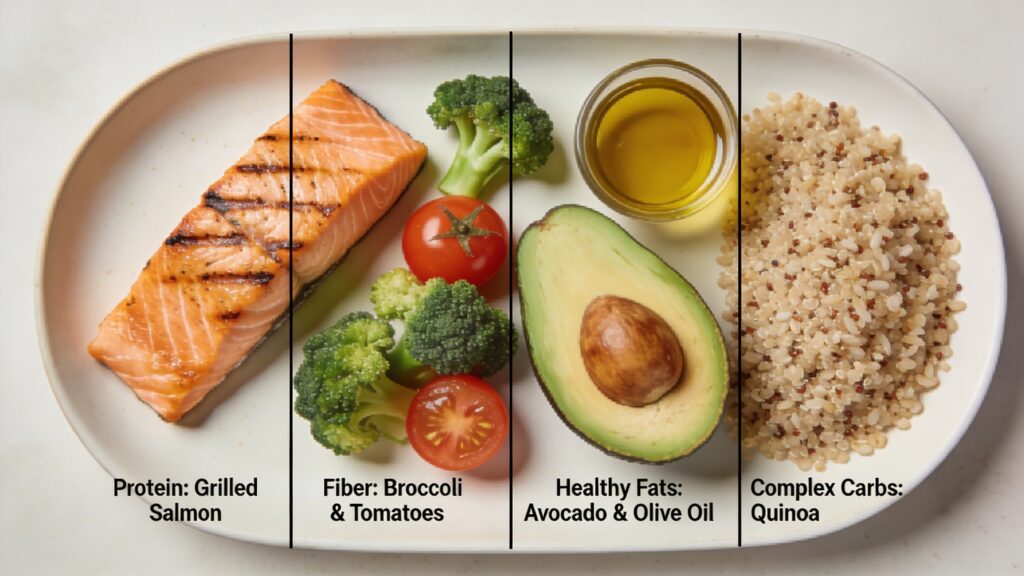
Every meal should include:
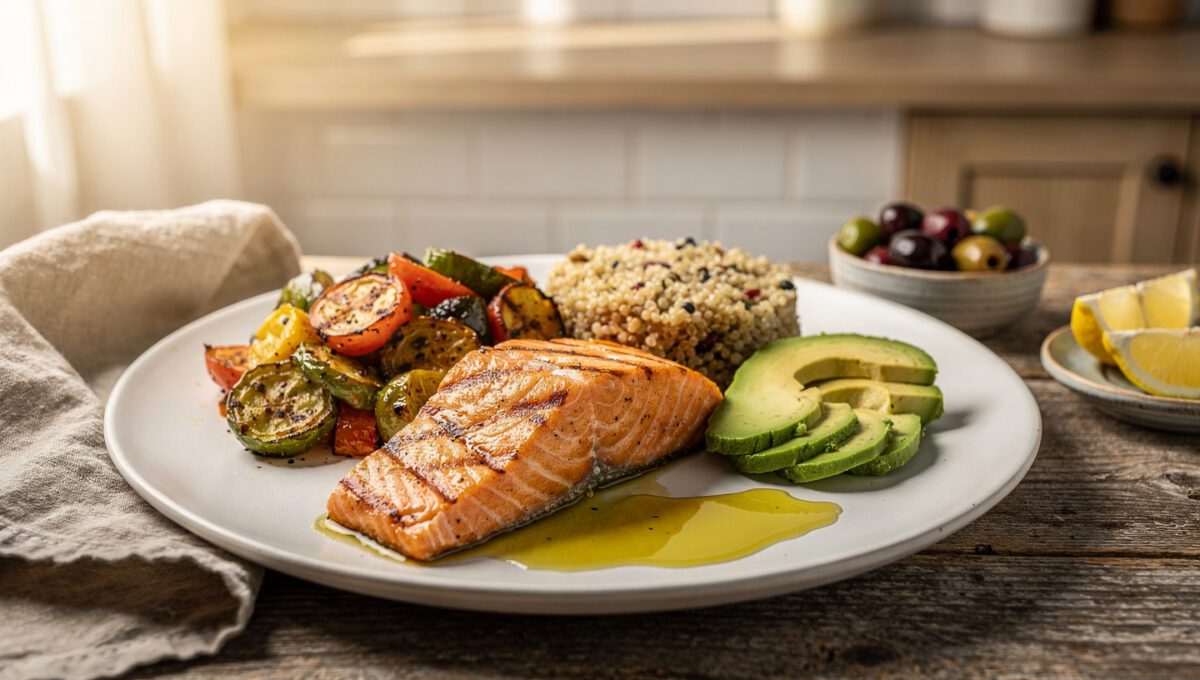
Protein + Fiber + Healthy Fat + Complex Carb
This combination:
- slows digestion
- stabilizes energy
- keeps you full for 4–5 hours
How to fix your meals (real examples)
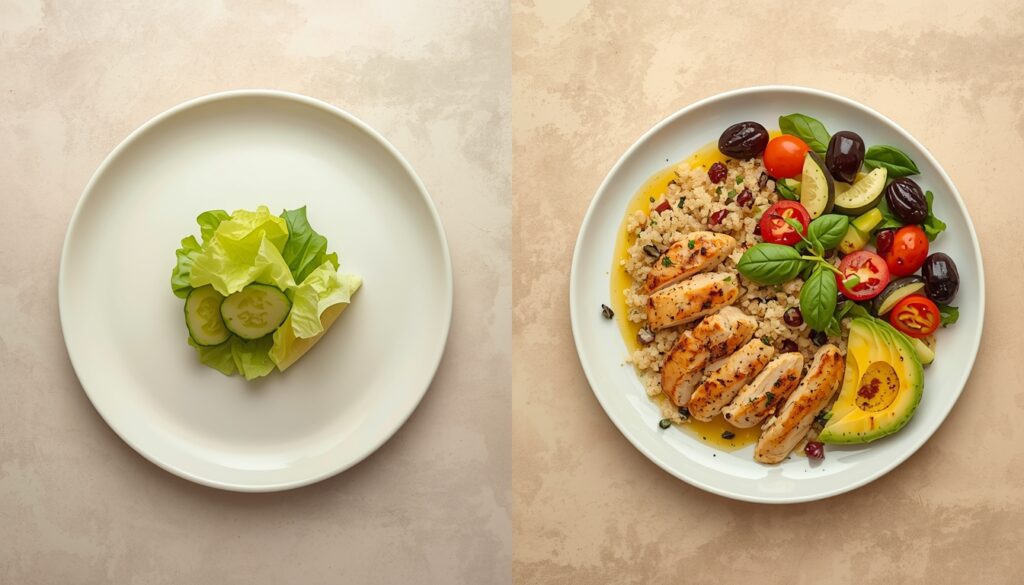
Before:
Salad with greens, cucumber, light dressing
After:
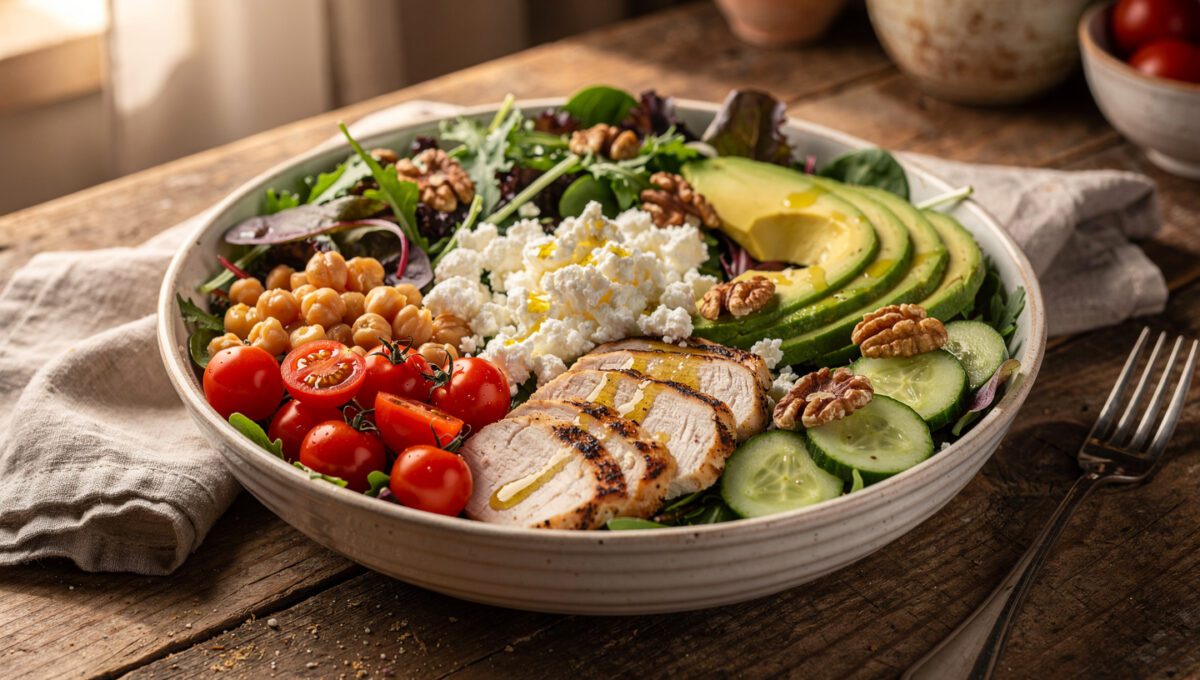
- Protein: grilled chicken or chickpeas
- Fiber: greens, cucumber, tomatoes
- Fat: olive oil, feta, olives
- Carb: quinoa or whole grain bread
Before:
Toast with jam
After:
- Protein: eggs or Greek yogurt
- Fiber: berries or chia seeds
- Fat: nut butter
- Carb: whole grain toast
Before:
Pasta with marinara
After:
- Protein: grilled chicken or lentils
- Fiber: vegetables (zucchini, spinach)
- Fat: olive oil, parmesan
- Carb: pasta
Quick check: why your meals aren’t lasting
If you’re still getting hungry fast, your meal likely:
- didn’t include a clear protein source
- was mostly carbs
- was low in fat
- digested too quickly
Even “healthy” meals can do this.
Reset your meals starting today
If this sounds like you, start here: Cravings Control Reset
This walks you through exactly how to rebuild your meals so you stop feeling hungry all day.
Why protein changes everything
Protein is the difference between:
- feeling full for 1 hour
vs - feeling full for 4–5 hours
It:
- slows how fast food leaves your stomach
- stabilizes blood sugar
- reduces cravings automatically
A simple rule to follow
At your next meal, ask:
“Where is the protein?”
If you can’t clearly see it…
That’s why you’re getting hungry again.
This is why your meals don’t “stick”
If your meals aren’t keeping you full, it’s not random.
It’s structure.
This is exactly why systems like The Balanced Plate Method: Build Meals That Keep You Full for 4–5 Hours
work so well.
They’re not about restriction.
They’re about building meals that actually last.
You don’t need to eat less. You need meals that last

If you’ve been stuck in the cycle of:
- eating
- getting hungry again
- snacking
- repeating
This is your way out.
Not by eating less.
But by eating smarter combinations.
Start with your next meal
You don’t need to overhaul everything today.
Just do this:
Add a real protein source to your next meal.
That’s it.
And notice what changes.
Because once your meals actually keep you full…
Everything else gets easier.
Make this automatic
If you want this to feel simple and repeatable:
Use the Full Plate Method app to build meals that keep you full without overthinking it.
The real timer: how fast your stomach empties
Your hunger is not really on a clock. It is on a valve. Food sits in your stomach, and how long it stays there is one of the biggest reasons you feel full for four hours or hungry again in one.
Here is the part that clicked for me. Protein, fat, and fiber all slow that valve down. Fat and protein trigger a hormone called CCK that tells your stomach to release its contents more slowly, and fiber physically bulks up the meal so it drains out more gradually. A meal built mostly from fast carbs (a bagel, a bowl of cereal, white rice on its own) has none of those brakes, so it empties quickly and your hunger comes right back.
Researchers have measured this directly. In a study published in the American Journal of Physiology (Gastrointestinal and Liver Physiology), meals engineered to empty from the stomach more slowly produced noticeably more fullness and less hunger, even when the calories were identical. The physical structure of the meal mattered as much as what was in it.
This is why “I ate a real meal and I am hungry an hour later” is so common. It is not that you did not eat enough. It is that the meal drained out of your stomach before your body registered it as satisfying. Add a protein anchor, a little fat, and some fiber, and you slow the valve down. That is the whole trick.
How fast you eat changes whether the meal registers
There is a second reason a real meal can leave you hungry an hour later, and it has nothing to do with what was on the plate. It is how fast you ate it.
Your fullness signal is on a delay. The gut hormones that tell your brain “we are satisfied” (PYY and GLP-1) take roughly twenty minutes to build up and get the message across. If you inhale your food in eight minutes, you finish eating long before that signal arrives, so your brain never gets the memo that you ate enough, and it fires hunger back up.
This is measurable. A review published in the journal Nutrients pulled together the research on eating rate and found that eating more slowly leads to greater fullness, a stronger rise in those satiety hormones, and less snacking afterward. In one study, slow eaters took in about 25 percent less from snacks a few hours later than fast eaters, from the very same meal.
So if you eat standing up, in the car, or scrolling your phone, that alone can be why hunger comes back so quickly. Slow down, put the fork down between bites, give the meal ten or fifteen minutes. You are not eating more. You are giving your fullness signal time to catch up with your mouth.
Some foods are built to satisfy more, calorie for calorie
Here is a fact that reframes the whole “I ate but I am still hungry” problem: two foods with the exact same calories can leave you feeling completely different. Some foods are far more filling per calorie than others.
Scientists actually measured this. In a classic study published in the European Journal of Clinical Nutrition, researcher Susanna Holt fed people equal-calorie portions of 38 common foods, tracked how full each kept them, and ranked them into a satiety index. Plain boiled potatoes, eggs, oatmeal, fish, and lean meat scored highest. Croissants, cake, doughnuts, and white bread scored lowest, sometimes leaving people hungry almost immediately.
The pattern was clear. Foods high in protein, fiber, and water satisfied the most. Foods that were airy, refined, and sugary satisfied the least, even at identical calories. So a 300-calorie pastry and a 300-calorie plate of eggs and potatoes are not remotely the same meal to your body.
This is often the quiet answer to “I ate a full meal and I am still hungry.” You may have eaten plenty of calories, just from foods near the bottom of the satiety list. Shift the same calories toward the top of it, the potatoes, eggs, oats, beans, and lean protein, and hunger stops coming back so fast.
About Ribert Rodriguez
Ribert is the founder of EnergiSource Wellness. He researches and writes every article on this site personally, cross-checking claims against published research rather than relying on generic wellness advice. His approach is rooted in the Mediterranean framework, built from years of testing meal structures on himself after struggling with cravings, late-night eating, and low energy.