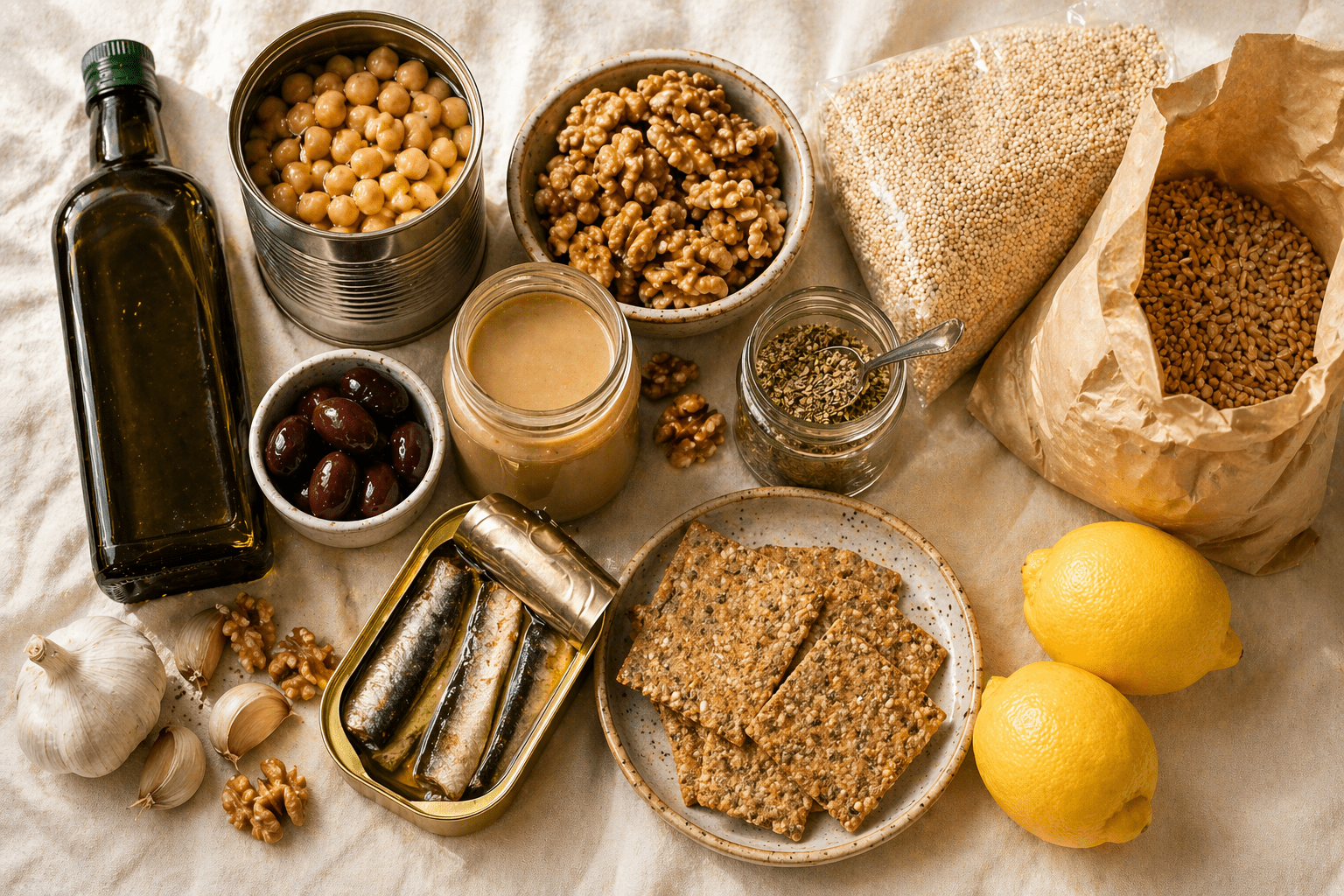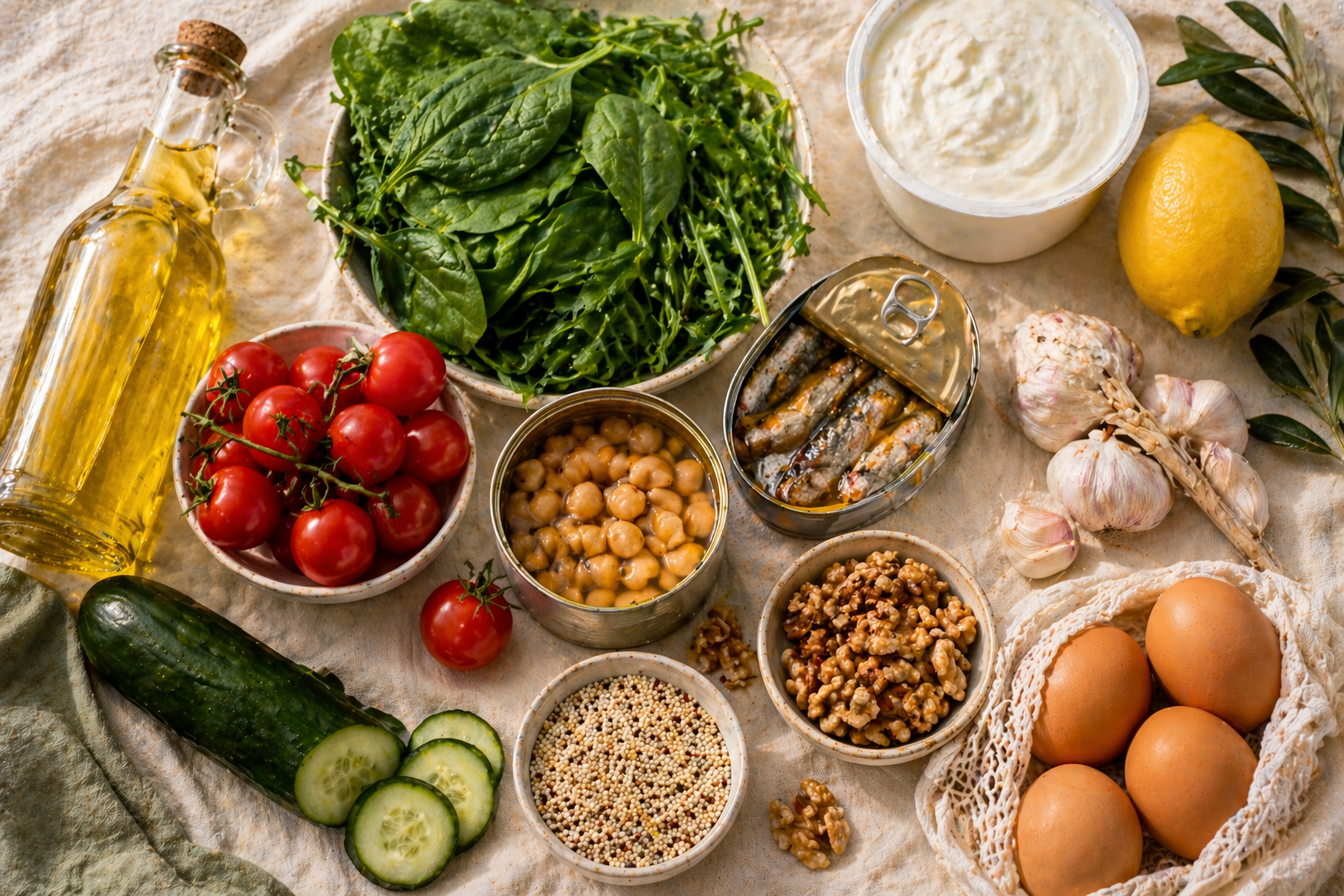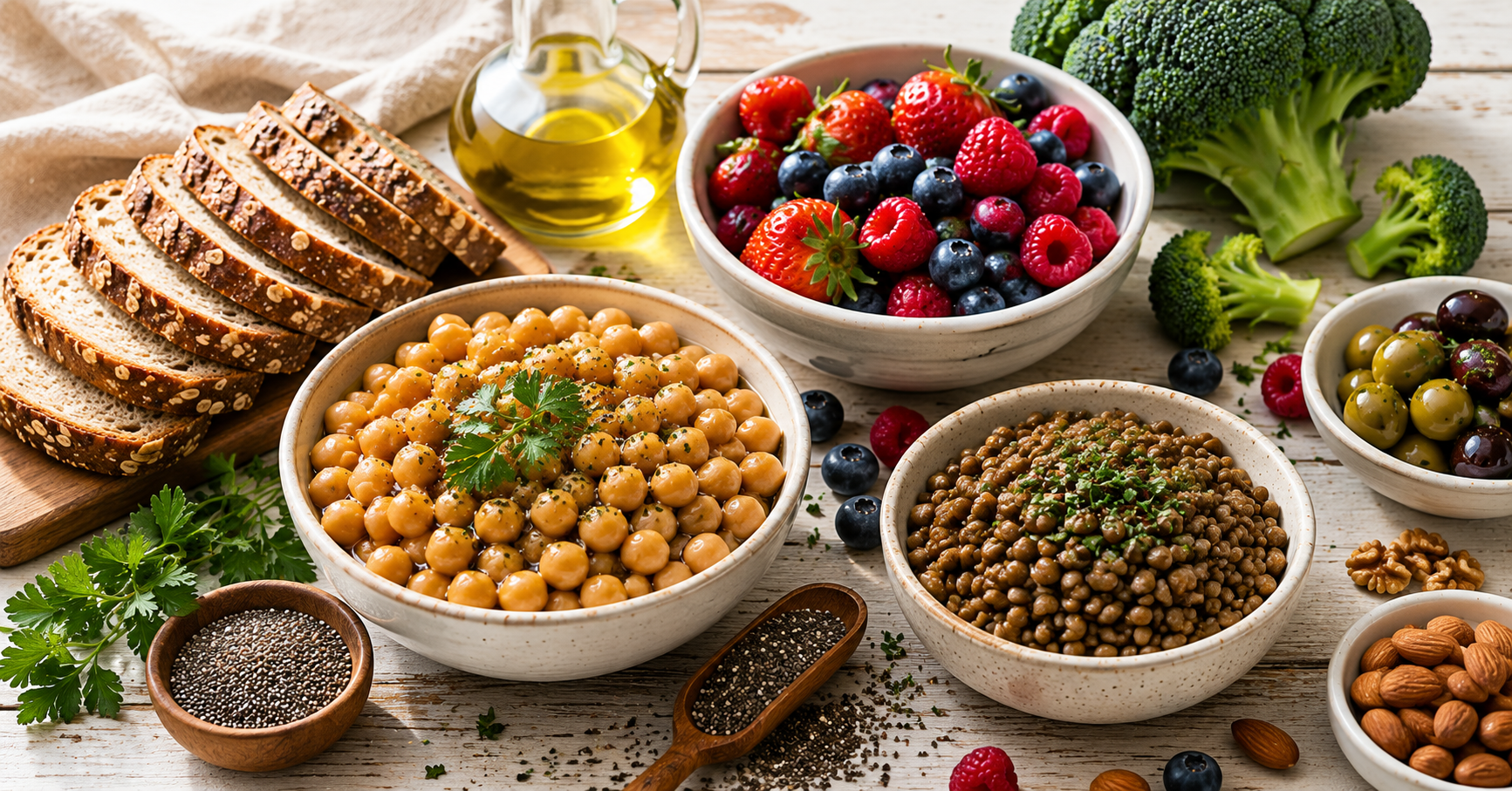
The foods that keep you full longest combine fiber and protein in the same bite, like legumes, Greek yogurt, and whole grains, because that combination slows digestion and blunts the blood sugar swings that trigger hunger.
15 Foods High in Both Fiber and Protein (At a Glance)
| Food | Serving | Protein | Fiber |
|---|---|---|---|
| Lentils (cooked) | 1 cup | 18g | 16g |
| Split peas (cooked) | 1 cup | 16g | 16g |
| Black beans (cooked) | 1 cup | 15g | 15g |
| Pinto beans (cooked) | 1 cup | 15g | 15g |
| Chickpeas (cooked) | 1 cup | 15g | 12g |
| Kidney beans (cooked) | 1 cup | 15g | 13g |
| Edamame (shelled) | 1 cup | 18g | 8g |
| Green peas (cooked) | 1 cup | 9g | 9g |
| Quinoa (cooked) | 1 cup | 8g | 5g |
| Whole wheat pasta (cooked) | 1 cup | 8g | 6g |
| Rolled oats (dry) | ½ cup | 5g | 4g |
| Chia seeds | 2 tbsp | 5g | 10g |
| Almonds | 1 oz (about 23) | 6g | 3.5g |
| Pistachios | 1 oz (about 49) | 6g | 3g |
| Greek yogurt + 1 tbsp chia + ½ cup raspberries | 1 bowl | ~22g | ~9g |
Wondering why this combination works? Here is how fiber keeps you full longer, and how much protein you need at each meal.
Something shifts when you start paying attention to what’s actually in your food.
Not just the calories. Not just the macros. The actual ingredients. The way food is made. What’s been taken out. What’s been put in instead.
Most people never get to that place of awareness. They move through the day eating what’s available, feeling hungry more than they should, blaming themselves for it, and never once questioning whether the food itself might be the problem.
This article is for the ones who are starting to question it.
Because if you’re always hungry, if you eat what seems like a reasonable meal and you’re standing in front of the fridge an hour later, there’s a very specific reason. And once you see it, you can’t unsee it.
The foods high in fiber and protein that your hunger hormones are looking for are simple, real, and have been part of Mediterranean eating for thousands of years. The answer, almost every time, is fiber working alongside protein.
Once you start building your meals around them, the hunger that felt constant starts to quiet on its own.
What Nobody Told You About Staying Full
Here’s something worth sitting with for a moment.
The average person eating a modern diet gets 10 to 15 grams of fiber per day. The minimum your body needs to regulate hunger properly is 25 to 38 grams. That’s a gap of 15 to 25 grams, every single day, in a nutrient your hunger hormones depend on to function the way they’re designed to.
That gap doesn’t happen by accident.
When you start reading ingredient labels, really reading them, you start to notice something. Real fiber has been quietly removed from a lot of what gets sold as food. White bread, white rice, crackers, cereals, protein bars, packaged meals. The processing that makes these things shelf-stable, convenient, and palatable also strips out most of the fiber they once had.
What’s left digests fast. Too fast for your body to register fullness before the hunger signal fires again.
You’re not eating wrong. You’re eating food that was made without the one thing your body needs most to feel satisfied.
That’s worth knowing.
There’s a reason the internet has started calling this “fibermaxxing”, maximizing fiber intake to regulate hunger and gut health. But you don’t need a trend name to tell you what your body has been asking for all along. You just need to stop eating food with the fiber removed and start eating food that still has it.
What Fiber Actually Does to Your Hunger
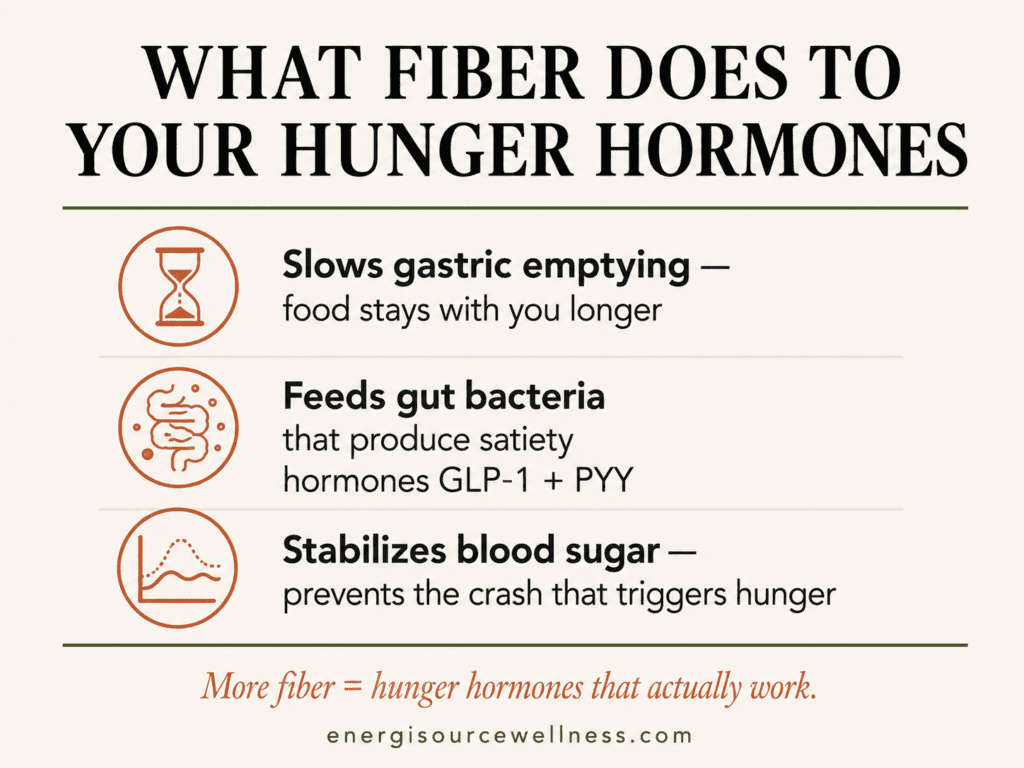
Fiber isn’t just roughage. It’s not just something that keeps digestion moving.
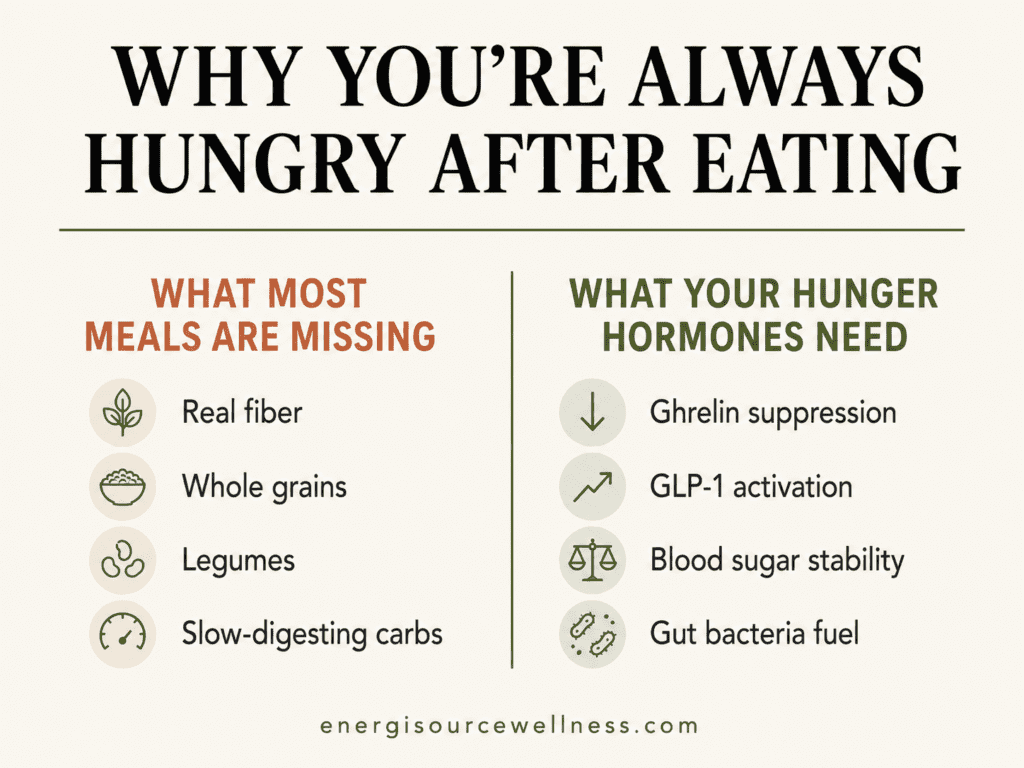
Fiber is one of the most powerful signals your hunger hormones have ever encountered, and when it’s missing from your meals, those hormones behave exactly the way you’d expect: they keep asking for more.
Here’s what fiber does inside your body when you eat enough of it:
It slows everything down. Fiber physically slows the rate at which your stomach empties, which means food stays with you longer, the fullness signal lasts longer, and the hunger signal takes longer to return. A meal with real fiber holds you 2 to 3 hours longer than the same meal without it.
It feeds the bacteria that make you feel full. Your gut is home to trillions of bacteria that do far more than digest food. When you eat fiber, specific bacteria ferment it and produce short-chain fatty acids that trigger the release of GLP-1 and peptide YY, two of your body’s most powerful satiety hormones. No fiber means less of these hormones. Less of these hormones means hunger that never fully quiets down.
It protects your blood sugar. Fiber slows the absorption of glucose into your bloodstream, which means blood sugar rises slowly and falls slowly instead of spiking and crashing. That crash, the one that hits an hour after a low-fiber meal, is what triggers ghrelin, your primary hunger hormone. Fiber interrupts that cycle before it starts.
This is why why you’re still hungry after eating is almost always a fiber story, even when the meal felt like enough.
The Mediterranean Connection
People who eat the traditional Mediterranean way aren’t thinking about fiber grams. They’re not tracking macros or following a protocol.
They’re just eating real food. Whole food. Food that hasn’t been processed into something unrecognizable.
Chickpeas. Lentils. Whole grains. Roasted vegetables. Berries. Oats. Seeds. These aren’t superfoods in the trendy sense. They’re just foods that still have everything in them that was there to begin with. Including the fiber your hunger hormones are looking for.
That’s the quiet truth behind why Mediterranean eating works so well for hunger. It’s not the olive oil alone, or the fish, or the lack of red meat. It’s that the whole structure of the diet is built around foods high in fiber and protein that haven’t had the fiber engineered out of them.
When you start building your plate around these foods, even one meal at a time, something shifts. The hunger quiets. Not because you’re eating more. Because you’re finally giving your body what it was asking for all along.
This is what building a balanced plate actually means at its foundation, not just protein and fat, but a real fiber source at every single meal.
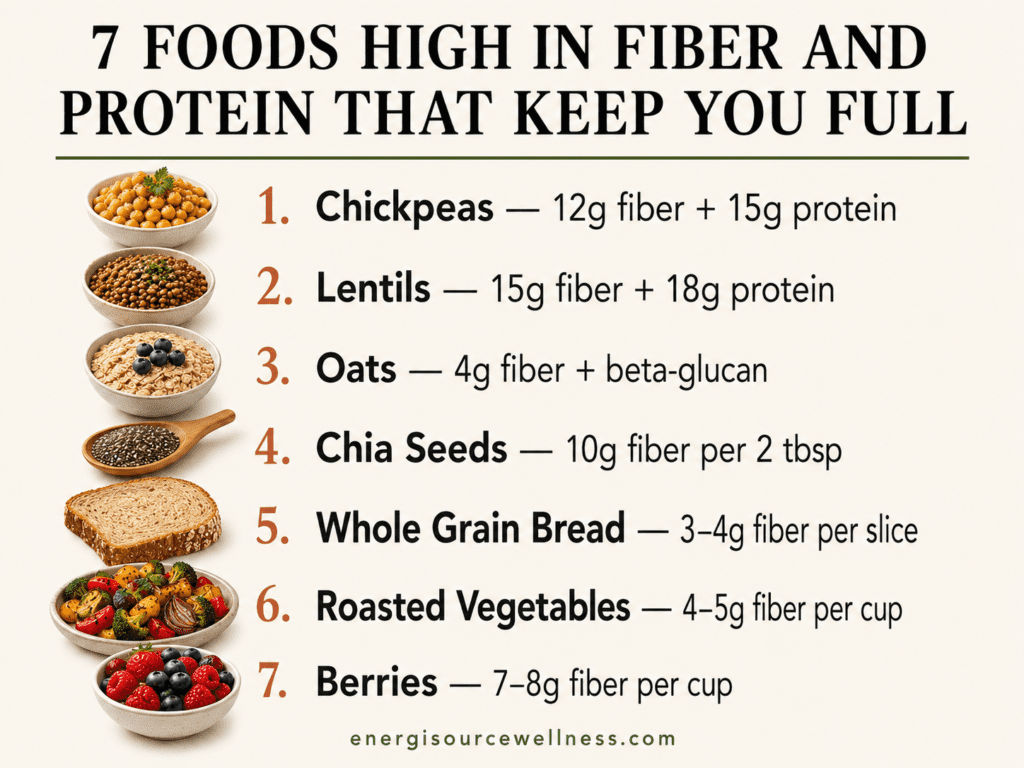
7 Mediterranean Foods High in Fiber and Protein That Keep You Full
These aren’t exotic ingredients. They’re pantry staples that Mediterranean cultures have eaten for generations, long before fiber became a wellness trend. Each one is naturally high in fiber and pairs with protein to create meals that actually hold you.
1. Chickpeas, 12g fiber + 15g protein per cup
The Mediterranean staple above all others. Chickpeas show up in everything, hummus, stews, roasted as a snack, tossed into salads. At 12 grams of fiber and 15 grams of protein per cup they’re one of the most complete hunger-suppressing foods you can build a meal around.
Add them to a grain bowl, blend them into hummus, roast them with olive oil and cumin for a snack that actually holds you. Once chickpeas become a regular part of your meals you’ll notice the afternoon hunger that used to be constant start to disappear.
2. Lentils, 15g fiber + 18g protein per cup
Lentils are the highest-fiber food most people never eat. One cup cooked delivers 15 grams of fiber and 18 grams of protein, a combination that hits every satiety signal simultaneously. They cook in 20 minutes with no soaking required, which makes them one of the most practical high-fiber high-protein additions to any meal.
Red lentils melt into soups and sauces. Green and black lentils hold their shape in salads and grain bowls. Either way you’re building a meal your hunger hormones will actually respond to.
3. Oats, 4g fiber per cup with beta-glucan
What makes oats uniquely effective for hunger isn’t just the fiber content. It’s the type. Oats contain beta-glucan, a soluble fiber that forms a thick gel in your digestive system and dramatically slows gastric emptying. Studies consistently show that oat-based breakfasts help lower ghrelin more effectively than most other breakfast options at the same calorie level.
Overnight oats with chia seeds and berries can easily reach 12 to 15 grams of fiber in a single breakfast, which is close to what most people get in an entire day.
4. Chia Seeds, 10g fiber per 2 tablespoons
This is the most fiber-dense addition you can make to any meal with almost zero effort. Two tablespoons of chia seeds add 10 grams of fiber to whatever you’re making, overnight oats, yogurt, a smoothie, even water. They expand in liquid to form a gel, which physically slows digestion and extends fullness significantly.
If there’s one thing to add to your current meals before changing anything else, it’s chia seeds.
5. Whole Grain Bread, 3–4g fiber per slice
The difference between whole grain and refined bread isn’t just nutritional. It’s mechanical. Whole grain bread digests slowly because the fiber structure is intact. White bread digests in roughly 30 to 45 minutes. Whole grain bread takes 2 to 3 hours. That difference is the difference between being hungry before your next meeting and being satisfied through it.
Read the label before you buy. The first ingredient should say “whole wheat flour” or “whole grain flour”, not “enriched flour” with whole grain listed fourth.
6. Roasted Vegetables, 4–5g fiber per cup
Broccoli, Brussels sprouts, cauliflower, zucchini, bell peppers, these are fiber-rich foods that most people underestimate because they don’t think of vegetables as filling. But a cup of roasted broccoli has 5 grams of fiber and takes up significant physical volume in your stomach, triggering the stretch receptors that send the fullness signal to your brain.
Roasting changes everything. The caramelization, the texture, the way olive oil brings out the flavor, roasted vegetables are a completely different experience from steamed or raw. Build them into dinner every night and you’re adding 4 to 5 grams of fiber to the meal that matters most for preventing night hunger.
7. Berries, 7–8g fiber per cup
Raspberries and blackberries are the highest-fiber fruits available, 8 grams per cup at roughly 60 calories. They’re also high in polyphenols that feed gut bacteria directly, which means they’re supporting both the fiber pathway and the gut microbiome pathway to satiety at the same time.
Add them to breakfast. Stir them into yogurt. Eat them as an afternoon snack instead of something packaged. The difference in how long you stay satisfied is immediate and measurable.
How to Build High Fiber High Protein Meals the Mediterranean Way
You don’t need to count grams. You don’t need an app. You just need one fiber source paired with one protein source at every meal, intentionally chosen, not accidentally included.
This is the Mediterranean plate structure applied to fiber. Simple, repeatable, and built around foods that still have everything in them that matters.
High fiber high protein breakfast: Overnight oats with chia seeds and berries plus a scoop of Greek yogurt on top. Or 2 scrambled eggs with spinach and a side of whole grain toast with almond butter. Either way you’re hitting 15 to 20 grams of fiber and 20+ grams of protein before 9am, which means you won’t be hungry until noon.
High fiber high protein lunch: A grain bowl built on farro or brown rice with roasted vegetables and a full cup of chickpeas or lentils. Olive oil and lemon dressing. This is a 15 to 18 gram fiber lunch that keeps you stable through the afternoon without a single crash.
High protein high fiber dinner: Salmon or chicken with a generous portion of roasted broccoli or Brussels sprouts and a small serving of whole grain. This closes your day with 8 to 10 more grams of fiber, which is what stops the night hunger that hits most people by 9pm. This is the meal structure that makes tomorrow easier too.
Three meals. Three fiber anchors. Three protein sources. No tracking required.
This is what the foods that keep you full longer all have in common, fiber and protein working together, combined with healthy fat, in the way Mediterranean eating has always done it naturally.
Ready to see what a full day of eating like this actually looks like? Get the free 1-Day Hunger Reset Formula. The complete Mediterranean daily structure that hits every satiety signal at every meal. Breakfast, lunch, dinner, and the timing that makes it work. Get the Free Guide →
The Quiet Shift That Changes Everything
Most people don’t need a new diet. They don’t need more discipline or a stricter routine.
They need to start paying attention to what’s actually in the food they’re eating every day, and choosing something closer to what food actually is when it hasn’t been taken apart and put back together.
Fiber is just one piece of that picture. But it’s the piece that most directly controls whether your hunger hormones are working for you or against you. And once you start eating enough of it (real fiber from real food, paired with real protein), the constant hunger that felt like a personal failing starts to resolve on its own.
Your body knows how to be satisfied. It was designed to be satisfied.
It just needs food that still has everything in it that was there to begin with.
Start with one meal. Add one fiber source you weren’t eating before. Pair it with protein. Notice what happens to your hunger in the two hours after.
That’s all it takes to begin seeing clearly.
Frequently Asked Questions
What foods are highest in fiber and protein?
Lentils lead with 15g fiber and 18g protein per cup, followed closely by chickpeas at 12g fiber and 15g protein. Chia seeds add 10g of fiber per 2 tablespoons with 5g of protein. Combined with Greek yogurt, eggs, or salmon at the same meal you’re hitting both the fiber and protein your body needs to feel full.
How much fiber do I need to stop feeling hungry all the time?
The minimum target is 25 grams per day for women and 38 grams for men. Most people eating a modern processed diet get 10 to 15 grams. Closing that gap, by adding one real fiber source per meal, is often enough to notice less between-meal hunger within a week or two.
What are the best high fiber breakfast ideas?
Overnight oats with chia seeds and berries is the highest-fiber breakfast you can make with minimal effort, up to 15 grams of fiber in one bowl. Add Greek yogurt for protein and you have a complete satiety meal. Other strong options: 2 eggs with spinach and whole grain toast, or cottage cheese with berries and a tablespoon of chia seeds.
Are fiber supplements as good as food fiber for hunger?
Not for hunger. Fiber supplements like psyllium husk can support digestion but they don’t provide the short-chain fatty acids that whole food fiber produces through gut fermentation, which means they don’t trigger GLP-1 and peptide YY the same way. Whole food fiber feeds your gut bacteria. Supplements mostly just add bulk.
What Mediterranean foods are highest in fiber and protein?
Lentils, chickpeas, oats, chia seeds, whole grain bread, roasted vegetables, and berries are the highest-fiber Mediterranean staples. Combined with salmon, eggs, Greek yogurt, or chicken at the same meal you create the protein-fiber combination that helps lower ghrelin most effectively and keeps you full for 3 to 5 hours.
The Bottom Line
Constant hunger is not a willpower problem. It’s not a portion problem. It’s not a you problem.
It’s a fiber and protein problem, specifically a gap between what your hunger hormones need to function properly and what most modern meals actually provide.
The fix isn’t complicated. It doesn’t require tracking, restriction, or a complete overhaul of how you eat. It requires adding one real fiber source (chickpeas, lentils, oats, chia seeds, whole grains, roasted vegetables, berries), to every meal you eat, alongside a real protein source.
That’s it. Two ingredients working together. Three times a day.
Your hunger hormones are not broken. They’re just waiting for the signal they were designed to receive.
Give it to them. See what happens.
“Want to see exactly how to build every meal around protein, fiber, and healthy fat without overthinking it? The Full Plate Method makes it simple”, [Try it free here →]
About Ribert Rodriguez
Ribert is the founder of EnergiSource Wellness. He researches and writes every article on this site personally, cross-checking claims against published research rather than relying on generic wellness advice. His approach is rooted in the Mediterranean framework, built from years of testing meal structures on himself after struggling with cravings, late-night eating, and low energy.