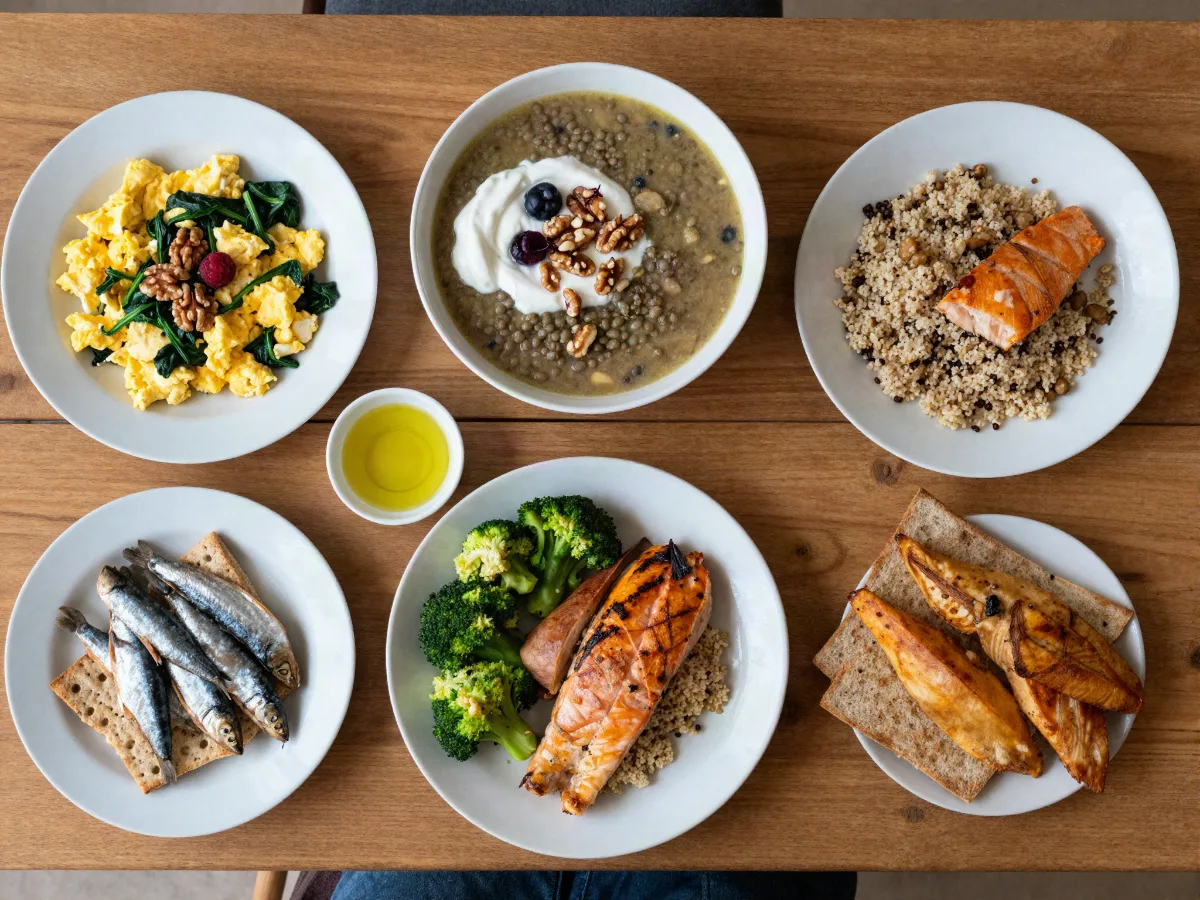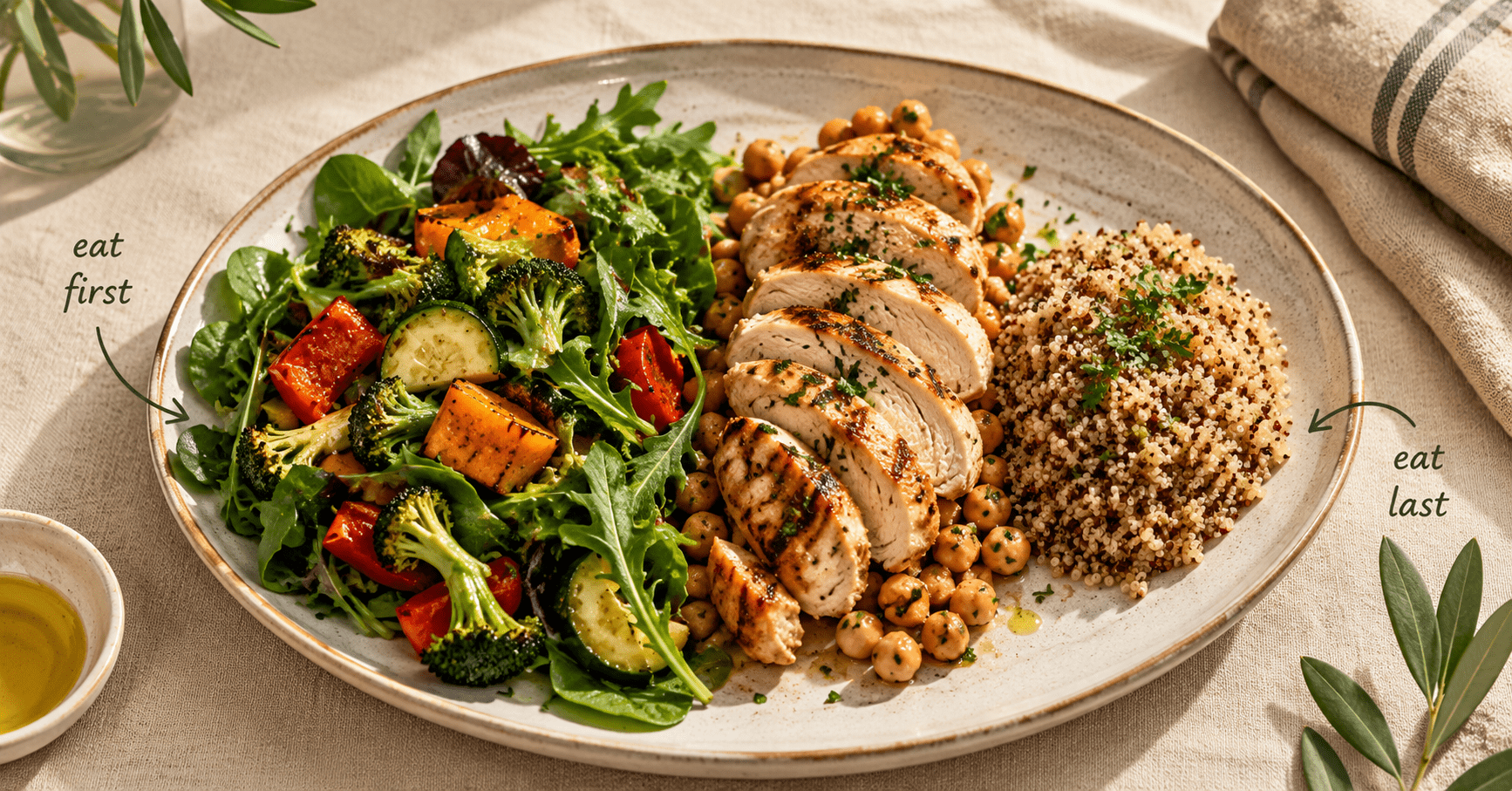
The order you eat food on your plate changes the blood sugar response by up to 40 percent without changing what you eat or how much. Vegetables first, then protein and fat, then carbohydrates last. That sequence slows how quickly glucose enters the bloodstream, prevents the spike that causes the 3pm crash, and keeps energy and focus stable through the afternoon. This is one of the most research-backed and least talked-about tools for blood sugar management.
For a long time I ate everything on my plate simultaneously. A forkful of rice, a bite of chicken, some vegetables, back to the rice. I was eating the right foods. I was eating reasonable amounts. And I was still reliably crashing by 3pm, needing coffee, losing focus, reaching for something sweet.
Then I read the food sequencing research and changed the order. Vegetables first for a few minutes. Then the protein. Carbohydrates last. Same lunch. Same ingredients. Same portion sizes. The 3pm crash stopped within the first week.
I realized I had been solving the wrong problem. I had been focused entirely on what to eat and had completely overlooked when within the meal to eat each component. The research had been there for years. Nobody in the personal wellness space had made it accessible without framing it as a diabetes management tool.
This is connected to the same principle behind why you feel tired after eating and the 3pm energy crash that follows. The crash is not about the quantity of food. It is about the glucose pattern created by the sequence in which different components of the meal are absorbed.
What food sequencing is and why it works
Food sequencing, also called meal sequencing, is the practice of eating the components of a mixed meal in a specific order to reduce the blood sugar response. The sequence is: vegetables first, then protein and fat, then carbohydrates last.
The mechanism is well established. When carbohydrates arrive in the digestive system on an empty stomach they absorb rapidly and create a concentrated glucose spike. When vegetables and protein arrive first, several things change:
• Fiber from vegetables physically slows gastric emptying, meaning food moves from the stomach to the small intestine more slowly. This distributes glucose absorption over a longer window rather than concentrating it.
• Protein triggers the release of GLP-1, glucagon-like peptide-1, a hormone that further delays digestion and improves the insulin response. This is the same mechanism targeted by GLP-1 receptor agonist medications but produced naturally by eating protein before carbohydrates.
• Fat from olive oil or protein sources creates a partial barrier in the stomach that slows carbohydrate absorption further.
• By the time the carbohydrates arrive last, the digestive system is already primed with enzymes, the gastric emptying rate is slowed, and the glucose enters the bloodstream gradually rather than in a rush.
The result is a glucose curve that rises slowly, peaks lower, and descends gradually rather than spiking sharply and crashing within two hours. That crash is what causes the 3pm fatigue, the loss of focus, and the sugar craving that most people experience as a normal part of the afternoon.
What the research shows
A study published in the journal Diabetes Care found that eating protein and vegetables before carbohydrates reduced the peak blood glucose response by 29 percent at 30 minutes, 37 percent at 60 minutes, and 17 percent at 90 minutes compared to eating carbohydrates first. Same meal. Same total food. Different order. Glucose response reduced by up to 40 percent.
A separate clinical trial with participants with prediabetes found that the protein-and-vegetable-first meal order reduced the incremental area under the glucose curve by 38.8 percent compared to carbohydrate-first eating. Insulin excursions were also significantly lower.
This is not a small effect. A 37 to 40 percent reduction in glucose peak changes whether the 3pm crash happens. It changes whether the afternoon craving fires. It changes whether you need a coffee at 2:30pm. And it costs nothing and requires no change to what you eat or how you balance your plate. Just the sequence.
The three-step sequence for every meal
The sequence works for any mixed meal where the components are separated or separable. It is less effective for combined dishes like a casserole or curry where all components are already mixed together, though even in those cases starting with a side salad or vegetables before the main dish applies the same principle.
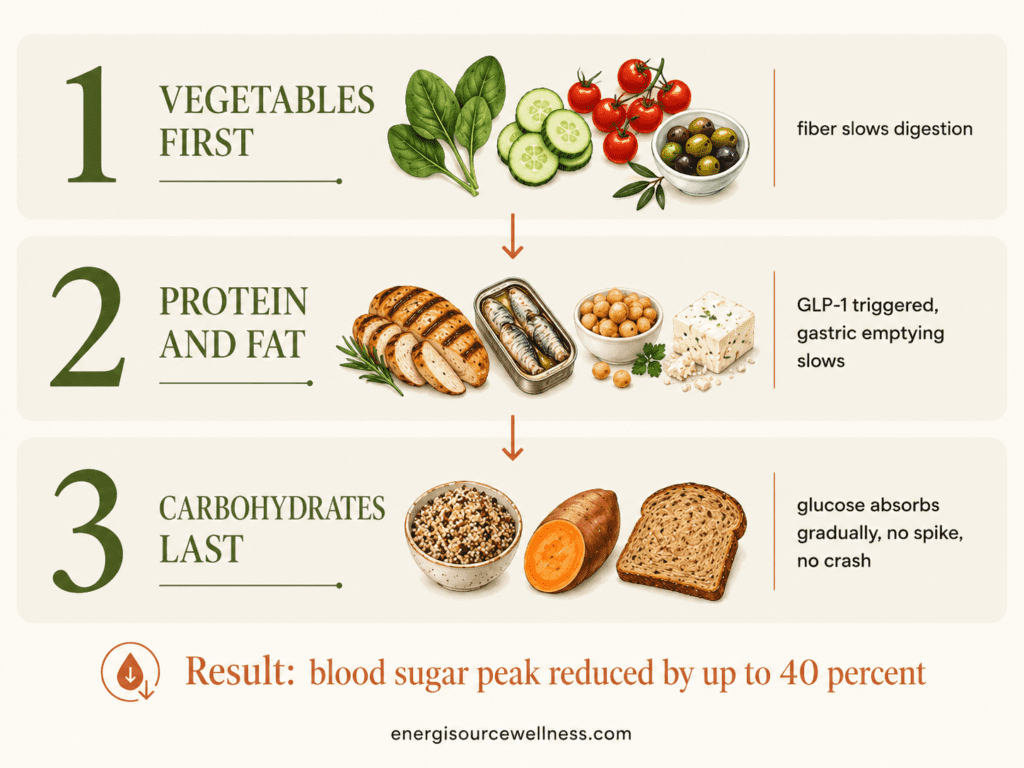
Step 1: Start with non-starchy vegetables (5 to 10 minutes)
Begin every meal with the non-starchy vegetables on the plate. Leafy greens, cucumber, tomatoes, zucchini, broccoli, asparagus, roasted peppers, steamed spinach. Eat these first and eat them slowly. The fiber in these vegetables begins the process of slowing gastric emptying and the chewing time means you are spending 5 to 10 minutes before any significant carbohydrate enters the digestive system.
In a Mediterranean lunch bowl this means starting with the salad base or roasted vegetables before touching the grain component. In the Mediterranean lunch bowls I eat regularly this happens naturally because the greens are underneath everything else and I eat them as I work through the bowl. The sequence is built into the structure of the meal.
What counts as non-starchy vegetables for this step:
• Leafy greens: spinach, arugula, kale, romaine, mixed greens
• Raw or roasted: cucumber, tomatoes, peppers, zucchini, broccoli, cauliflower, asparagus
• Olives and avocado count here because their fat content also contributes to slowing the subsequent carbohydrate absorption
• Do not use: corn, peas, potatoes, sweet potatoes, or legumes in this first step. Those are higher in carbohydrates or starch and belong in the later stages.
Step 2: Eat protein and fat (the main component)
After the vegetables, move to the protein and fat components of the meal. Chicken, fish, eggs, sardines, Greek yogurt, chickpeas, lentils, feta cheese, walnuts, olive oil-dressed components. Spend another 5 to 10 minutes here before touching the carbohydrate portion.
Chickpeas and lentils straddle steps 2 and 3 because they contain both protein and fiber alongside carbohydrates. In practice they belong in step 2 because their carbohydrate content is slow-digesting and their protein and fiber content is high enough that they function more like a protein source than a carbohydrate source in the sequencing context. This is why chickpeas and lentils are such effective ingredients in Mediterranean meals: they deliver protein, fiber, and slow carbohydrates in one ingredient, which is ideal for both composition and sequencing.
What counts as protein and fat for step 2:
• Fish: salmon, sardines, tuna, cod, shrimp
• Poultry: chicken, turkey
• Eggs: any preparation
• Legumes: chickpeas, lentils, white beans, black beans
• Dairy: Greek yogurt, feta cheese, cottage cheese
• Healthy fat sources: olive oil dressing, walnuts, avocado
Step 3: Eat carbohydrates last
After the vegetables and protein, move to the carbohydrate portion. Quinoa, rice, bread, pasta, sweet potato, fruit. By this point in the meal the digestive system has been primed with fiber, protein, and fat. The carbohydrates now absorb into a system that is already processing slower and producing GLP-1. The glucose response is significantly blunted compared to eating the same carbohydrates first.
A practical note: if you are eating olive oil as part of the dressing or cooking fat, make sure it is present in steps 1 and 2 as well as step 3. The fat in olive oil at the beginning of the meal contributes meaningfully to the gastric emptying delay that makes the whole sequence work. A dry salad without dressing in step 1 misses part of the mechanism.
What counts as carbohydrates for step 3:
• Grains: quinoa, rice, whole grain bread, pasta, oats
• Starchy vegetables: sweet potato, potato, corn, peas
• Fruit: best at the end of the meal for the same reason
• Any bread or crackers if they are part of the meal
>> Want the meal structure that makes food sequencing automatic?
The Full Plate Method app builds Mediterranean meals with vegetables, protein, and carbs already in the right ratio. Free forever. Build your plate free
How to apply this to Mediterranean eating
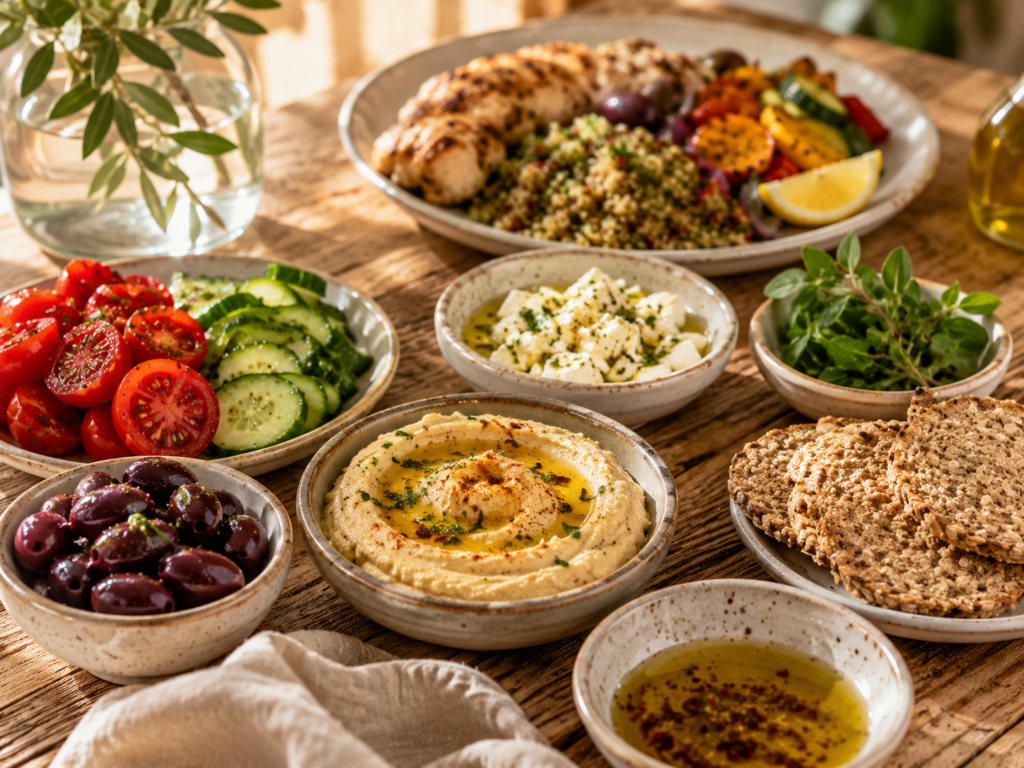
Mediterranean meals are naturally well-suited to food sequencing because they typically include distinct components rather than combined single-pot dishes. A Mediterranean lunch bowl has a greens base, a protein, legumes, and a grain. The components are already separate. The sequencing is just a matter of which you pick up first.
Mediterranean lunch bowl sequence
Start with the arugula or spinach base and any cucumber or tomatoes. Eat through the salad layer. Move to the chickpeas and any protein such as chicken or tuna. Then the feta and olives alongside. Finally the quinoa or any grain component. The physical structure of a Mediterranean bowl makes this natural rather than forced.
Mediterranean dinner plate sequence
Start with the side salad or any roasted vegetables. Move to the fish or protein main. Then the grain side last. In a typical Mediterranean dinner of grilled salmon, roasted vegetables, and quinoa, this means eating the roasted vegetables for the first few minutes, then the salmon, then addressing the quinoa toward the end of the meal.
Breakfast application
At breakfast the sequence is: vegetables or avocado first (spinach, tomatoes, cucumber, avocado), then eggs or protein, then any carbohydrate component such as a slice of whole grain toast or a small portion of oats. If eating a savory Mediterranean breakfast this happens naturally. If eating something like overnight oats, start with the walnuts and any avocado first, then eat the oats.
The salad starter approach for restaurant meals
The simplest application for restaurant meals or any situation where sequencing the main plate feels unnatural is to always start with a salad or a vegetable starter before the main dish arrives. Even a simple side salad with olive oil dressing eaten before the pasta or the sandwich applies the first step of the sequence and meaningfully reduces the glucose response to the meal that follows.
This is why the Mediterranean habit of starting with a mezze spread of hummus, olives, cucumber, and vegetables before the main course is not just a cultural convention. It is functionally a food sequencing practice that has been embedded in the eating pattern for generations without anyone calling it food sequencing.
Common questions about food sequencing
Does food sequencing work for every meal?
It works best for meals where the components are separate and identifiable. A plate of grilled chicken, roasted vegetables, and quinoa is ideal. A curry or a mixed pasta dish where everything is combined is harder to sequence, though you can still start with a side salad or a vegetable-forward first bite before the combined dish. The effect is most pronounced when there is a meaningful time gap of 5 to 10 minutes between eating the first component and the carbohydrates, which requires the meal to have some physical separation between components.
How much of a difference does food order actually make?
The clinical research shows a 29 to 40 percent reduction in peak blood glucose response. In practical terms this is the difference between a post-meal crash and no crash for many people. It is also the difference between an afternoon coffee being optional versus necessary. The effect is significant enough to notice within the first week of consistent application, which makes it one of the most immediately verifiable dietary changes available.
Do I have to eat each component completely before moving to the next?
No. The research protocol used a 10-minute gap between components in some studies but the practical application does not require strict separation. The key is that vegetables and protein dominate the first half of the meal and carbohydrates are addressed toward the end. If you naturally move between components throughout the meal but keep the proportions tilted toward vegetables and protein early and carbohydrates late, you get most of the benefit without needing to eat each component in complete isolation.
What about drinks with a meal?
Sweetened drinks consumed at the beginning of a meal create a glucose spike before any food sequencing can help, which undermines the whole practice. Water is the ideal meal companion. Sparkling water with lemon is also fine. If you are going to have juice or a sweetened drink, treat it the way you would treat a carbohydrate: consume it after the vegetables and protein rather than before or alongside the first bites.
Does this mean I should stop eating fruit?
No. Fruit is a nutritious food and belongs at the end of the meal rather than before it. A piece of fruit as dessert after a meal containing vegetables and protein has a very different glucose response than fruit juice or a fruit smoothie consumed on an empty stomach before protein is present. The sequencing principle means that fruit consumed last, in a whole food form with its fiber intact, is a reasonable addition to any meal.
Can food sequencing replace other blood sugar strategies?
Food sequencing is one tool and it works best as part of a broader approach that includes building balanced meals with protein, fiber, and fat, eating at consistent times, and choosing whole food carbohydrates over refined ones. Sequencing a meal of refined white rice, no vegetables, and minimal protein will produce less benefit than sequencing a meal that already has good composition. The sequencing amplifies the effect of good meal composition rather than replacing it.
The practical reality of applying this
Food sequencing sounds like it requires significant attention and discipline. In practice it becomes automatic within about two weeks because the feedback loop is fast and clear. You feel the difference in the afternoon within the first few days. That immediate feedback reinforces the behavior more effectively than any abstract health principle.
The application I settled on is simple. Every meal starts with whatever is most vegetable-forward on the plate. At lunch that is the salad base or roasted vegetables. At dinner it is whatever side vegetable is present. At breakfast it is the spinach or avocado component. I eat that for a few minutes before picking up the fork for the protein or grain. That is the entire practice.
What I noticed beyond the 3pm crash disappearing was a change in how satisfied I felt from each meal overall. Eating vegetables first means I am already somewhat satisfied by fiber and volume before the higher-calorie components arrive. The same total meal leaves me more satisfied and with a flatter post-meal energy curve. It connects directly to the broader pattern described in the balanced plate method where composition and sequence together produce the 4 to 5 hour fullness window.
The bottom line
The 3pm crash is not caused by how much you ate at lunch. It is caused by how the glucose from that lunch entered your bloodstream. Eating vegetables and protein before carbohydrates at every meal is a zero-cost, no-restriction strategy that reduces the blood sugar peak by up to 40 percent and prevents the crash that drives the afternoon fatigue, the 3pm coffee, and the sugar craving.
Start at your next meal. Look at your plate. Eat the vegetables first. Move to the protein. Address the carbohydrates last. Track how you feel at 3pm for the next three days. The feedback will be faster and clearer than almost any other dietary change you have made.
I learned to eat this way from observation rather than research. Growing up, the meal always started with salad and olives and vegetables before the main dish arrived. The main dish with the rice or the bread came after. Nobody called it food sequencing. It was just how meals worked. When I read the clinical research years later I recognized exactly what I had grown up doing and had moved away from in adulthood. Getting back to it was straightforward. The 3pm crash was one of the first things that cleared.
Ribert
>> Want to build meals that already follow this sequence automatically?
The 7-Day Mediterranean Meal Plan includes 28 meals structured around the protein-fiber-fat formula with built-in food sequencing. $17, instant download. Get the 7-Day Mediterranean Meal Plan for $17
Free printable
Hungry again at 9pm?
Get the free printable Night Hunger Snack List: 10 Mediterranean snacks with exact portions and protein counts, for the evenings when cravings hit. Enter your email and download it instantly.
Free. No spam. Unsubscribe anytime.
Keep reading
How to Balance Blood Sugar to Stop Hunger and Cravings
Why You Feel Tired After Eating
What to Eat for Breakfast to Stop Cravings All Day
This article shares personal experience and general nutrition information, not medical advice.
About Ribert Rodriguez
Ribert is the founder of EnergiSource Wellness. He built this site to share what actually worked for him after years of struggling with cravings, late-night eating, and low energy. His approach is rooted in the Mediterranean framework and a belief that food is one of the most powerful tools for how you think and feel.