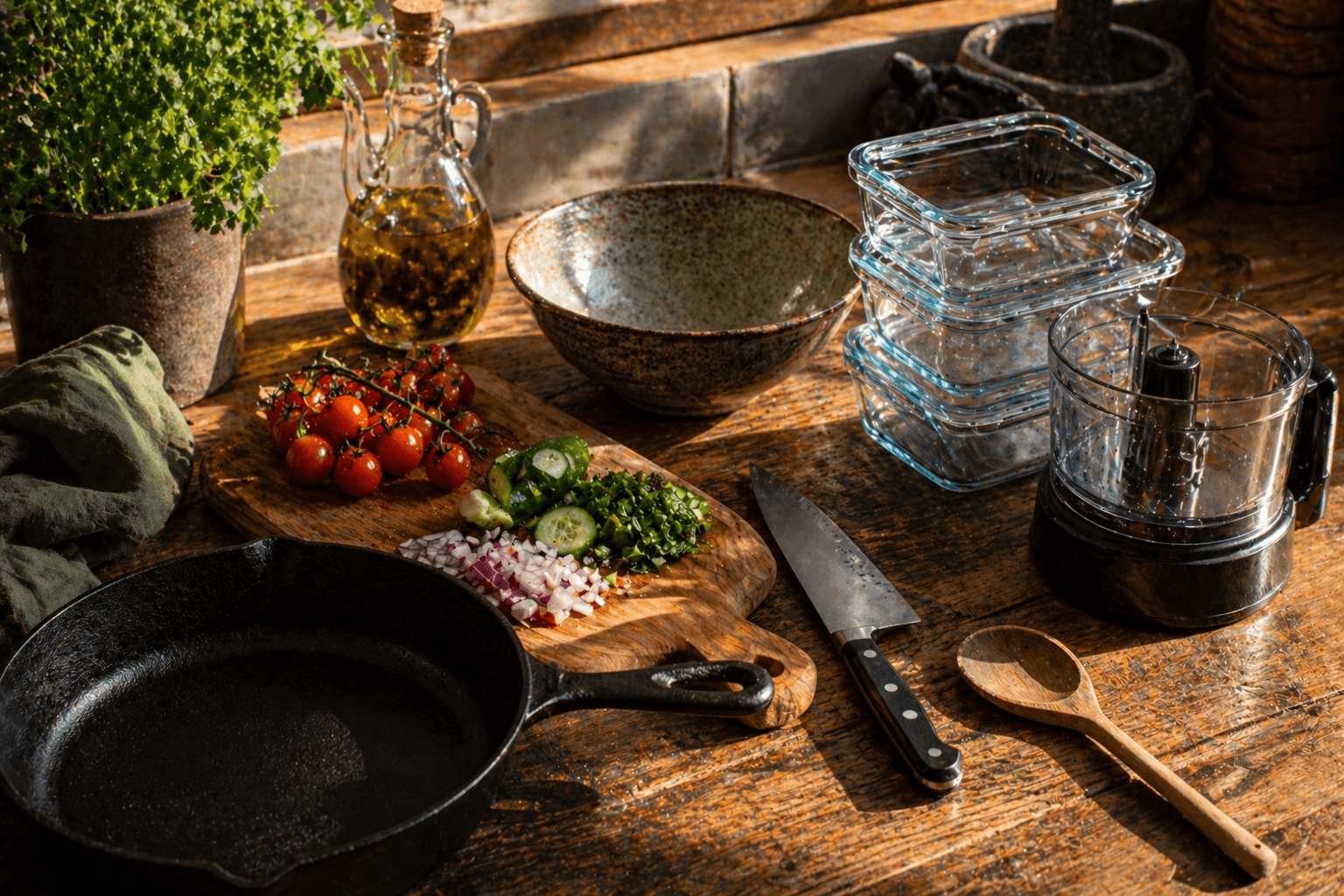
Quick answer: The Mediterranean kitchen essentials are a good chef’s knife, a wooden cutting board, a heavy skillet, a Dutch oven or heavy pot, a sheet pan, glass meal prep containers, a small food processor, a salad spinner, and a simple spice and herb setup. That’s it. You don’t need specialty cookware or expensive gadgets, just a few tools and accessories you’ll use almost every day.
Walk into any kitchen store and you’ll be told you need 50 things to cook well.
Air fryers. Spiralizers. Sous vide machines. Specialty pans for every task. A drawer full of gadgets that get used twice and live in the back forever.
I dug into how Mediterranean cooking actually works (the way it’s been done for centuries, before the kitchen gadget industry existed), and the truth is almost embarrassing. You need very little. A few good pieces of equipment and you can cook 90% of Mediterranean meals without ever buying another tool.
Most “must-have kitchen lists” are trying to sell you things you don’t need. This isn’t that list.
Below are the 9 tools that actually matter for Mediterranean cooking. What each one does. Why it makes meals easier. And which ones you can skip entirely.
The principle behind a Mediterranean kitchen, fewer tools, used often
Here’s what most kitchen articles miss.
Mediterranean cooking is built on simplicity. You’re not making complicated dishes that require specialty equipment. You’re making the same kinds of meals over and over with subtle variations. Grilled fish. Roasted vegetables. Grain bowls. Salads. Stews. Eggs.
That repetition means you don’t need 50 tools. You need 9 tools that handle 90% of cooking, and you use them every day.
This is why visiting a Mediterranean grandmother’s kitchen is humbling. There’s almost nothing there. A few good knives. A heavy pot. A skillet that’s been used for 30 years. A cutting board. A mortar and pestle. That’s it. And she’s making better food than most American kitchens stocked with $5,000 of equipment.
The wellness industry doesn’t tell you this because there’s no money in selling you fewer things.
The 9 Mediterranean kitchen essentials, tools, and accessories (and why each one matters)
1. A good chef’s knife
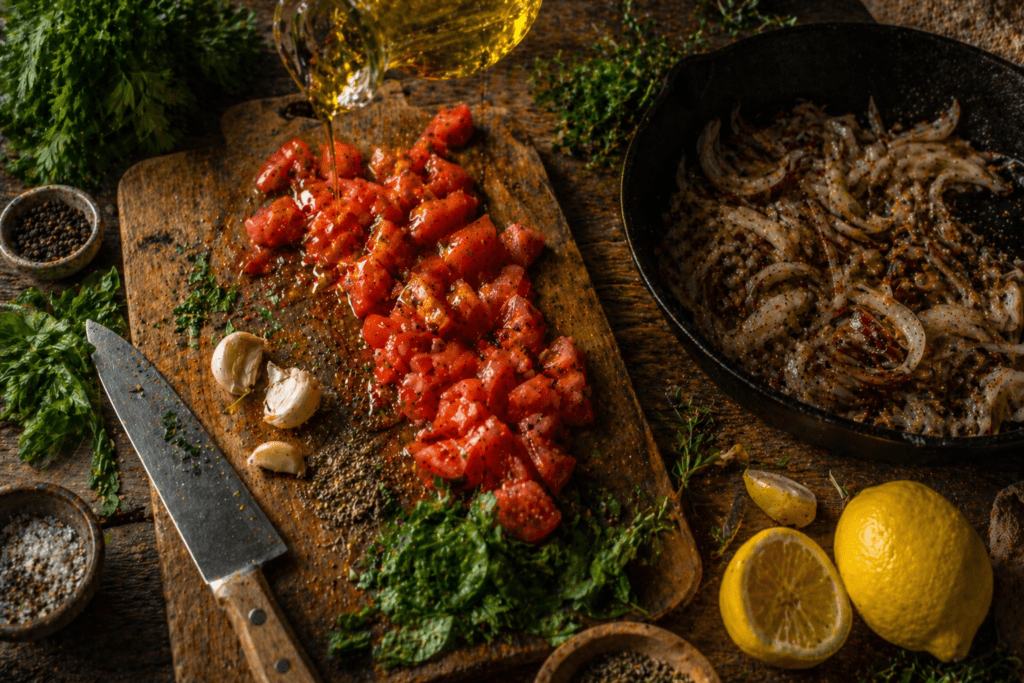
This is the single most important tool in your kitchen.
A sharp 8-inch chef’s knife handles 90% of all cutting tasks, vegetables, herbs, fish, meat, fruit. A dull knife is more dangerous than a sharp one and makes every prep step take twice as long.
You don’t need a 15-piece knife block. One good chef’s knife replaces almost all of them.
What to buy: A mid-range chef’s knife from Wüsthof, Victorinox, or Mac. Don’t spend $300 on a Japanese knife as a beginner. It’s not necessary and they require more maintenance. A $60-$120 chef’s knife will last you a decade if you keep it sharp.
The skip list: Knife sets, paring knives (use the chef’s knife), fillet knives unless you butcher fish often, fancy ceramic knives.
2. A wooden cutting board
You’re going to use this every single day. Get one that lasts.
A real wooden cutting board (not bamboo, not plastic) is gentler on knife edges, naturally antibacterial, and looks beautiful enough that you can use it as a serving board too. Plastic cutting boards develop deep grooves that hold bacteria, wood doesn’t.
What to buy: A solid maple, walnut, or end-grain cutting board, at least 14″x10″. Treat it with mineral oil every couple months and it’ll last 20 years.
The skip list: Color-coded plastic boards (overkill), tiny cutting boards (you need real surface area), glass cutting boards (terrible for knives).
3. A heavy non-stick or cast iron skillet
Eggs are central to Mediterranean breakfast cooking. You need a skillet that handles them well.
The choice is between a high-quality non-stick pan (easier, faster, but eventually wears out) or cast iron (lasts forever, takes some learning, develops a natural non-stick surface). Both work. I personally use both, non-stick for eggs and quick weeknight cooking, cast iron for searing and roasting.
What to buy: For non-stick: a 10-inch ceramic non-stick skillet, ceramic is healthier than traditional non-stick coatings. For cast iron: a 10 or 12-inch Lodge skillet. Inexpensive, and with basic care it lasts for years.
The skip list: Cheap non-stick pans (the coating breaks down fast), copper pans (mostly aesthetic), nonstick “infomercial” pans.
4. A heavy pot or Dutch oven
For soups, stews, lentils, beans, and slow cooking. This is the pot you’ll reach for constantly.
Mediterranean cooking has a deep tradition of slow-cooked legume dishes, Tuscan white bean stew, lentil soup with vegetables, chickpea stews. A heavy pot with a tight lid handles all of these effortlessly.
What to buy: A 5-7 quart enameled cast iron Dutch oven. Lodge makes a great budget version (~$80). Le Creuset is the premium choice if you want something that lasts forever.
The skip list: Specialty cookers like Instant Pots (useful for some, but not actually necessary for Mediterranean cooking), pressure cookers, slow cookers if you have a Dutch oven.
5. A sheet pan (or two)
Roasted vegetables are central to Mediterranean cooking. A good heavy sheet pan is non-negotiable.
The trick is to buy a real heavy aluminum half-sheet pan, not a thin one that warps the second you put it in a hot oven. Heavy pans hold heat evenly, brown vegetables properly, and last forever.
What to buy: A heavy aluminum half-sheet pan, 18″x13″. Look for “heavy gauge” or “commercial weight.” Nordic Ware makes the best ones.
The skip list: Air fryers (a sheet pan in a hot oven does the same thing for the same foods), specialty roasting pans, copper sheet pans.
Want a complete Mediterranean meal system that uses these basic tools? The Cravings Control Reset is a 7-day plan with simple meals you can make with the equipment most people already have. Get instant access for $27 →
6. Glass meal prep containers
If you want Mediterranean eating to actually stick, meal prep makes the difference. It pairs well with the meal prep routine that stuck for me.
Glass containers are the right choice. They’re durable, don’t absorb stains or smells like plastic, can go from fridge to oven to microwave, and they don’t leach chemicals. Plastic containers degrade over time and can release microplastics into your food.
What to buy: A set of glass meal prep containers with locking lids, variety of sizes from 1-cup to 4-cup. Pyrex makes solid budget ones. The locking lid versions are worth the extra few dollars.
The skip list: Plastic Tupperware (replace it), single-use containers, mason jars for everything (some things, sure, but not everything).
7. A small food processor
Most Mediterranean sauces and spreads come together in 60 seconds with a food processor, hummus, pesto, romesco, olive tapenade, herb dressings. Without one, you’re either skipping these dishes or doing way more work.
You don’t need a giant 12-cup model. A small 3-4 cup food processor handles 90% of Mediterranean spread-and-sauce work and takes up almost no counter space.
What to buy: A 3-4 cup food processor, Cuisinart and Hamilton Beach both make solid budget options. Don’t spend more than $60 unless you do a lot of large-batch food prep.
The skip list: Giant 12-cup processors (overkill for most Mediterranean work), high-end blenders for hummus (overkill), specialty hummus-makers.
8. A salad spinner
This sounds optional but it’s not. Mediterranean cooking uses a lot of leafy greens. A salad spinner takes washed greens and dries them in 10 seconds, which means salads with dressings that actually stick instead of pooling at the bottom.
Wet greens water down dressings, dilute olive oil, and ruin the texture of salads. A salad spinner solves all three problems and costs nothing.
What to buy: Any decent salad spinner, OXO makes the standard reliable one for around $30. Lasts forever.
The skip list: Drying greens with paper towels (works but uses tons of paper), restaurant-style spinners (overkill for home use).
9. A spice rack and herb storage
Mediterranean cooking lives on dried and fresh herbs. Oregano, basil, rosemary, thyme, parsley, mint, bay leaves. You’ll use all of them constantly.
Without a spice rack, you’ll either forget you have herbs or never reach for them because they’re buried in a drawer. A simple wall-mounted or counter spice rack changes the entire experience of cooking.
What to buy: A simple kitchen spice rack with clearly labeled jars. Wall-mounted versions free up counter space. The brand barely matters. The function is what counts.
The skip list: Pre-filled “Mediterranean spice” gift sets (overpriced), giant 50-jar racks (you’ll use 12 herbs max).
A Water Filter (Yes, It Counts as a Kitchen Essential)
Here is something most kitchen lists skip. You can buy the best olive oil and the freshest vegetables and still cook and drink with tap water you have never really thought about. I care about what touches my food, and that includes the water I cook with, fill my coffee with, and drink all day. A good filter pitcher is the simplest upgrade, no plumbing, no installation, just cleaner water from day one.
The one I point people to is Clearly Filtered. It is independently tested to remove far more contaminants than the standard pitcher most people own, which fits the whole reason you are reading a list like this: real food, clean ingredients, fewer things you did not ask for.
See the Clearly Filtered Pitcher →What you don’t need (but are being sold)
This is the section the kitchen industry doesn’t want you to read.
Air fryers. A heavy sheet pan in a 400°F oven does the same thing for the same foods. Air fryers are convenient if you have one, but you don’t need to buy one for Mediterranean cooking.
Instant Pots and pressure cookers. Useful for some people, but Mediterranean cooking uses gentle, slow methods. A Dutch oven and a pot of patience covers everything.
Specialty knives. Bread knives, fillet knives, paring knives, boning knives. A good chef’s knife handles 95% of tasks.
Spiralizers. Zucchini noodles are a fad food. Real Mediterranean eating uses real noodles in moderate portions. Skip it.
Garlic presses. A chef’s knife crushes garlic faster and creates better flavor.
Avocado tools. A spoon and a knife. That’s it.
Specialty oils for every cuisine. You need extra virgin olive oil. That’s the only oil Mediterranean cooking really needs. Maybe a bit of avocado oil for high-heat searing. Skip everything else, sesame oil, coconut oil, “wellness” oils. Marketing.
Egg cups, banana hangers, butter softeners, garlic peelers. All gimmicks.
The kitchen gadget industry generates billions selling things people don’t need. Don’t fall for it.
Building a Mediterranean kitchen on a budget
If you’re starting from scratch, you don’t need to buy everything at once.
Tier 1, Buy these first (about $150-200 total):
- A good chef’s knife (~$80)
- A wooden cutting board (~$40)
- A non-stick or cast iron skillet (~$30-60)
That’s it. With those three things, you can already make 80% of Mediterranean meals.
Tier 2, Add these as you go (~$200 more): 4. A Dutch oven (~$80) 5. A heavy sheet pan (~$30) 6. Glass meal prep containers (~$50) 7. A small food processor (~$50)
Tier 3, Nice to have (~$60 more): 8. A salad spinner (~$30) 9. A spice rack (~$30)
Total to fully equip a Mediterranean kitchen: about $400-450 over time.
Compare that to what most “must-have kitchen lists” tell you to spend ($1,500+ on gadgets you’ll use twice), and you start to see the racket.
→ Related: Mediterranean Pantry Essentials, what to actually stock
How simple Mediterranean cooking actually looks
With these 9 tools, here’s what an average Mediterranean cooking week looks like:
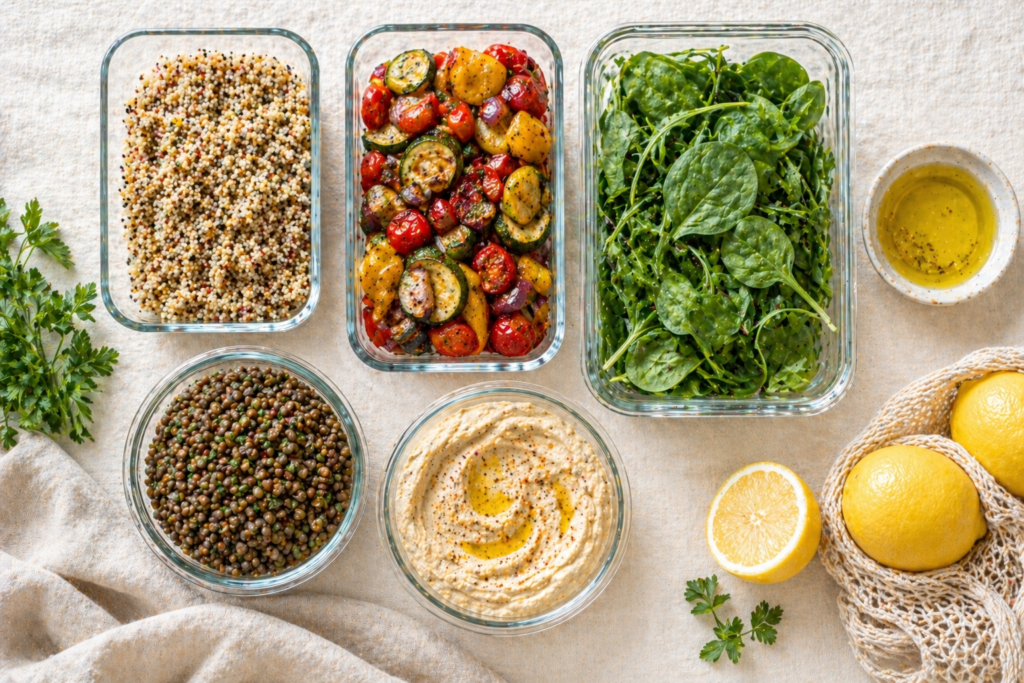
Sunday: Sheet pan of roasted vegetables (sheet pan + oven). Pot of lentil soup (Dutch oven). Hummus made fresh (food processor). Wash and spin a big container of greens (salad spinner). Store everything in glass containers for the week.
Weekday breakfasts: Eggs scrambled in the non-stick skillet with greens. Done in 5 minutes.
Weekday lunches: Build a bowl from the prepped components. Greens, leftover roasted vegetables, a protein (lentils from the soup, or eggs), drizzle of olive oil, herbs from the spice rack. Done in 2 minutes.
Weekday dinners: Salmon on the sheet pan. Quinoa cooked in the Dutch oven. A salad from the prepped greens. Done in 25 minutes.
That’s it. No specialty equipment. No 30-minute Instagram recipes that need 14 ingredients. Real food, made with simple tools, eaten consistently.
This is how my abuela cooked in DR. This is how Mediterranean grandmothers cook. The tools haven’t changed in 100 years because they don’t need to.
Frequently Asked Questions
What utensils do you need for Mediterranean cooking?
Very few. A chef’s knife, a wooden spoon, a spatula, tongs, a whisk, a vegetable peeler, and a citrus squeezer cover almost everything. Mediterranean cooking is mostly chopping, roasting, and tossing things with olive oil and lemon, so simple utensils do the job.
What’s the most important kitchen tool for Mediterranean cooking?
A good chef’s knife. Without a sharp knife, prep work takes forever and feels miserable. A $60-$120 chef’s knife is the single best investment you can make in your Mediterranean kitchen.
Do I need a special pan for Mediterranean cooking?
No. A standard non-stick or cast iron skillet handles eggs, fish, vegetables, and anything else you’d cook for Mediterranean meals. Cast iron is more durable and develops natural non-stick. Non-stick is easier to clean and faster for daily use.
Is a food processor really necessary?
Almost. You can make hummus by hand with a fork, but it takes 20 minutes and isn’t as smooth. Pesto, romesco, olive tapenade, and most Mediterranean spreads are dramatically easier with a small food processor. It’s worth the $50.
What kitchen tools should I avoid wasting money on?
Air fryers (sheet pan does the same thing), spiralizers, knife sets (one chef’s knife replaces them), Instant Pots if you already have a Dutch oven, garlic presses, specialty oils for every cuisine. Most kitchen gadgets are bought once and used twice.
Can I cook Mediterranean food without an oven?
Yes, but you’d be limited. Roasted vegetables and baked fish are central to Mediterranean cooking. If you only have a stovetop, focus on stews, pan-seared fish, sautéed vegetables, and salads, all completely doable, just a smaller range.
Do I need a high-end blender?
No. Most Mediterranean smoothies and sauces work fine in a small food processor. Smoothies blend in any blender. The high-end Vitamix is amazing if you have $400 for it, but completely unnecessary for getting started.
A Mediterranean kitchen isn’t built by buying more. It’s built by owning fewer, better things.
A sharp knife. A wooden board. A pan that lasts forever. A pot heavy enough to slow-cook lentils for 3 hours without burning them. A few glass containers for prep. A spice rack for the herbs you’ll actually use.
That’s it. That’s the whole kitchen.
The gadget industry will keep selling you things to fill your kitchen drawers. But Mediterranean cooking has been done for thousands of years with almost nothing. Your abuela didn’t have an air fryer. She had a heavy pan and 70 years of knowing what to do with it.
Buy the basics once. Use them daily. Skip everything else.
Ready to actually use these tools? The free 3-Day Hunger Reset gives you simple Mediterranean meals that work with the basic kitchen setup above. No specialty equipment needed. Grab it free and start tomorrow.
About Ribert Rodriguez
Ribert is the founder of EnergiSource Wellness. He researches and writes every article on this site personally, cross-checking claims against published research rather than relying on generic wellness advice. His approach is rooted in the Mediterranean framework, built from years of testing meal structures on himself after struggling with cravings, late-night eating, and low energy.