Constant hunger even after eating enough food usually means your meals aren’t triggering ghrelin to drop, because they’re missing enough protein, fiber, or fat to send that fullness signal. Fixing meal composition, not eating less, is what resolves it.
You just ate. Not a snack. Not coffee. An actual meal, something you made, something that seemed like enough. And forty-five minutes later you’re standing in front of the open fridge, staring at nothing, wondering what is wrong with you.
This isn’t a once-in-a-while thing. It’s every day. After breakfast. After lunch. After dinner. You eat more than you think you should and you’re still hungry. You’ve tried eating less, eating more, eating different things. Nothing seems to make the hunger stop.
Here’s what I want you to know before anything else: this is not an appetite problem. It’s not a willpower problem. And it is absolutely not a you problem.
Constant hunger is a structural problem, something specific is missing from your meals that your hunger hormones need in order to switch off. Once you understand what that is, fixing it is actually straightforward. Let me show you exactly what’s happening.
Your Hunger Is a Hormone, Not a Character Flaw
Before we get into the fix, I want to explain what’s actually happening in your body when you feel hungry all the time. Because once you understand the mechanism, everything else makes sense.
Hunger is controlled primarily by a hormone called ghrelin. Ghrelin is produced in your stomach and it does one job. It signals your brain that it’s time to eat. When ghrelin is high, you feel hungry. When it drops, you feel satisfied.
The problem is that ghrelin doesn’t drop just because you ate something. It drops in response to specific signals, protein hitting your digestive system, fiber slowing gastric emptying, fat triggering satiety hormones in your gut. If those signals don’t happen, because your meal was missing protein, fiber, or fat, ghrelin stays elevated. Or it drops briefly and rises again fast. Either way you’re hungry again within an hour.
This is why you can eat a full bowl of pasta and be hungry two hours later. Or have a salad for lunch and be starving by 3pm. The meals had calories. They didn’t have the specific combination that tells ghrelin to stand down.
That combination is what we’re going to fix.
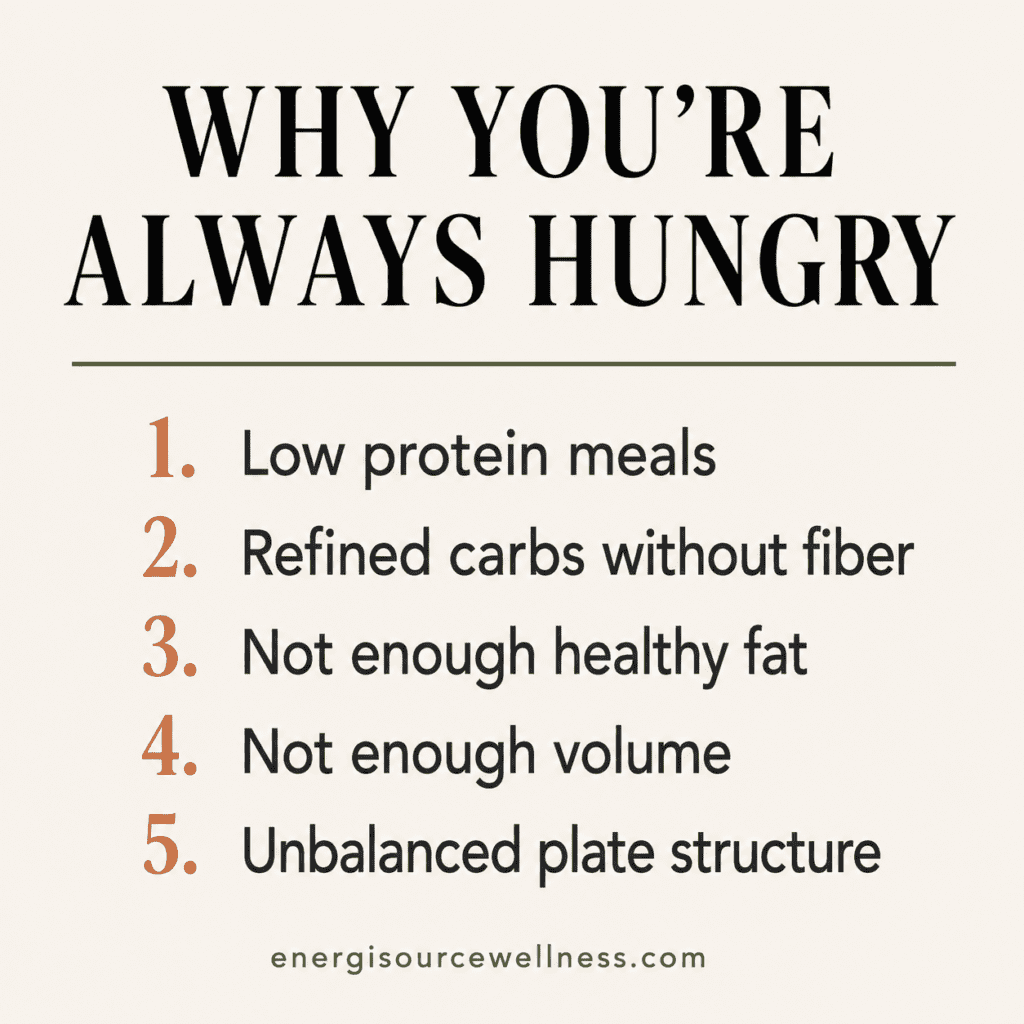
The 5 Real Reasons You’re Always Hungry
1. Your Meals Are Too Low in Protein
This is the single biggest driver of constant hunger and the one most people overlook.
Protein directly suppresses ghrelin. A review of the clinical evidence on high-protein diets found that protein-rich meals reliably raise PYY and GLP-1, two hormones that signal fullness to your brain, while lowering ghrelin. Most of the research uses roughly 20 or more grams of protein per meal as the threshold where this effect shows up clearly. When you eat less than that, or skip protein entirely, those signals never fire properly.
Think about the meals that leave you hungry fastest. A bowl of cereal. Toast with jam. A big salad with no protein. Rice and vegetables. These are all meals that are either completely missing protein or have so little that it doesn’t move the needle.
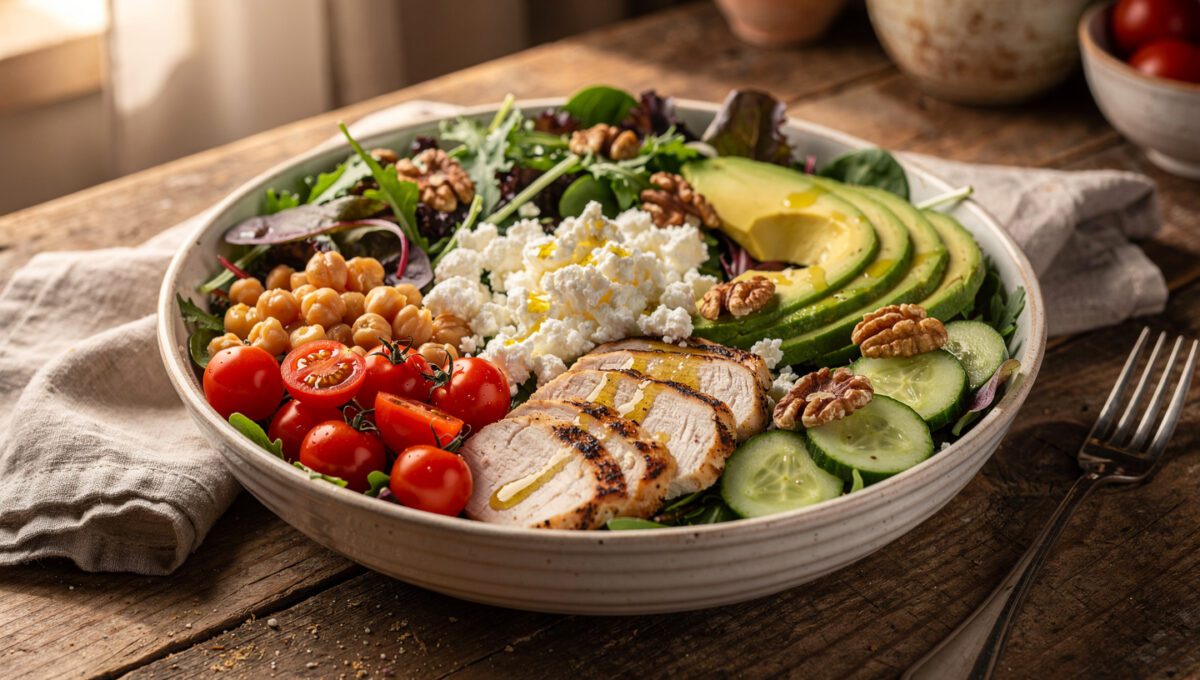
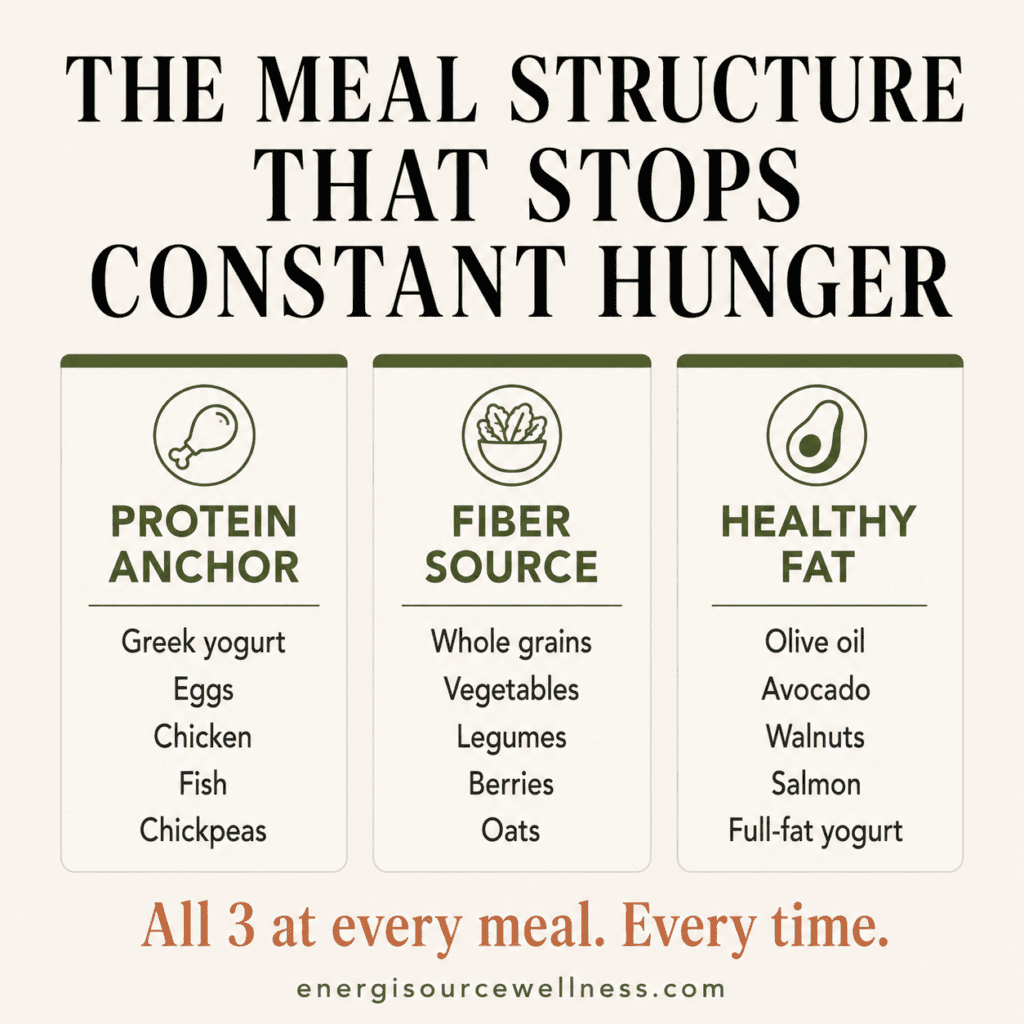
The fix is straightforward: every meal needs a protein anchor. Eggs, Greek yogurt, cottage cheese, chicken, fish, lentils, chickpeas. Not a garnish, an anchor. Something that anchors the whole meal around 20–30 grams of protein minimum.
If you want to understand exactly why you’re still hungry after eating even when your meals feel substantial, protein is almost always the missing piece.
2. You’re Eating Refined Carbs Without Fiber
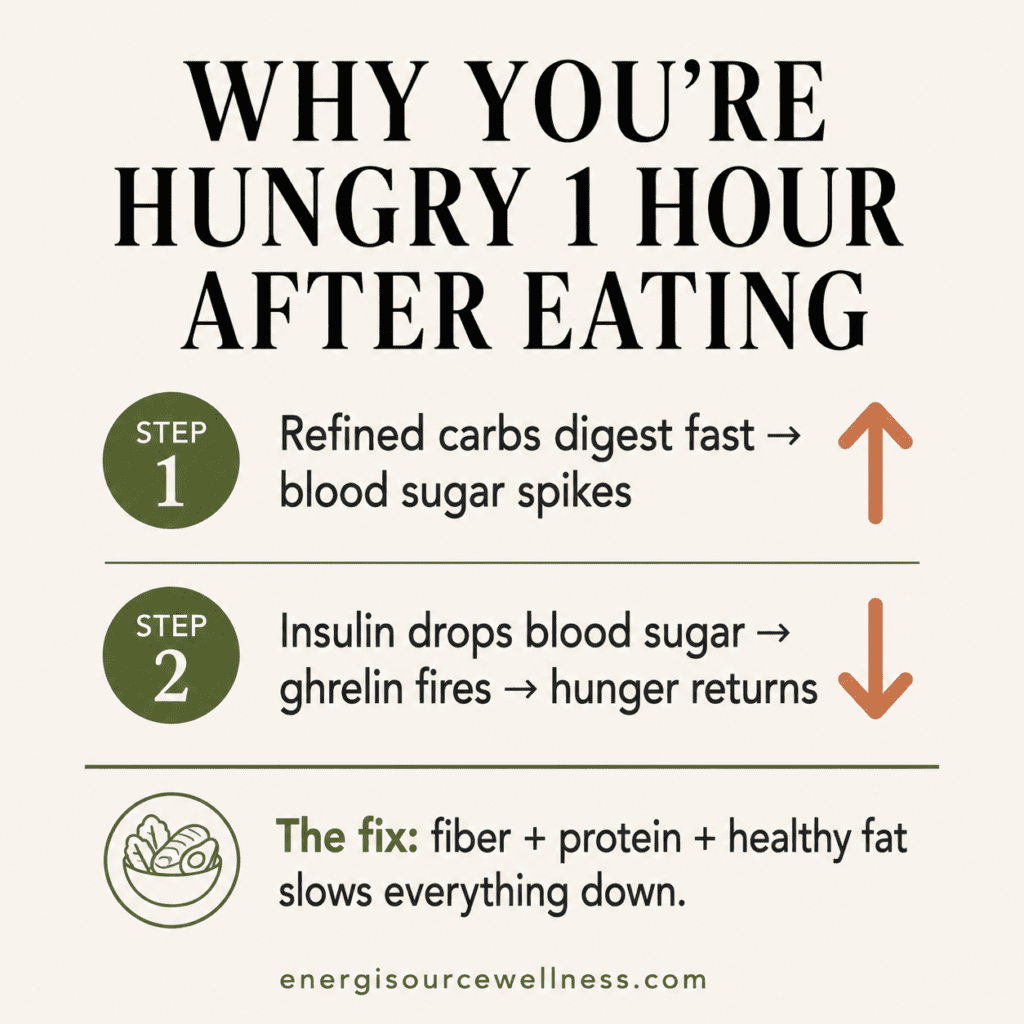
Refined carbohydrates (white bread, white rice, regular pasta, most crackers and cereals), digest extremely fast. They spike your blood sugar quickly, your pancreas releases insulin to bring it back down, and then blood sugar drops below baseline. That drop is what triggers the hunger signal.
That cycle typically plays out within a couple of hours, which is why you can eat a full breakfast of toast and orange juice and be genuinely hungry before lunch. It’s not that you didn’t eat enough. It’s that what you ate processed through your system too fast to maintain stable blood sugar.
Fiber is what slows this down. Whole grains, vegetables, legumes, and fruit all contain fiber that interrupts the fast-digestion cycle and keeps blood sugar rising and falling slowly instead of spiking and crashing. When blood sugar is stable, ghrelin stays low. When blood sugar crashes, ghrelin fires.
This is also why breakfast doesn’t keep you full for most people. It’s built around refined carbs with no protein and no real fiber, which means blood sugar spikes and crashes before 10am every single morning.
3. You’re Not Eating Enough Healthy Fat
Fat is the most misunderstood satiety nutrient. For decades we were told to eat less fat to lose weight, and what happened was that people replaced fat with refined carbs and felt hungry constantly.
Here’s what fat actually does in the context of hunger: it slows gastric emptying, meaning food physically stays in your stomach longer. It triggers the release of cholecystokinin, a satiety hormone that tells your brain the meal is complete. And it slows the absorption of everything else you ate, keeping blood sugar more stable for longer.
A fat-free meal digests significantly faster than a meal with healthy fat. That’s why the Greek dressing on a salad isn’t a guilty indulgence. It’s what makes the salad actually hold you. It’s why olive oil on roasted vegetables changes how long they keep you full. The fat is doing structural work.
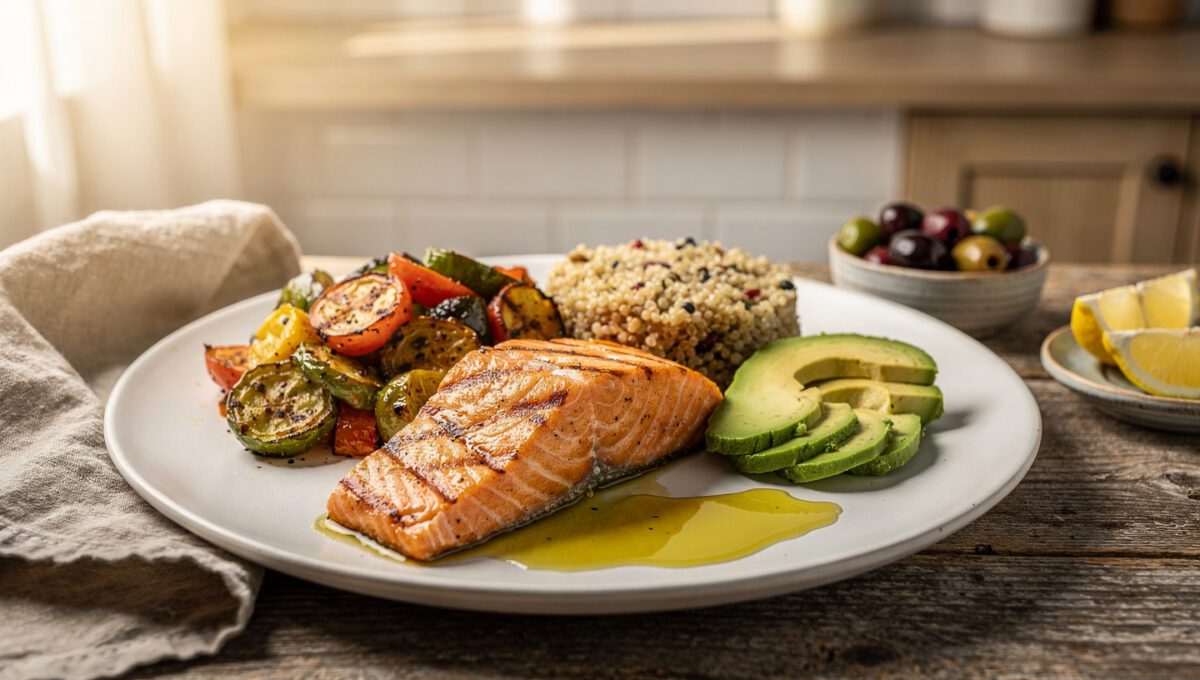
Healthy fat sources to include at every meal: olive oil, avocado, walnuts, almonds, salmon, whole eggs, full-fat Greek yogurt. Not a lot, a tablespoon of olive oil, a quarter of an avocado, a small handful of nuts. Enough to slow things down and trigger satiety.
4. Your Meals Don’t Have Enough Volume
This one is physical rather than hormonal. Your stomach has stretch receptors, nerve endings that detect how full the stomach is physically. When food fills the stomach to a certain volume, those receptors send a fullness signal to your brain.
Low volume, high calorie foods (like nut butter, cheese, crackers, protein bars), can hit your calorie target without ever triggering those stretch receptors. You’ve eaten enough calories but your stomach doesn’t register it as a full meal. The fullness signal doesn’t fire properly.
Mediterranean eating naturally solves this because it’s built around high-volume, nutrient-dense foods, roasted vegetables, salads with substance, grain bowls, soups, legumes. These foods fill the stomach physically while also providing the protein, fiber, and fat that trigger hormonal satiety. You get both signals at once.
If your meals are consistently small and dense rather than large and whole-food based, adding volume (more vegetables, larger portions of whole grains, bigger protein portions), can make an immediate difference in how long you stay full.
5. Your Meals Are Structurally Unbalanced
This is the umbrella cause that covers everything above. Even if you’re eating enough of each individual component, if they’re not combined at the same meal they don’t work together the way they’re supposed to.
Protein alone doesn’t suppress hunger as well as protein plus fiber. Fiber alone doesn’t stabilize blood sugar as well as fiber plus fat. Fat alone doesn’t trigger satiety as effectively as fat plus protein. The three work together, each one amplifying the effect of the others.
This is the foundation of how to build a meal that actually holds you. Every meal needs all three components present and in meaningful amounts. Not a trace of protein. Not a drizzle of olive oil. Actual anchors (a real protein source, a real fiber source, a real fat source), at every single meal.
When all three are present your hunger hormones get a clear, complete signal that the meal was sufficient. Ghrelin drops. Peptide YY rises. You feel full and you stay full.
Sound familiar? All 5 of these come down to the same root fix. Get the free 1-Day Hunger Reset Formula. The complete Mediterranean daily structure that hits every satiety signal at every meal so constant hunger becomes something that used to happen to you. Get the Free Guide →
What Constant Hunger Actually Looks Like Through the Day
Let me show you what the hunger cycle looks like when meals are unstructured, and what it looks like when they’re fixed.
The unstructured day: Breakfast, cereal or toast with coffee. Hungry by 10am. Grab a snack, something sweet. Energy spikes then crashes by noon. Lunch, a salad or sandwich, feels like enough. Hungry again by 2pm. Coffee and something from the office kitchen. Afternoon drags. Dinner, whatever, probably not enough protein. 9pm, standing in the kitchen looking for something, anything, to make the hunger quiet down.
This isn’t a discipline failure. This is exactly what happens when meals don’t hit the three satiety signals consistently.
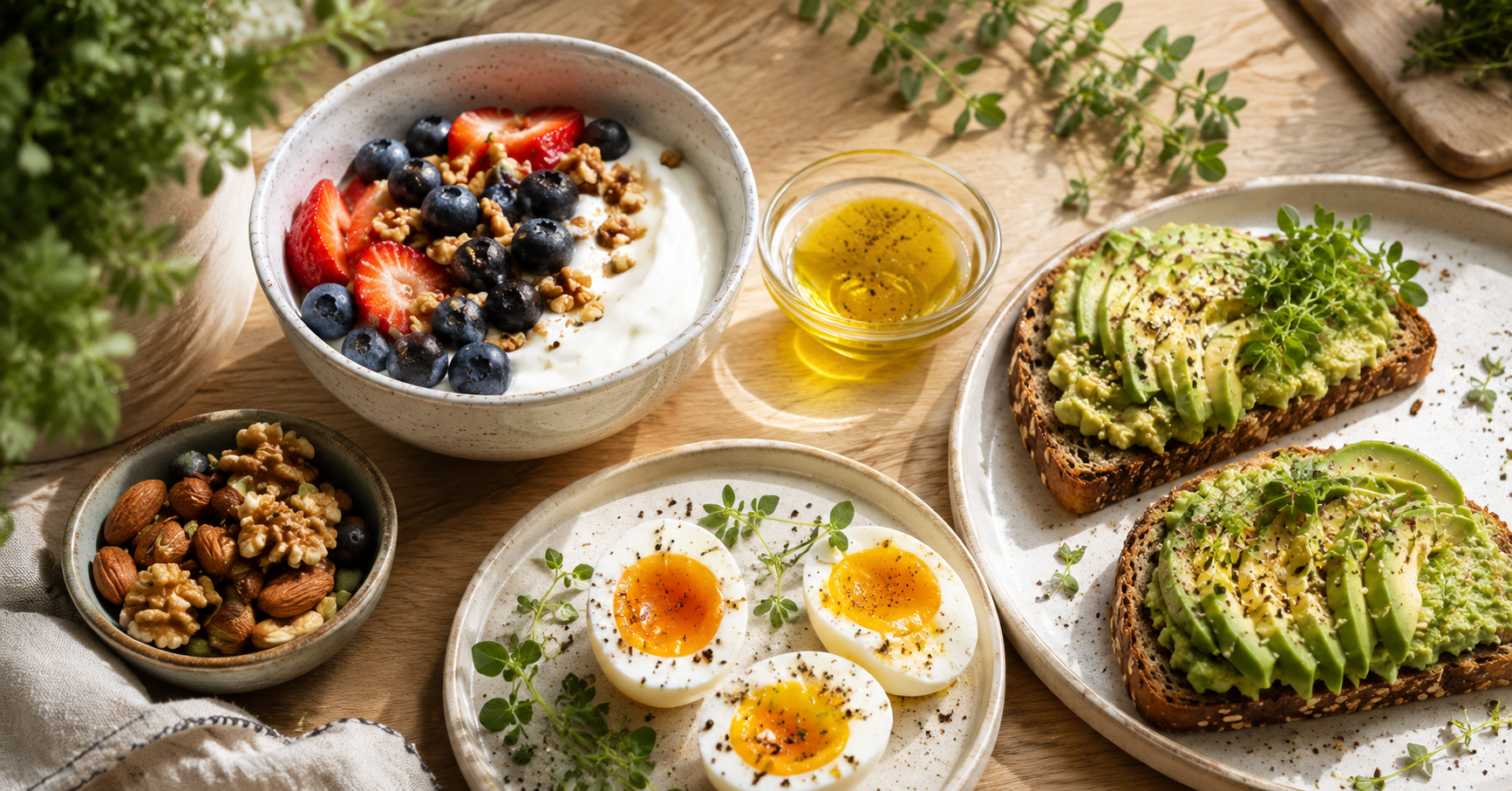
The structured day: Breakfast, Greek yogurt with berries, walnuts, and a drizzle of honey. 20g protein, real fiber, healthy fat. Not hungry until noon. Lunch, grilled chicken over roasted vegetables with olive oil and a side of farro. Another complete satiety signal. Energy stable through the afternoon. Dinner, salmon, roasted greens, whole grain, olive oil. Satisfied. No kitchen loop at 9pm.
Same person. Different structure. The hunger didn’t go away because of willpower. It went away because the meals finally gave the hunger hormones what they needed to switch off.
If you want to go deeper on staying full in a calorie deficit specifically, eating less without fighting hunger, the structure above is exactly what makes that possible.
The Specific Meal Fixes That Stop Constant Hunger
You don’t need to overhaul your entire diet. You need to add the missing piece to what you’re already eating.
If breakfast leaves you hungry by 10am: You’re missing protein. Add eggs, Greek yogurt, or cottage cheese. A bowl of oats alone won’t hold you, but oats plus Greek yogurt plus a handful of walnuts will. That’s the combination. See exactly what breakfasts actually keep you full and why most common breakfast choices set you up to fail by mid-morning.
If lunch leaves you hungry by 3pm: You’re probably missing fat or eating refined carbs without fiber. A sandwich on white bread with turkey and lettuce digests fast and leaves you hungry sooner. The same sandwich on whole grain with avocado, turkey, and spinach digests noticeably slower, since the added fiber and fat both slow the process down. Add olive oil to your salad. Add avocado to your wrap. Add a handful of almonds on the side. Small additions, significant difference.
If dinner leaves you snacking all night: This is the most common pattern and it almost always comes down to insufficient protein at dinner and nothing after to anchor the evening. Read exactly why night hunger happens and how to build a dinner that closes the hunger loop for good instead of leaving it open until midnight.
If you’re hungry all day no matter what: Start with foods that keep you full longer, Mediterranean staples that are specifically high in the protein, fiber, and fat combination that suppresses ghrelin most effectively. Build your meals around those foods as the default and the constant hunger typically starts to ease up within a week or two.
Frequently Asked Questions About Constant Hunger
Why am I always hungry even after eating a full meal? The most common reason is that your meal was missing one or more of the three satiety signals, protein, fiber, or healthy fat. Even a large meal can leave you hungry quickly if it’s built primarily from refined carbs without protein or fat to slow digestion and suppress ghrelin. Restructuring meals around a protein anchor, real fiber, and healthy fat typically brings noticeable improvement within a week or two, though the exact timeline varies by person.
What causes constant hunger all day long? Constant hunger throughout the day is almost always caused by a pattern of meals that consistently miss the satiety trifecta, protein, fiber, and fat at every meal. When any one of these is missing from multiple meals in a row, ghrelin stays elevated and hunger becomes a background state rather than a signal that comes and goes.
Is it normal to feel hungry all the time? It’s extremely common but it’s not normal in the sense that it’s not how your body is supposed to function. Constant hunger is feedback. Your hunger hormones are telling you that something in your meal structure isn’t meeting their requirements. Once the structure is fixed most people are surprised by how quickly the constant hunger resolves.
What should I eat to stop feeling hungry all the time? Focus on meals built around high-protein foods (Greek yogurt, eggs, chicken, fish, legumes), real fiber sources (whole grains, vegetables, legumes, fruit), and healthy fats (olive oil, avocado, nuts). The Mediterranean plate structure combines all three naturally at every meal and is specifically effective at keeping hunger hormones suppressed for 3–5 hours.
Can always feeling hungry be a sign of something wrong? In most cases constant hunger is structural, a meal composition issue rather than a medical one. However if you’ve made significant dietary changes and still feel constantly hungry it’s worth speaking with a doctor to rule out conditions like insulin resistance, thyroid issues, or other hormonal imbalances that can affect hunger regulation.
The Bottom Line
You are not always hungry because of who you are. You are always hungry because of how your meals are built.
Every meal you eat is either giving your hunger hormones the signal they need to switch off, or it isn’t. Protein, fiber, and healthy fat together send that signal clearly. Refined carbs, low-protein meals, and fat-free everything don’t send it at all.
The fix is not eating less. It’s not more discipline. It’s building every meal around the three things that actually tell ghrelin to stop, a real protein anchor, a real fiber source, a small amount of healthy fat. Mediterranean eating does this by default, which is why people who eat this way don’t spend their days fighting hunger.
Start with one meal. Breakfast is usually the easiest place to see the difference fast. Add protein. Add fiber. Add fat. See how you feel at 10am compared to your usual morning.
Constant hunger is not your baseline. It’s just what happens when meals are missing what they need. Give them what they need, and it stops.
About Ribert Rodriguez
Ribert is the founder of EnergiSource Wellness. He researches and writes every article on this site personally, cross-checking claims against published research rather than relying on generic wellness advice. His approach is rooted in the Mediterranean framework, built from years of testing meal structures on himself after struggling with cravings, late-night eating, and low energy.