Quick answer: If you’re always hungry on the Mediterranean diet, your meals are almost always short on protein, not on food. Bread, pasta, grain bowls, fruit and big salads are all “Mediterranean”, but on their own they digest fast and leave you hungry again in an hour or two. Aim for 25 to 30 grams of protein at every meal, add a fiber source (beans, lentils, vegetables) and a little olive oil or nuts, and eat enough overall. Many people notice a difference within the first week.
Get the free Hunger-Free Day Formula ↓
This is one of the most common complaints from people who just switched. You did everything right. You swapped the drive-through for whole grains, olive oil and vegetables, and now you’re hungrier than before. It feels like the diet is broken. It isn’t. The Mediterranean diet is a pattern, not a set menu, and it’s very easy to build it out of foods that look healthy but don’t hold you.
I went through the same thing. My “Mediterranean” breakfast was toast with olive oil and a piece of fruit, and lunch was a big salad. By 3pm I was raiding the pantry. Below are the 7 reasons this happens and exactly how to fix each one.
7 Reasons You’re Always Hungry on the Mediterranean Diet
1. Your meals are mostly carbs
Pasta, crusty bread, couscous, rice and grain bowls show up in a lot of Mediterranean recipes, and on social media they’re often the whole meal. Refined carbs digest quickly, so they don’t keep you full for long. In the original studies, the Mediterranean pattern was built mostly on vegetables, beans, fish and olive oil, with bread and pasta as a side, not the base.
Fix: Make carbs a quarter of the plate, not most of it. Choose the slower ones (farro, bulgur, lentils, chickpeas, whole grain bread) and never eat them alone. Pair every carb with a protein.
2. You’re not eating enough protein
This is the big one. Protein is the most filling of the three macronutrients, and research reviews consistently find that higher-protein meals increase fullness and reduce how much people eat later (Leidy et al., 2015). Many people who switch to Mediterranean eating cut back on meat and don’t replace it with anything, so protein quietly drops.
Fix: Get 25 to 30 grams of protein at each meal. That’s about 1 cup of plain Greek yogurt, 4 ounces of chicken or fish, or 3 eggs plus a side of cottage cheese. Not sure how much you need? Use the calculator below, or read how much protein you need to stay full.
Free tool
How Much Protein Do You Need to Stay Full?
Enter your weight and pick what fits you best. You’ll get a daily target, how to split it across meals, and a sample Mediterranean day that hits it.
Enter your weight to see your target.
Want this planned for you?
The 7-Day Mediterranean Meal Plan gives you 28 meals and snacks built around protein, fiber, and healthy fat, plus the grocery list.
Prefer to start free? Get the free high-protein snack list
Estimates for healthy adults, based on common dietitian ranges (about 1.0 to 1.6 g per kg of body weight, higher for active people). If you’re in a larger body, entering a goal or reference weight gives a more realistic number. If you have kidney disease, are pregnant, or take GLP-1 medication, check your target with your doctor or dietitian. This is general information, not medical advice.
3. Your salads are big but empty
A huge bowl of greens with tomato, cucumber and a light dressing is high volume but very low in protein and fat. It fills your stomach for an hour, then you’re hungry again. This is so common I wrote a whole post on why most salads don’t keep you full.
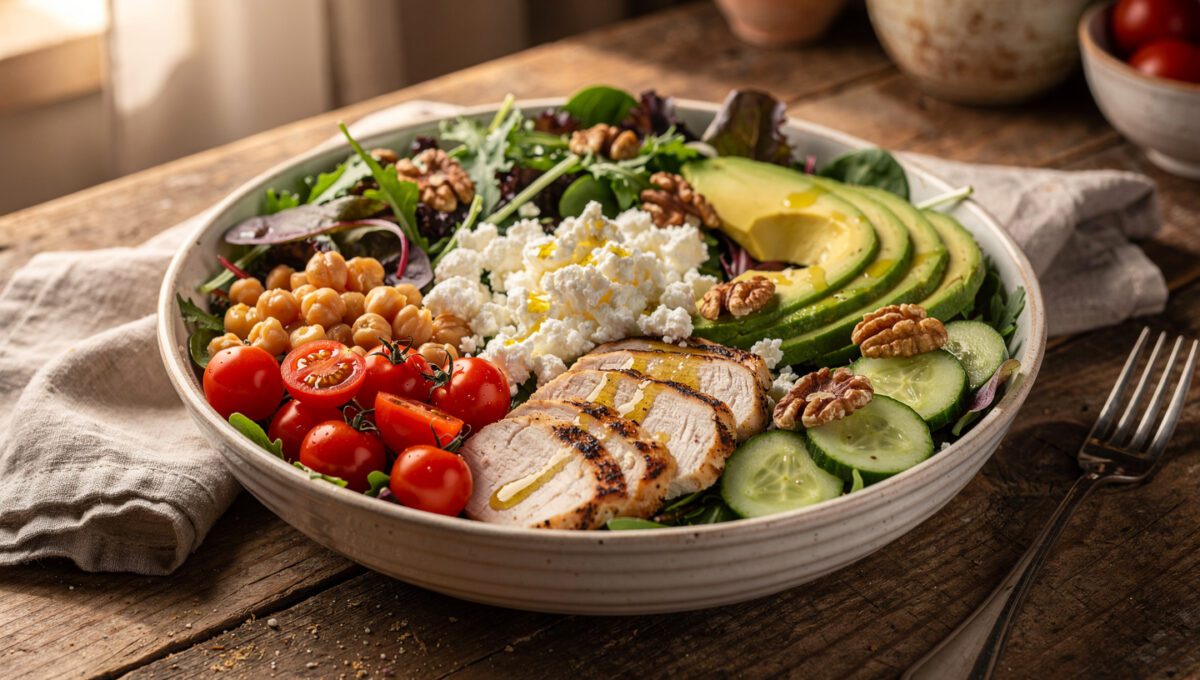
Fix: Every salad gets a real protein (chicken, tuna, salmon, eggs, chickpeas or lentils), a fat (olive oil, feta, olives, avocado or nuts) and something chewy (a scoop of farro or beans).
4. You’re eating too little overall
Mediterranean food is lower in calories per bite than processed food, which is great, but it’s easy to under-eat without noticing. When you eat much less than your body needs, hunger hormones push back hard. One well-known study found that after weight loss, the hunger hormone ghrelin stayed higher for a year (Sumithran et al., 2011). Skipping breakfast or eating a tiny lunch usually backfires by evening.
Fix: Eat 3 real meals. If you’re hungry between them, add a planned protein snack instead of white-knuckling it.
5. Your snacks are fruit, crackers or hummus alone
An apple, a handful of grapes, or hummus with pita chips all feel Mediterranean, but they’re mostly carbs. They’re fine as part of a snack, not as the whole thing.
Fix: Pair them. Apple with a cheese stick, hummus with cucumber and 2 hard-boiled eggs, grapes with a handful of almonds. Here are more Mediterranean snacks that keep you full.
6. You’re relying on “Mediterranean” packaged food
Store-bought pita chips, flavored hummus, granola, bars and “Mediterranean-style” frozen meals are often ultra-processed. In a controlled study at the NIH, people ate about 500 more calories a day on an ultra-processed diet than on a minimally processed one, even though both diets offered the same nutrients (Hall et al., 2019). These foods are easy to eat fast and don’t keep you satisfied.
Fix: Keep the packaged stuff as a convenience, not the base. Plain Greek yogurt, canned fish, eggs, canned beans and frozen vegetables are just as quick and far more filling.
7. You’re short on sleep (or stressed)
Sometimes it’s not the food. In one sleep study, just 2 nights of short sleep raised ghrelin, lowered leptin (the fullness hormone) and increased hunger by about 24% (Spiegel et al., 2004). If your hunger is worst on days after a bad night, that’s a clue.
Fix: On low-sleep days, front-load protein at breakfast and lunch and keep an easy protein snack ready for the afternoon.
Also normal: if you just jumped from a low-fiber diet to lots of beans and vegetables, your body can take a week or two to adjust. Hunger often settles once your meals are balanced.
What a Filling Mediterranean Day Looks Like
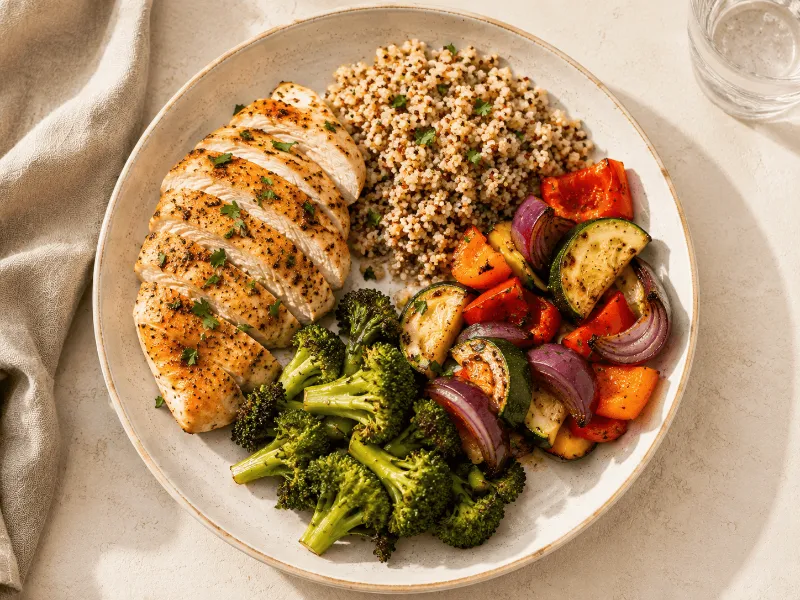
Here’s a simple day built the Full Plate way: protein first, plenty of fiber, a little healthy fat, and carbs as a side. Numbers are approximate.
| Meal | What to eat | Protein | Fiber |
|---|---|---|---|
| Breakfast | 1 cup plain Greek yogurt, berries, 1 tbsp chia seeds, 2 tbsp walnuts | about 27 g | about 8 g |
| Lunch | Big salad with 4 oz grilled chicken, ½ cup lentils, cucumber, tomato, feta, olive oil and lemon | about 45 g | about 10 g |
| Snack | 2 hard-boiled eggs, cucumber slices, 2 tbsp hummus | about 14 g | about 2 g |
| Dinner | 5 oz baked salmon, roasted vegetables, ½ cup farro, olive oil | about 38 g | about 8 g |
| Total | about 124 g | about 28 g |
Want to build meals like this from what’s already in your fridge? Try the free Full Plate Meal Builder. Pick what you have and it builds a filling plate in seconds.
Quick Fixes: Match Your Hunger to the Fix
| If you’re hungry… | Most likely cause | Try this |
|---|---|---|
| 1 to 2 hours after breakfast | Toast, fruit or oats with little protein | Add Greek yogurt, eggs or cottage cheese (25 g+) |
| Mid-afternoon | Light salad or grain bowl lunch | Add 4 oz chicken, fish or ½ cup beans plus olive oil |
| Right after dinner | Pasta-heavy plate | Half the pasta, double the vegetables, add a protein |
| Late at night | Under-eating during the day | Bigger lunch, and a planned protein snack |
| All day, every day | Too little food overall, or poor sleep | Eat 3 full meals; check your sleep |
Could It Be Something Else?
If you’re eating balanced meals with enough protein and you’re still hungry all the time, talk to your doctor. Constant hunger can be linked to things like thyroid problems, blood sugar issues, some medications, pregnancy or hormonal changes. This post is general education, not medical advice.
Free printable
Build a day that keeps you full
Get the one-page Hunger-Free Day Formula: the exact meal structure that keeps hunger from crashing back an hour later, with protein targets for every meal. It’ll land in your inbox in under a minute.
Want every meal worked out for you? The Cravings Control Reset is a 7-day high-protein Mediterranean plan with 28 meals, a grocery list and a Sunday prep plan, built so you’re not hungry between meals. It’s $27 and designed for exactly this problem.
Frequently Asked Questions
Is it normal to be hungry when starting the Mediterranean diet?
Yes, it’s common in the first week or two, usually because meals have less protein than before or because you’re eating less overall. Adding 25 to 30 grams of protein per meal helps most people noticeably.
How much protein should I eat on the Mediterranean diet?
A practical target is 25 to 30 grams per meal, which works out to roughly 75 to 120 grams a day for most adults. Fish, eggs, Greek yogurt, cottage cheese, chicken, beans and lentils all count.
Does olive oil help you feel full?
Fat slows digestion, so a tablespoon of olive oil on a meal helps it last longer. But olive oil alone isn’t very filling and it’s calorie-dense, so use it to dress protein and vegetables rather than as the main source of fullness.
What are the most filling Mediterranean foods?
Greek yogurt, eggs, fish, chicken, lentils, chickpeas, beans, cottage cheese, nuts and vegetables like roasted eggplant or zucchini. In a classic satiety study, boiled potatoes, fish and oatmeal ranked among the most filling foods tested (Holt et al., 1995). See the full Mediterranean food list for fullness.
Why am I hungry an hour after a Mediterranean breakfast?
Breakfasts like toast with olive oil, fruit or plain oats are mostly carbs. Add a protein like Greek yogurt or eggs and a fiber source like chia or berries. More ideas in breakfasts that keep you full.
Can I lose weight on the Mediterranean diet without being hungry?
Many people find it easier because high-fiber, high-protein meals are filling. Results vary from person to person, so focus on meals that keep you satisfied and talk to your doctor or a dietitian about weight goals.
How this was researched: the advice here is based on peer-reviewed studies on protein and satiety (Leidy 2015), ultra-processed food and intake (Hall 2019), hunger hormones after weight loss (Sumithran 2011), sleep and appetite (Spiegel 2004) and the satiety index (Holt 1995), plus nutrition values from USDA FoodData Central. Last updated: October 1, 2026.
Related: Why am I always hungry even though I eat a lot? · Hungry 1 hour after eating? · Mediterranean vs keto for hunger