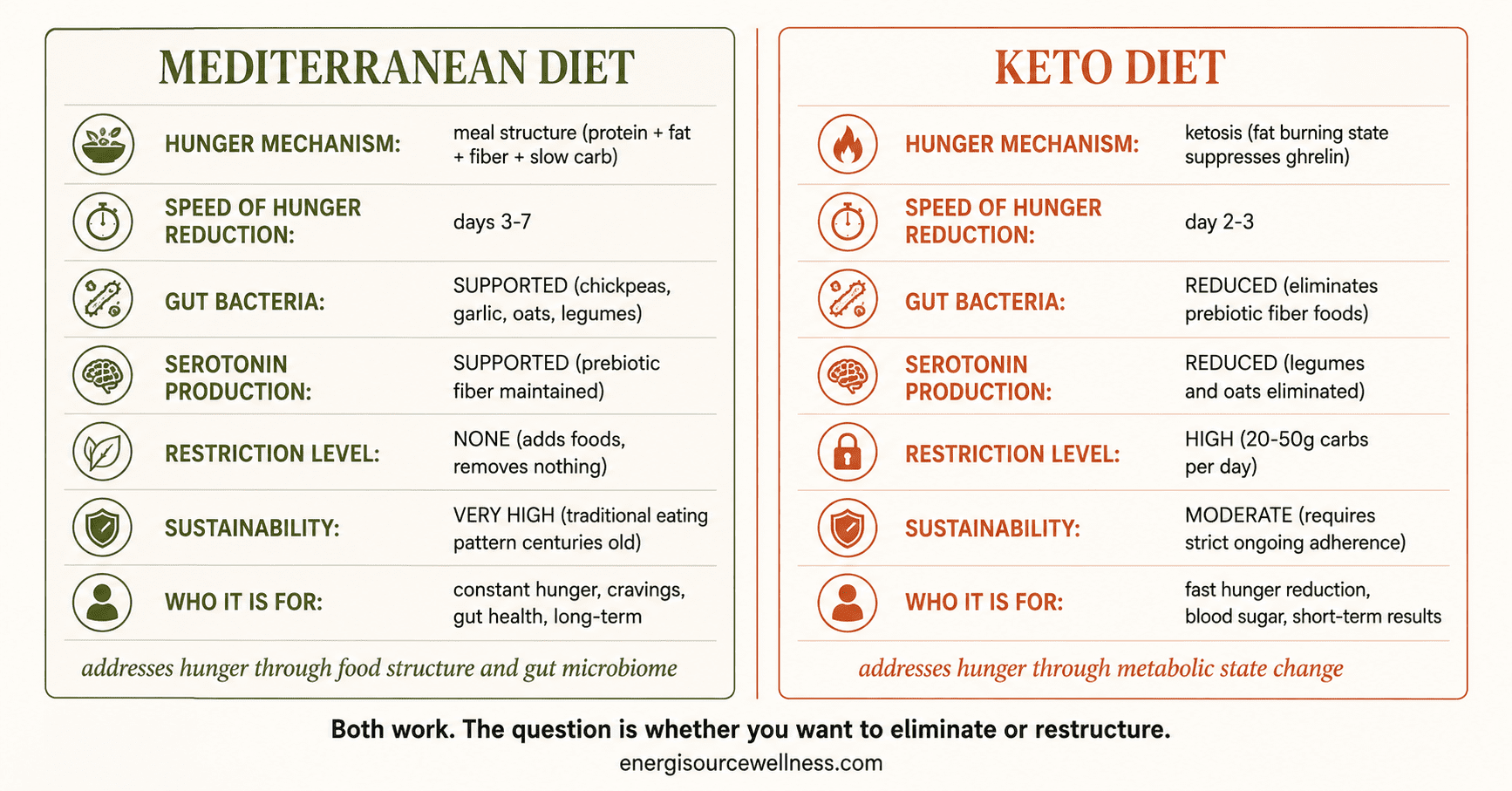
For hunger control specifically, the Mediterranean diet outperforms keto in the long term because it keeps the prebiotic fiber foods (legumes, garlic, onions, oats) that regulate hunger hormones through the gut microbiome, while keto eliminates them. Keto suppresses hunger effectively in the short term through ketosis and produces measurable ghrelin reduction. But it achieves this by eliminating chickpeas, lentils, oats, and most fruits, the exact foods that regulate serotonin production, gut bacteria diversity, and the long-term hunger hormone environment. The Mediterranean approach addresses hunger through meal structure and gut microbiome support without any elimination. For someone whose primary goal is stopping constant hunger and cravings without restriction, the mechanisms favor Mediterranean.
I want to be honest about what this comparison is and is not. It is not a comprehensive health comparison of keto vs Mediterranean. Both approaches have legitimate research behind them for multiple health outcomes. This comparison is specifically about hunger control and craving management, which is what most people reading this site are actually trying to address.
Already on the Mediterranean diet and still hungry? Here are 7 reasons you’re always hungry on the Mediterranean diet and how to fix them.
I tried a version of keto for about three weeks before landing on the Mediterranean framework. The hunger reduction was real and fast. By day 3 in ketosis the afternoon craving had largely disappeared. What I noticed by week 2 was that I was avoiding chickpeas, lentils, oats, and most fruit, the exact foods I had been reading about as the primary drivers of long-term hunger hormone regulation and gut bacteria diversity. The approach that was suppressing my hunger fastest was also eliminating the foods I understood to be most important for sustainable hunger management.
The Mediterranean framework gave me comparable hunger reduction without that trade-off. The mechanism is slower to establish (days 3 to 7 vs day 3 for keto) but it works through the gut bacteria and hormone system rather than through the metabolic state of ketosis, which means it sustains without the dietary restriction that keto requires.
This is a comparison between two legitimate approaches written from personal experience with both and research on both. For the full Mediterranean food list that drives the hunger control mechanism, the Mediterranean diet food list for hunger and fullness gives you the complete breakdown.
How each approach suppresses hunger
Understanding the mechanism behind each approach clarifies why the hunger reduction works, how fast it works, and how sustainable it is over time.
How keto suppresses hunger
Keto reduces hunger primarily through two mechanisms. First, restricting carbohydrates to 20 to 50 grams per day forces the body into ketosis, a metabolic state where fat is burned for fuel instead of glucose. Ketone bodies produced in ketosis have a direct appetite-suppressing effect on the hypothalamus, reducing ghrelin output and increasing cholecystokinin production. This is why keto dieters consistently report significant hunger reduction within the first 2 to 3 days of achieving ketosis. The hunger reduction is real, measurable, and often dramatic.
Second, the high fat content of the keto diet slows gastric emptying significantly. When 70 to 75 percent of calories come from fat, the stomach empties much more slowly than it does on a mixed macronutrient diet, extending the satiety window from any given meal. The combination of ketosis-related appetite changes and fat-driven gastric emptying delay produces the genuine and consistent hunger reduction that makes keto attractive for people who have struggled with constant hunger on other approaches.
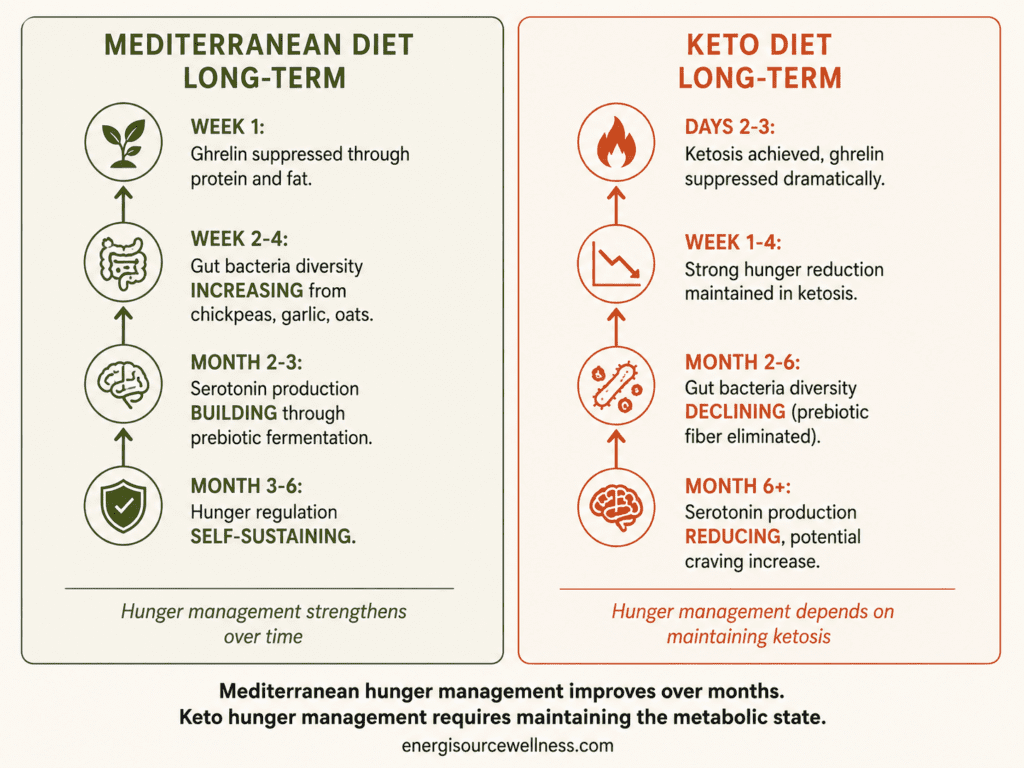
The limitation for long-term hunger management is that keto eliminates chickpeas, lentils, oats, most fruits, and starchy vegetables, the primary prebiotic fiber sources that feed the gut bacteria responsible for serotonin production and long-term hunger hormone regulation. In the short term this does not matter because ketosis is providing a more powerful hunger suppression mechanism. Over months of strict keto eating, gut bacteria diversity tends to decline from the reduction in prebiotic fiber, which can gradually increase craving intensity and hunger signal frequency even while remaining in ketosis.
How Mediterranean suppresses hunger
The Mediterranean approach suppresses hunger through the four-element meal formula: protein above 20 grams helps lower ghrelin, your main hunger hormone, healthy fat from olive oil and avocado slows gastric emptying through cholecystokinin, prebiotic fiber from chickpeas and lentils feeds gut bacteria that produce the short-chain fatty acids signaling fullness to the brain, and slow carbohydrates from quinoa and sweet potato stabilize blood sugar and prevent the false hunger signals from the spike-and-crash cycle. All four mechanisms operate simultaneously at each meal.
The initial hunger reduction on Mediterranean is slightly slower than keto because it works through meal structure and gut bacteria changes rather than through the metabolic state of ketosis. Most people notice meaningful craving reduction between days 3 and 7. By week 2 the hunger and craving pattern is consistently different. The gut bacteria changes that produce the most significant long-term hunger regulation take 2 to 4 weeks to establish.
The advantage over time is that the Mediterranean approach maintains and builds the gut bacteria diversity that makes hunger regulation more robust and self-sustaining. The prebiotic fiber from legumes, garlic, and oats feeds the bacteria that produce serotonin (which reduces sweet cravings), short-chain fatty acids (which signal satiety). These mechanisms strengthen over months of consistent Mediterranean eating rather than depending on maintaining a specific metabolic state.
The gut bacteria difference: the most important comparison most articles miss
Most keto vs Mediterranean comparisons focus on macronutrients, weight loss speed, and cardiovascular markers. The gut bacteria difference is the most important comparison for hunger control specifically and it is the one almost never discussed.
The foods that keto eliminates are largely the foods that feed beneficial gut bacteria most effectively. Chickpeas and lentils provide resistant starch and inulin. Oats provide beta-glucan. Garlic and onions provide fructooligosaccharides. Green bananas and apples provide pectin. All of these are the primary prebiotic fiber sources that feed the Bifidobacterium and Lactobacillus species responsible for serotonin production, short-chain fatty acid generation, and ghrelin regulation.
Research on the gut microbiome effects of ketogenic diets consistently shows that gut bacteria diversity decreases on strict keto because of the significant reduction in fermentable prebiotic fiber. This reduction in diversity is associated over time with reduced short-chain fatty acid production, lower gut-based serotonin output, and less efficient hunger hormone regulation. For people doing keto for 30 to 90 days this rarely becomes a significant issue. For people following strict keto for 6 to 12 months, the gut bacteria effects begin to compound and can produce increased craving intensity and hunger frequency even while ketosis is maintained.
The Mediterranean approach maintains and builds gut bacteria diversity simultaneously with the direct hunger suppression from protein and fat. This is why the Mediterranean approach tends to produce hunger management that feels increasingly effortless over time as the microbiome adapts, while keto hunger management tends to require sustained dietary adherence to maintain because it depends on the metabolic state of ketosis rather than on gut bacteria diversity.
>> Want the Mediterranean meal structure that addresses hunger without elimination?
The Full Plate Method app builds Mediterranean meals with the four-element formula that keeps most people full for 3 to 5 hours without restricting any food category. Free forever. Build hunger-controlling meals free
Head to head comparison: 8 hunger and craving factors
Factor 1: Speed of initial hunger reduction
Keto wins. Some studies link ketosis with lower appetite, though results vary between people. The hunger reduction on keto is often dramatic and immediate, making it the more compelling short-term choice for people who want fast results. Mediterranean produces initial hunger improvements between days 3 and 7, slightly slower because the mechanism works through meal structure and early gut bacteria shifts rather than through a metabolic state change.
Winner for speed: Keto
Factor 2: Sustainability of hunger reduction over 6 to 12 months
Mediterranean wins. Keto requires strict ongoing adherence to carbohydrate limits to maintain ketosis. When carbohydrate intake exceeds the threshold, ketosis breaks and the ketosis-driven hunger suppression stops. The Mediterranean approach builds gut bacteria diversity over time that makes hunger regulation increasingly self-sustaining and resilient to occasional dietary variation. Most people find Mediterranean eating easier to maintain indefinitely because it restricts nothing and works through food addition rather than food elimination.
Winner for sustainability: Mediterranean
Factor 3: Craving reduction for sweet and carbohydrate cravings
Split decision. Keto reduces sweet cravings through ketosis and the elimination of the blood sugar spike-and-crash cycle that drives many carbohydrate cravings. Mediterranean reduces sweet cravings through the serotonin production from gut bacteria fed by prebiotic fiber. Both approaches effectively reduce sweet cravings but through different mechanisms. Keto does it faster. Mediterranean does it more durably and without requiring elimination of any food category.
Winner for craving reduction: Tie (keto faster, Mediterranean more durable)
Factor 4: Blood sugar stability
Both approaches significantly improve blood sugar stability compared to a standard Western diet. Keto produces more dramatic blood sugar stabilization because carbohydrate restriction greatly reduces the blood sugar spikes that can drive hunger. Mediterranean stabilizes blood sugar through the protein-fat-fiber-slow carb formula that prevents spikes without eliminating carbohydrates. For people with significant insulin resistance or blood sugar instability, keto may produce faster initial blood sugar improvement. For people with normal blood sugar seeking to prevent the spike-and-crash hunger cycle, Mediterranean provides sufficient stabilization.
Winner for blood sugar: Keto (short-term), Mediterranean (long-term sustainability)
Factor 5: Gut health and microbiome diversity
Mediterranean wins clearly. The prebiotic fiber foods that drive gut microbiome diversity (chickpeas, lentils, oats, garlic, onions, green bananas) are the exact foods eliminated on keto. A systematic review of ketogenic diet studies found it consistently reduces gut bacteria diversity, at least in the shorter term some research suggests this may partially recover the longer someone stays on the diet. Mediterranean eating specifically builds gut microbiome diversity through its emphasis on legumes, whole grains, garlic, and onions as daily staples. This gut health difference is the most significant long-term hunger management advantage of the Mediterranean approach.
Winner for gut health: Mediterranean
Factor 6: Serotonin and mood stability
Mediterranean wins. Approximately 90 to 95 percent of serotonin is produced in the gut through prebiotic fiber fermentation. By eliminating the prebiotic fiber foods that drive gut-based serotonin production, keto reduces the gut’s serotonin output over time. This can manifest as increased evening sweet cravings, mood instability, and sleep disruption, particularly after several months of strict keto adherence. Mediterranean maintains and builds gut-based serotonin production through consistent prebiotic fiber intake.
Winner for serotonin: Mediterranean
Factor 7: Food variety and practical sustainability
Mediterranean wins substantially. Keto eliminates most fruits, all grains, most legumes, and starchy vegetables. The daily food choices on strict keto are significantly narrower than on Mediterranean. Mediterranean adds foods to an existing eating pattern rather than removing them, making it substantially easier to implement across different food environments, social eating situations, and budget constraints. The practical friction of maintaining keto in a world where most social and food service environments are not keto-compatible is one of the most consistent reasons people discontinue the approach.
Winner for practical sustainability: Mediterranean
Factor 8: Cost
Mediterranean wins on typical implementation. Keto as commonly practiced emphasizes high quality meats, specialty low-carb products, and significant fat sources which can be expensive. Mediterranean as traditionally practiced is built around eggs, canned fish, dried legumes, seasonal vegetables, oats, and olive oil, which are among the most affordable foods available. The Mediterranean approach is particularly accessible on a budget because its most powerful hunger-controlling foods (chickpeas, lentils, eggs, oats) are also its most affordable ingredients.
Winner for cost: Mediterranean
Who should choose keto over Mediterranean
Keto is the more appropriate choice for specific situations where its mechanisms provide unique advantages.
• People with significant insulin resistance or type 2 diabetes who need rapid blood sugar improvement under medical supervision
• People who have tried Mediterranean eating for 4 to 6 weeks without meaningful hunger improvement and need a more aggressive hunger suppression mechanism
• People doing a short-term (4 to 8 week) intervention before transitioning to a more sustainable long-term approach
• People with epilepsy or other specific medical conditions where ketosis is therapeutically indicated
• People who genuinely do not enjoy legumes, oats, or most fruits and would find Mediterranean eating difficult to maintain
Keto is not the better choice for someone who wants to eat chickpeas, enjoy fruit occasionally, and build a sustainable long-term hunger management approach without tracking macros or maintaining a specific metabolic state.
Who should choose Mediterranean over keto
Mediterranean is the more appropriate choice for the vast majority of people whose primary goal is sustainable hunger control and craving reduction.
- People who want to stop constant hunger and cravings without eliminating any food category
- People who want the hunger management to improve over time rather than requiring maintenance of a specific metabolic state
- People who want to build gut health alongside hunger control rather than trading one for the other
- People who eat in social situations, restaurants, or travel regularly where strict carbohydrate counting is impractical
- People on a budget who need the most affordable hunger management approach available
- People who want a way of eating they can maintain for years rather than months
The Mediterranean approach is specifically designed for the person described by this site: always hungry, struggling with cravings, wanting to eat real food without restriction, and wanting the hunger management to become more automatic over time rather than more demanding.
The honest answer to the comparison
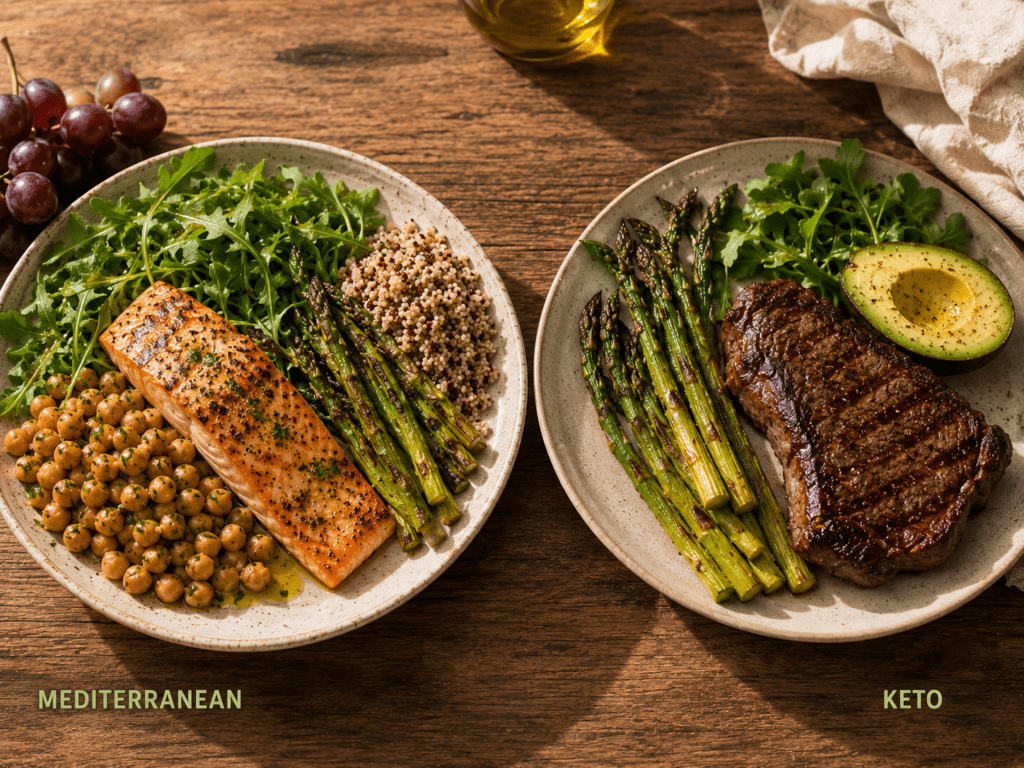
Keto produces faster hunger reduction and more dramatic short-term results. Mediterranean produces more durable, self-sustaining hunger regulation that improves over months without restriction. Both are legitimate approaches with research behind them. The choice depends on what trade-offs you are willing to make.
If you are willing to eliminate chickpeas, lentils, oats, most fruits, and most starchy vegetables indefinitely to maintain ketosis and its hunger suppression mechanism, keto works well for hunger control. If you want to build a way of eating that adds foods rather than removes them and produces hunger management that strengthens over time through gut bacteria diversity, Mediterranean is the better long-term fit for hunger control specifically.
My personal conclusion after trying both is that the Mediterranean approach produced the same subjective experience of not thinking about food between meals that keto produced, but through a mechanism that felt sustainable indefinitely rather than dependent on avoiding a banana. The trade-off in speed of initial hunger reduction (a few days slower than keto) was worth the elimination of the restriction that keto requires.
Frequently asked questions
Which is better for hunger control, keto or Mediterranean?
For initial hunger reduction, keto produces faster results because ketosis is linked to lower appetite early on. For long-term sustainable hunger control without restriction, Mediterranean produces more durable results because it maintains and builds the gut bacteria diversity that regulates hunger hormones over time. The best choice depends on whether you prioritize speed of initial results (keto) or long-term sustainability without food elimination (Mediterranean).
Can you do Mediterranean and keto at the same time?
A Mediterranean-keto hybrid is possible and involves keeping Mediterranean food quality standards (olive oil, fatty fish, vegetables, avocado, nuts) while reducing carbohydrates significantly by eliminating or severely limiting legumes, grains, and most fruit. This approach achieves the blood sugar and ketosis benefits of keto alongside the food quality benefits of Mediterranean. The trade-off is that eliminating legumes and oats removes the primary prebiotic fiber sources that drive Mediterranean eating’s gut bacteria and long-term hunger hormone benefits.
Is Mediterranean diet good for blood sugar like keto?
Yes, though through a different mechanism and with different speed. Keto produces more dramatic initial blood sugar improvement because carbohydrate restriction greatly reduces blood sugar spikes. Mediterranean stabilizes blood sugar through the protein-fat-fiber-slow carb formula that prevents spikes without eliminating carbohydrates. For most people without significant insulin resistance, Mediterranean provides sufficient blood sugar stabilization to stop the spike-and-crash hunger cycle. For people with significant insulin resistance or type 2 diabetes, keto may produce faster initial improvement under medical supervision.
Why does keto reduce hunger so quickly?
Keto reduces hunger quickly because ketone bodies produced in ketosis have a direct appetite-suppressing effect on the hypothalamus, reducing ghrelin output. The high fat content of keto also slows gastric emptying significantly. These two mechanisms together produce the dramatic hunger reduction most keto dieters experience within the first 2 to 3 days of achieving ketosis. The hunger reduction is real and is one of the most compelling aspects of the keto approach for people who have struggled with constant hunger on other dietary patterns.
Does Mediterranean diet reduce cravings as well as keto?
Mediterranean reduces cravings through a different mechanism than keto but produces comparable craving reduction with 1 to 2 weeks of consistent application. Keto reduces cravings by eliminating the blood sugar fluctuations and carbohydrate availability that drive many food cravings. Mediterranean reduces cravings by building the gut bacteria diversity that produces serotonin (which reduces sweet cravings), stabilizing blood sugar through meal structure, and providing the prebiotic fiber that regulates the gut-brain craving signaling pathway. Most people following Mediterranean eating consistently report that cravings become manageable rather than urgent within a few weeks and continue to improve over subsequent months.

Free printable
Hungry again at 9pm?
Get the free printable Night Hunger Snack List: 10 Mediterranean snacks with exact portions and protein counts, for the evenings when cravings hit. Enter your email and download it instantly.
Free. No spam. Unsubscribe anytime.
The bottom line
Mediterranean diet vs keto for hunger control is not a question with a single answer that applies to everyone. Keto is the faster hunger reduction approach, with ketosis linked to lower appetite early on for many people. Mediterranean is the more durable hunger regulation approach, building gut bacteria diversity and hormone self-regulation that strengthens over months without requiring food elimination. For most people whose primary goal is stopping constant hunger and cravings sustainably without tracking macros, avoiding social eating situations, or eliminating legumes and fruits, the Mediterranean approach is the better long-term fit. For people who need fast initial results and are willing to maintain strict carbohydrate limits indefinitely, keto is a legitimate choice for hunger control. For ongoing Mediterranean meal planning, Eat This Much generates customized Mediterranean meal plans with grocery lists automatically, removing the planning friction that is the most common barrier to maintaining any dietary approach long-term.
The keto vs Mediterranean decision for me came down to one question: do I want to build something or maintain something? Keto requires maintaining a metabolic state. Mediterranean builds a gut bacteria and meal structure environment that becomes more self-sustaining over time. Both work for hunger control. I chose the one that felt like it was working with my biology rather than circumventing it.
Ribert
>> Want to start Mediterranean eating today?
The Full Plate Method app builds Mediterranean meals with the four-element formula that keeps most people full for 3 to 5 hours without any food elimination. Free forever. Start building Mediterranean meals free
This article shares personal experience and general nutrition information, not medical advice. If you have diabetes, insulin resistance, or other metabolic health conditions, speak with your healthcare provider before making significant dietary changes.
About Ribert Rodriguez
Ribert is the founder of EnergiSource Wellness. He built this site to share what actually worked for him after years of struggling with cravings, late-night eating, and low energy. His approach is rooted in the Mediterranean framework and a belief that food is one of the most powerful tools for how you think and feel.