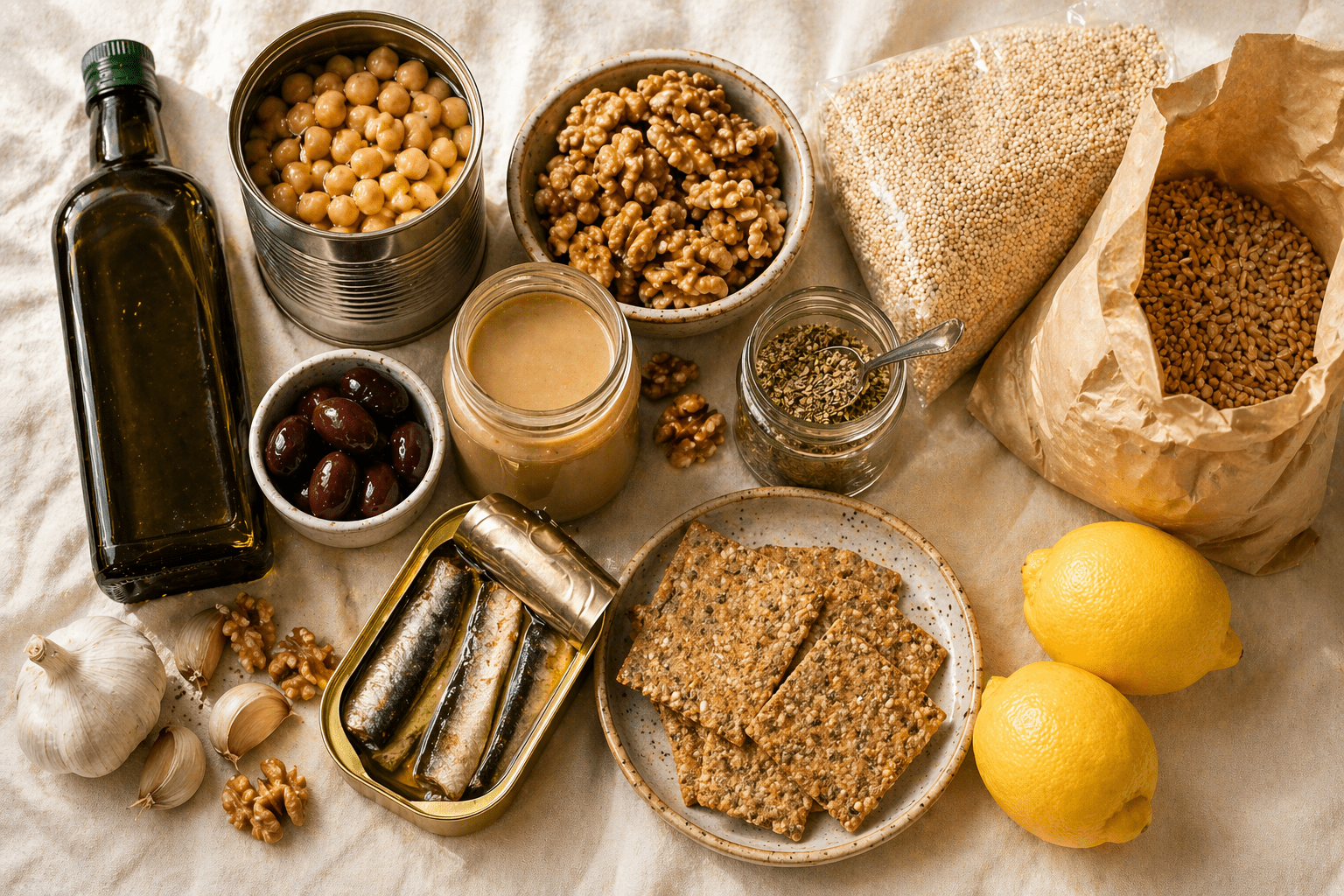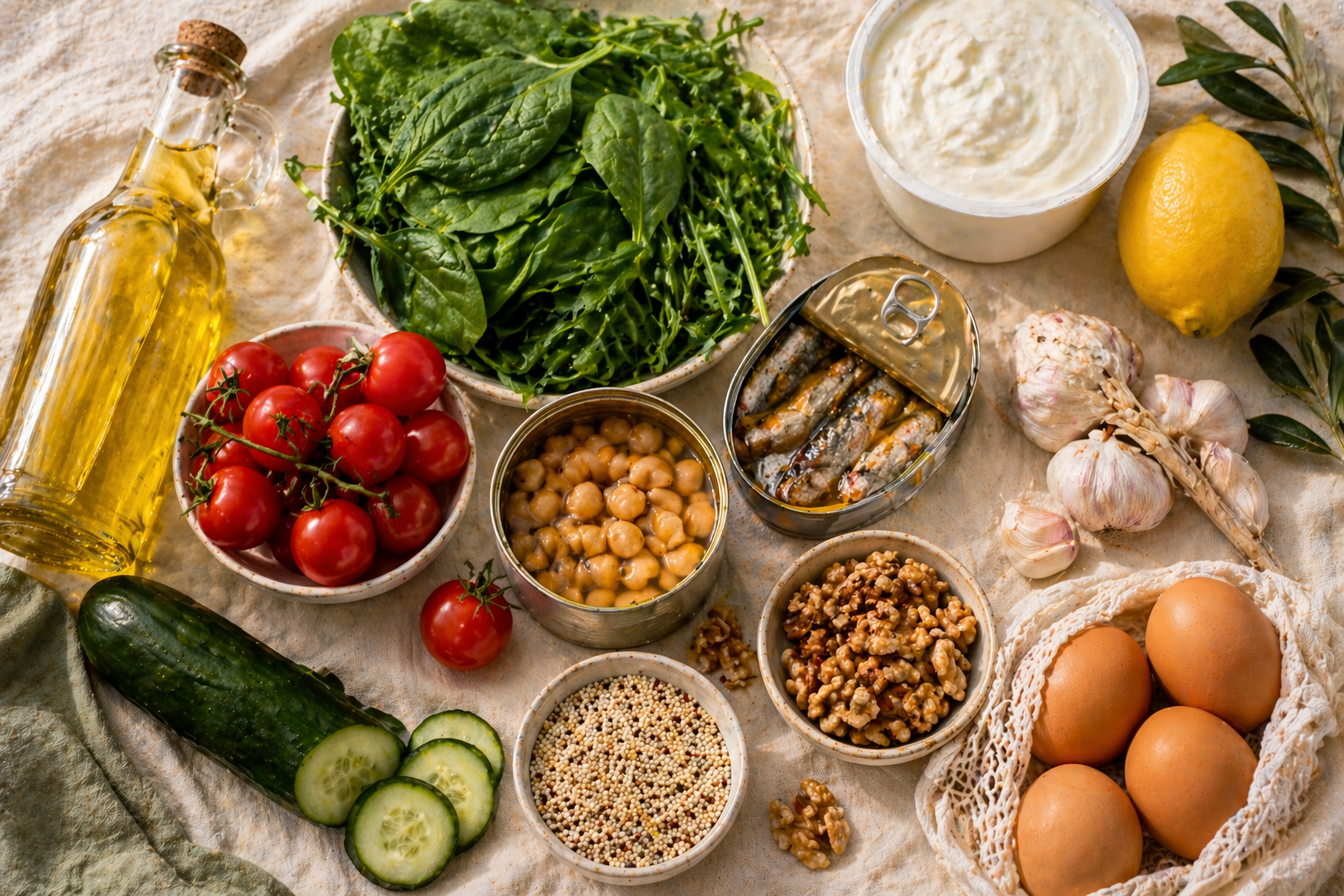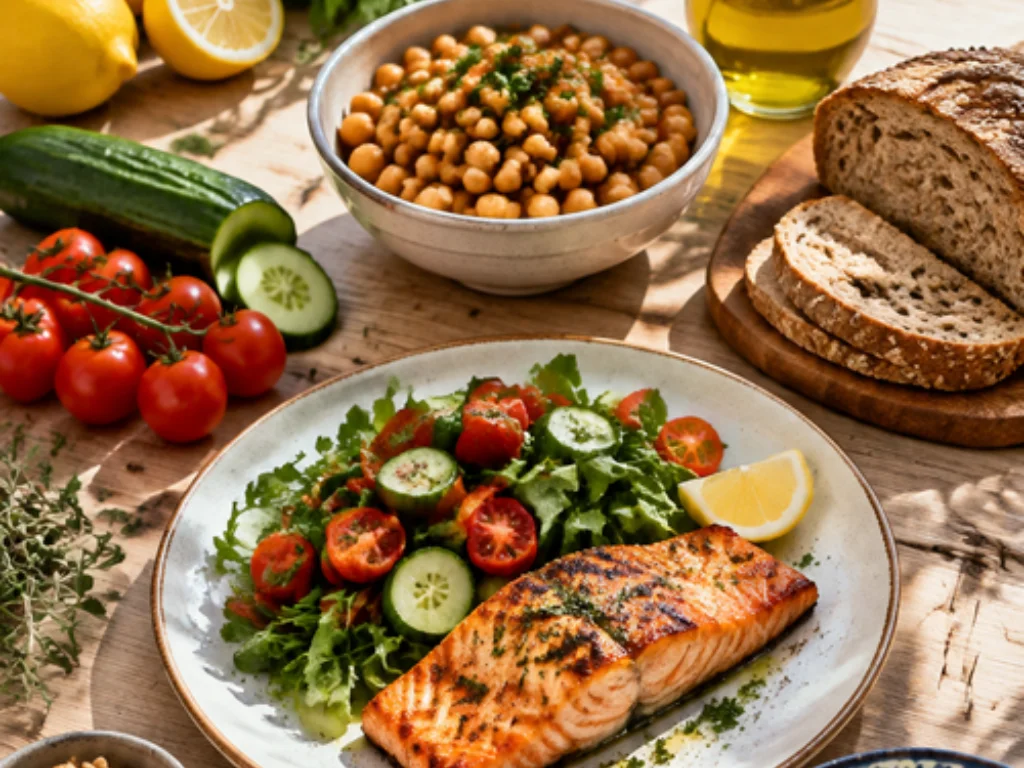
Quick answer: The Mediterranean diet is a way of eating built around vegetables, beans, whole grains, fruit, nuts, olive oil and fish, with moderate dairy, eggs and poultry and very little processed food. To start, change one meal at a time: cook with olive oil, add a vegetable and a protein to every plate, and swap refined snacks for fruit, nuts or yogurt. The 7-day plan below shows what a full week can look like.
Get the free $50 grocery list ↓
Key Takeaways
- The Mediterranean diet is a pattern, not a rulebook. Nothing is banned and there is nothing to count.
- Most beginners go wrong in one place: they eat lots of vegetables and olive oil but too little protein, and end up hungry.
- Build every plate the same way: a protein, a fiber-rich food, a healthy fat, and a smart carb.
- You do not need specialty ingredients. Canned beans, canned fish, frozen vegetables, eggs and oats cover most of it.
- Start with one meal. Breakfast is the easiest to change and the one most people feel first.
Most guides to the Mediterranean diet hand you a food pyramid and a list of things to eat more of. That part is easy to find. What I rarely see explained is why so many people start it, eat well for a week, and quit because they are hungry all the time.
I am not a doctor or a dietitian. I am someone who got curious about why some meals hold you for hours and others do not, and this guide is how I would explain the Mediterranean diet to a friend starting from zero. It covers what the diet is, what to buy, how to build a plate that keeps you full, and a simple first week.
What Is the Mediterranean Diet?
The Mediterranean diet is an eating pattern based on the traditional food of countries around the Mediterranean Sea, such as Greece, southern Italy and Spain. It centers on plants, olive oil and fish, and treats red meat and sweets as occasional foods.
It is not a branded program, so there is no official version. In practice it looks like this:
| How often | Foods |
|---|---|
| Every day | Vegetables, fruit, whole grains, beans and lentils, nuts and seeds, extra virgin olive oil, herbs and spices |
| A few times a week | Fish and seafood, eggs, poultry, yogurt and cheese |
| Now and then | Red meat, sweets, pastries |
| Rarely | Sugary drinks, processed meats, heavily processed snacks |
Is the Mediterranean Diet Actually Good for You?
The research behind it is stronger than for most ways of eating, especially for heart health. That is the main reason it keeps getting recommended.
The best-known trial is PREDIMED, which followed about 7,400 adults in Spain who were at high risk of heart disease. Those assigned to a Mediterranean diet with extra virgin olive oil or nuts had roughly 30% fewer major cardiovascular events over about five years than those advised to follow a lower-fat diet (Estruch et al., New England Journal of Medicine, 2018).
A caution worth keeping in mind: that study was in older adults at high risk, and it measured heart events. It does not prove the diet will do any particular thing for you. If you have a medical condition, ask your doctor before changing how you eat.
Why Do Beginners Feel Hungry on the Mediterranean Diet?
Usually because the plate is missing protein. A big salad with olive oil, or pasta with vegetables, is Mediterranean, but it digests quickly and can leave you looking for a snack an hour later.
This is the most common reason people give up, and it is fixable. Keep the vegetables and olive oil and add a clear protein to the meal: eggs, Greek yogurt, fish, chicken, lentils or beans. I go into this in detail in why you are always hungry on the Mediterranean diet.
How Do You Build a Mediterranean Plate That Keeps You Full?
Put four things on it: a protein, a fiber-rich food, a healthy fat and a smart carb. I call this the Full Plate Method, and it works for any meal.
| Part of the plate | What it does | Easy Mediterranean choices |
|---|---|---|
| Protein | Slows digestion and keeps you full longest | Eggs, Greek yogurt, cottage cheese, fish, canned tuna or sardines, chicken, lentils |
| Fiber | Adds volume and slows the meal down | Leafy greens, tomatoes, peppers, broccoli, beans, chickpeas, berries |
| Healthy fat | Makes the meal satisfying | Extra virgin olive oil, olives, nuts, seeds, avocado |
| Smart carb | Gives steady energy | Oats, whole grain bread, brown rice, quinoa, potatoes, fruit |
Want to know how much protein to aim for? This calculator gives you a daily range and a per-meal target:
Free tool
How Much Protein Do You Need to Stay Full?
Enter your weight and pick what fits you best. You’ll get a daily target, how to split it across meals, and a sample Mediterranean day that hits it.
Enter your weight to see your target.
Want this planned for you?
The 7-Day Mediterranean Meal Plan gives you 28 meals and snacks built around protein, fiber, and healthy fat, plus the grocery list.
Prefer to start free? Get the free high-protein snack list
Estimates for healthy adults, based on common dietitian ranges (about 1.0 to 1.6 g per kg of body weight, higher for active people). If you’re in a larger body, entering a goal or reference weight gives a more realistic number. If you have kidney disease, are pregnant, or take GLP-1 medication, check your target with your doctor or dietitian. This is general information, not medical advice.
What Should You Buy First?
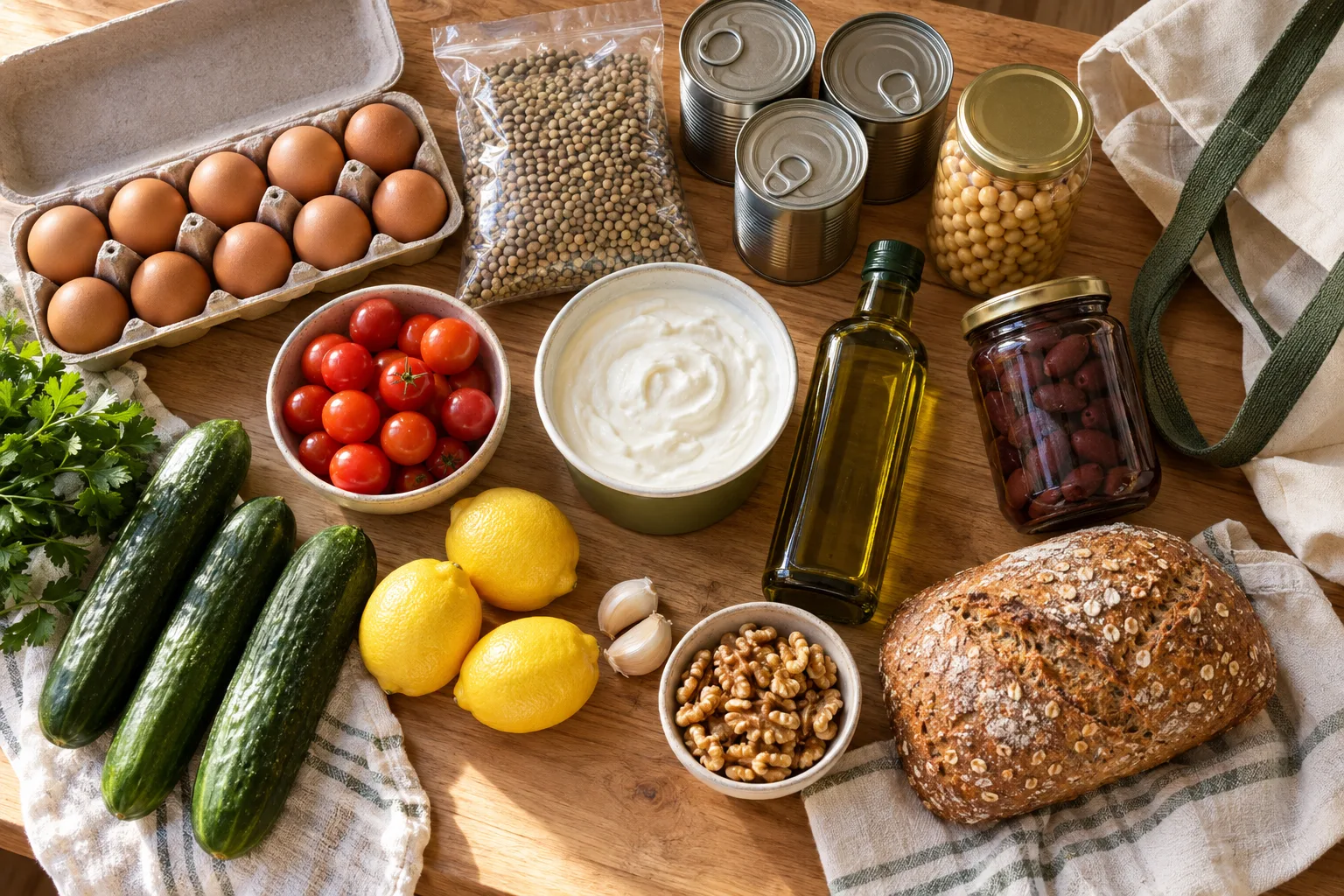
Start with a short list of foods that keep well and work in many meals. You do not need to replace your whole kitchen in one trip.
- Proteins: eggs, plain Greek yogurt, canned tuna or sardines, chicken thighs, dried or canned lentils and chickpeas
- Vegetables and fruit: tomatoes, cucumbers, spinach, onions, frozen broccoli or mixed vegetables, lemons, apples, berries (frozen is fine)
- Grains and starches: rolled oats, whole grain bread, brown rice or quinoa, potatoes
- Fats and flavor: extra virgin olive oil, olives, walnuts or almonds, feta, garlic, dried oregano
For the longer version, see the Mediterranean diet grocery list and pantry essentials. If cost is the worry, here is how to do it on a budget.
Free printable
Get the $50 grocery list
The full checklist with prices, plus a 7-day meal map that turns this one shopping trip into a week of meals. Print it or keep it on your phone at the store.
Free. No spam. Unsubscribe anytime.
What Does a Week on the Mediterranean Diet Look Like?
Here is a simple first week. Every meal has a protein, and dinners are built so the leftovers become the next day’s lunch. Swap any day for another, and repeat breakfasts as often as you like.
| Day | Breakfast | Lunch | Dinner |
|---|---|---|---|
| Mon | Greek yogurt with berries, walnuts and oats | Chickpea salad with tuna, cucumber, tomato and feta | Lemon chicken thighs with roasted vegetables and potatoes |
| Tue | Scrambled eggs with spinach on whole grain toast | Leftover lemon chicken over greens with olive oil and lemon | Lentil soup with whole grain bread |
| Wed | Greek yogurt with berries, walnuts and oats | Leftover lentil soup with a boiled egg | Baked salmon with brown rice and broccoli |
| Thu | Overnight oats made with Greek yogurt | Salmon and rice bowl with cucumber and olives | Whole grain pasta with white beans, tomatoes and spinach |
| Fri | Scrambled eggs with tomatoes and feta | Hummus plate with boiled eggs, vegetables and pita | Chicken and vegetable sheet pan with chickpeas |
| Sat | Cottage cheese with fruit and nuts | Leftover sheet pan chicken in a wrap | Shrimp or white fish with potatoes and a tomato salad |
| Sun | Vegetable omelet with whole grain toast | Greek salad with canned sardines or tuna | Bean and vegetable stew, then prep for the week |
As a rough guide, a day like Monday gives you about 22g of protein at breakfast, 30g at lunch and 32g at dinner. Those are estimates and depend on your portions.
If you would rather cook a few things on Sunday and assemble meals during the week, this guide to Mediterranean meal prep shows how.
Want the week planned for you?
7-Day High-Protein Mediterranean Meal Plan
Seven days laid out for you: 28 meals and snacks with approximate protein for each, a tip for every day, and one grocery list that covers the whole week. Real food, no calorie counting.
Get the Meal Plan for $17How Do You Start Without Changing Everything at Once?
Change one meal a week. People who try to switch every meal on day one tend to be back to their old routine by the weekend.
- Week 1, breakfast: replace cereal or a pastry with eggs, or Greek yogurt with fruit and nuts.
- Week 2, lunch: add a protein to whatever you already eat. Tuna, chicken, beans or a boiled egg on your usual salad or sandwich.
- Week 3, dinner: cook with olive oil, fill half the plate with vegetables, and have fish once or twice.
- Week 4, snacks: keep fruit, nuts and yogurt where the chips used to be.
What Mistakes Do Beginners Make?
- Too little protein. This is the big one. Vegetables and olive oil alone will not hold you.
- Treating it as all-you-can-eat pasta and bread. Grains are part of it, but they share the plate.
- Pouring olive oil freely. It is healthy and also dense in calories. A tablespoon or two per meal is plenty.
- Buying expensive specialty products. Beans, eggs, oats and frozen vegetables do the job.
- Expecting it to feel like a diet. It is slower and less dramatic than that, which is why people can keep it up.
Frequently Asked Questions
Can you lose weight on the Mediterranean diet?
Some people do, but it is not designed as a weight-loss diet and results vary. It tends to help because meals built on protein, fiber and healthy fat are filling, which makes it easier to eat less without feeling deprived. If weight loss is a medical goal, work with your doctor.
Can you eat bread and pasta on the Mediterranean diet?
Yes. Whole grain bread and pasta are part of the traditional pattern. The difference is portion and company: they share the plate with vegetables, beans and a protein instead of being the whole meal.
Do you have to eat fish?
No. Fish is traditional, but you can get protein from eggs, yogurt, poultry, beans and lentils. If you do eat fish, canned tuna, salmon and sardines are affordable ways to include it.
Is the Mediterranean diet expensive?
It does not have to be. Dried beans, lentils, oats, eggs, canned fish and frozen vegetables are some of the cheapest foods in the store, and they cover most of what the diet asks for.
How long does it take to get used to it?
Most people settle into it over a few weeks when they change one meal at a time. Trying to change everything at once is usually what makes it hard to stick with.
Why am I still hungry on the Mediterranean diet?
Most often because meals are short on protein. Add eggs, yogurt, fish, chicken or beans to each meal and keep the fiber and olive oil. Hunger that continues despite balanced meals is worth mentioning to your doctor.
How this was researched: the description of the eating pattern follows the traditional Mediterranean diet as used in the PREDIMED trial (Estruch et al., NEJM 2018). Protein figures are estimates based on typical portions. This is general nutrition education, not medical advice. Last updated: October 15, 2026.