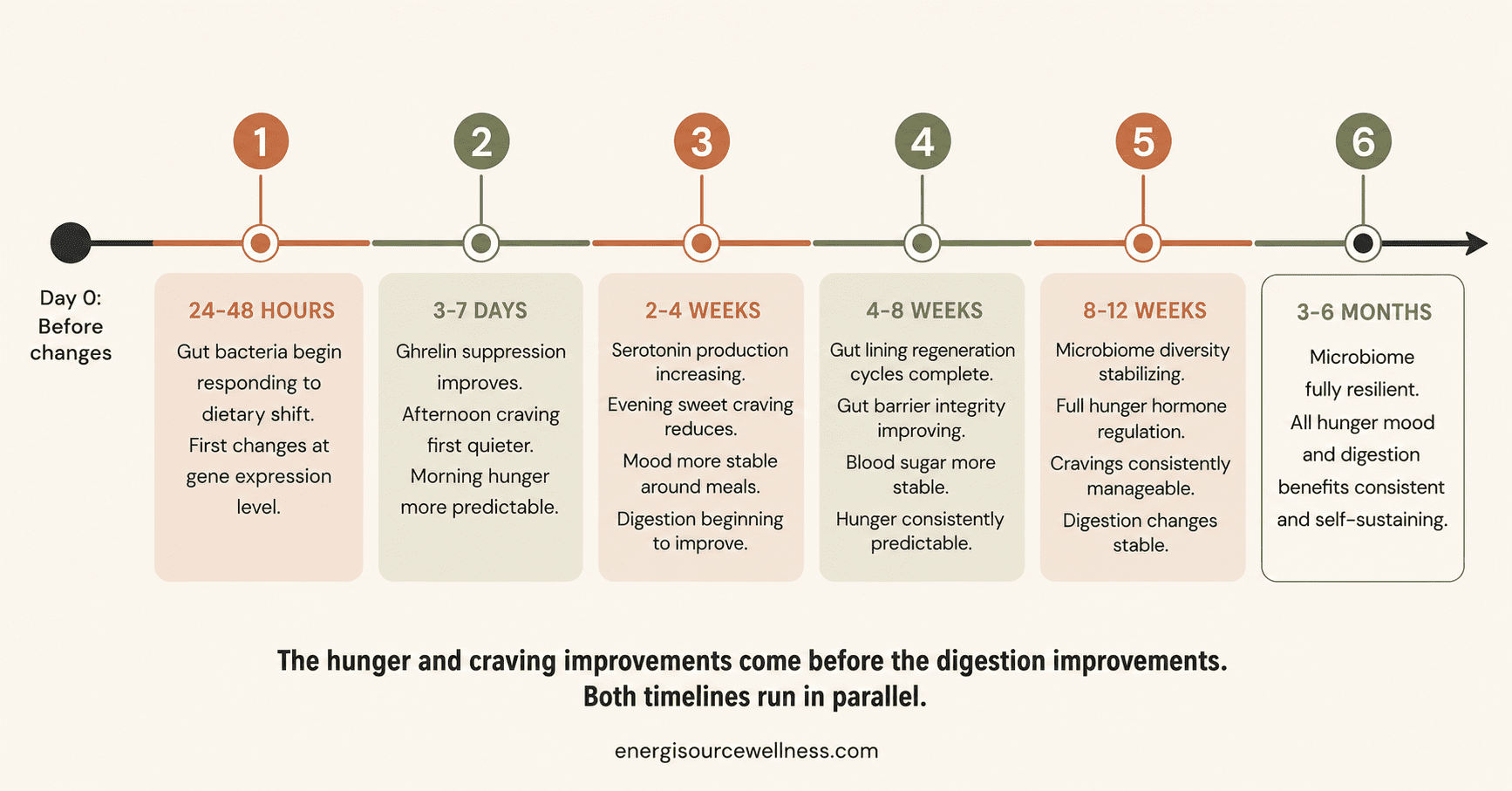
Gut bacteria composition begins shifting within 24 to 48 hours of consistent dietary change. Some people notice changes in hunger and cravings within the first week or two of adding daily probiotic and prebiotic foods. Meaningful mood stabilization and reduced craving intensity typically arrive between weeks 2 and 4. Full gut microbiome stabilization with consistent hunger regulation and minimal cravings takes 8 to 12 weeks of sustained Mediterranean eating. The timeline for the hunger and craving changes is faster than most gut health articles describe because those articles are written for the digestion and bloating timeline, not for the hunger hormone and serotonin timeline, which responds more quickly.
When I started paying attention to my gut health I expected the changes to take months. What I noticed was that the afternoon craving was quieter by day 4. Not gone. But noticeably less urgent than it had been. The morning hunger was more predictable by the end of the first week. The evening sweet pull after dinner started to ease by week 2.
The digestive changes, the reduction in bloating and improved regularity, took longer. About 3 to 4 weeks before those were consistently different. But the hunger and craving changes happened faster than I expected because they are driven by serotonin and ghrelin, hormones that respond more quickly to changes in gut bacteria composition than the deeper structural changes in gut barrier integrity and microbiome diversity that drive the long-term digestive benefits.
Most gut health content gives you the digestion timeline because that is what most people notice first or care about most. But for people whose primary concern is constant hunger, persistent cravings, and mood instability around eating, the hunger and craving timeline is more relevant and more encouraging because it moves faster.
This article gives you the specific timeline for both, organized by what you can expect to notice and when. For the full list of signs that your gut health is affecting your hunger and mood, signs your gut health is affecting your hunger and mood covers the eight most important ones in detail.
Why the timeline differs for hunger versus digestion
Understanding why hunger and craving changes happen faster than digestive changes helps set realistic expectations and prevents the discouragement that often leads people to abandon gut health changes before the full benefit arrives.
The hunger and craving timeline is driven primarily by serotonin and ghrelin, both of which respond relatively quickly to changes in gut bacteria composition. Serotonin production in the gut increases as beneficial bacteria populations grow in response to prebiotic fiber, and this happens within days of starting consistent prebiotic food consumption. Ghrelin regulation improves as gut bacteria diversity increases, which begins within 24 to 72 hours of dietary change even if the diversity improvement is initially small.
The digestion timeline is driven by deeper structural changes: gut barrier repair, mucosal healing, reduction in inflammatory cytokine production, and the rebalancing of microbial populations that have been imbalanced over months or years. These changes require the gut lining to complete multiple regeneration cycles, each taking 5 to 7 days, and the microbiome to build sufficient beneficial bacteria populations to produce meaningful quantities of butyrate and other short-chain fatty acids. This takes longer than the hormone signal changes that improve hunger and cravings.
The practical implication is that you can expect to notice hunger and craving improvements before you notice digestion improvements. This is encouraging rather than confusing once you understand the mechanism. It also means that if you stop the dietary changes because your digestion has not improved yet, you will be abandoning the changes at the exact point when the hunger and craving benefits are already active and the deeper digestive improvements are about to begin.
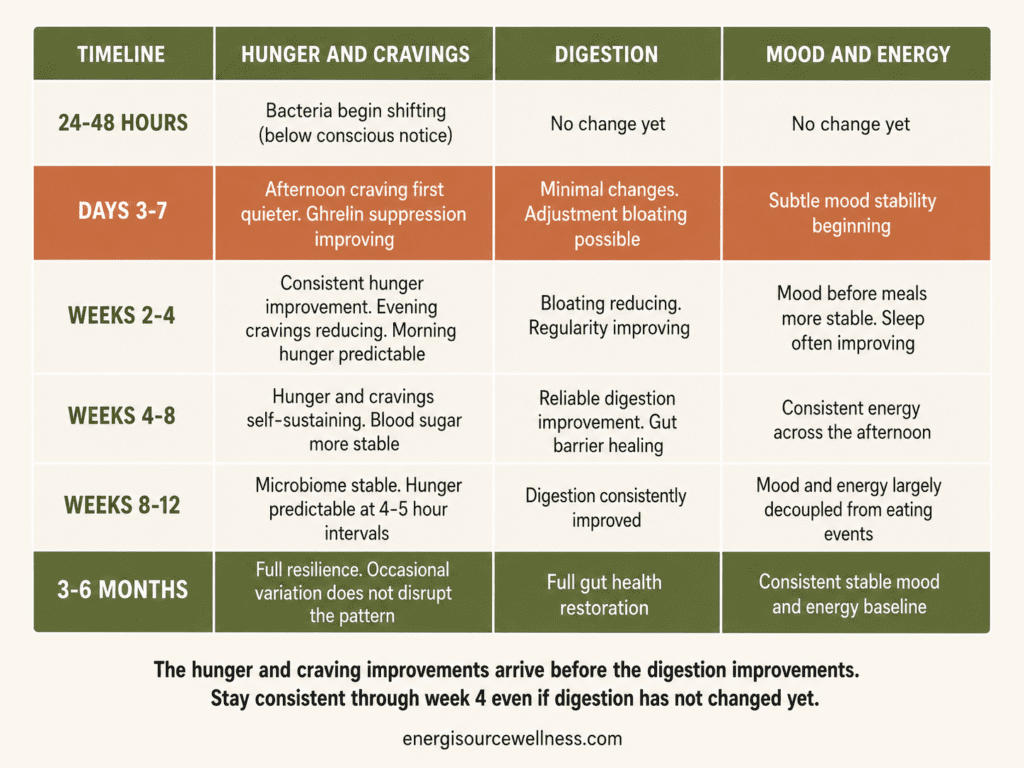
The complete gut health improvement timeline
24 to 48 hours: First bacterial shifts
Research published from Harvard and UC San Francisco found that significant shifts in the types of bacteria present in the gut can begin within 24 to 48 hours of a major dietary change. When you add probiotic foods like Greek yogurt, kefir, and sauerkraut and prebiotic fiber from chickpeas, garlic, onions, and oats, the gut bacteria begin altering their gene expression to process the new food sources within the first day. Within two days, the actual composition of the microbial community begins to shift measurably.
What you will not notice at 24 to 48 hours: virtually nothing subjectively. This phase is happening entirely below the threshold of conscious experience. You will not feel different. The changes are real but they are at the level of bacterial gene expression and early population shifts, not at the level of hormone output or serotonin production yet.
What to do: Focus on consistency rather than outcome monitoring at this stage. Eat the probiotic and prebiotic foods at every meal as described. The foundation is being laid even though nothing feels different yet.
Days 3 to 7: First hunger and craving signals
This is typically the first window when people notice something different. By day 3 to 5 of consistent probiotic food and prebiotic fiber consumption, most people report that the afternoon sweet craving is noticeably less intense. It may still fire but it feels more like a mild preference than an urgent biological signal. Morning hunger begins arriving at a more predictable time. The evening sweet pull after dinner starts to ease.
These early changes are driven by initial improvements in serotonin production from the gut as beneficial bacteria populations begin responding to prebiotic fiber supply. The changes are not dramatic and they are not fully consistent yet. Day 4 might feel different, day 5 might feel similar to before, and day 6 might feel different again. This inconsistency is normal at this stage because the beneficial bacteria populations are still building and their serotonin and ghrelin-regulating output is not yet stable.
What to notice: Whether the afternoon craving feels more like a mild preference or still like an urgent signal. Whether morning hunger arrives at a predictable time. Whether the post-dinner sweet craving is present but manageable rather than overwhelming.
Weeks 2 to 4: Consistent hunger and craving improvement
By the end of the second week of consistent Mediterranean gut health eating, most people report that the hunger and craving patterns are meaningfully and consistently different from before. The afternoon craving either does not fire or is easily managed with a small planned snack rather than requiring willpower to resist. Evening sweet cravings are present but significantly reduced in intensity. Morning hunger arrives predictably and does not feel urgent immediately upon waking.
Mood stability around meals also improves in this window. The irritability before meals that many people with gut bacteria imbalance experience begins to reduce as gut-derived inflammatory cytokines decrease and serotonin production stabilizes. Sleep quality often improves by weeks 2 to 3 as gut-based melatonin production increases alongside the serotonin production improvement.
Digestion begins to show initial improvements in this window as well. The gut lining completes multiple regeneration cycles (renewing every 5 to 7 days) and the first measurable improvements in gut barrier integrity begin to appear. Early signs include reduced bloating after high-fiber meals (the initial adjustment bloating from week 1 resolving), more regular bowel movements, and reduced gas in response to legumes that would previously have caused significant discomfort.
What to notice: Consistency of the hunger and craving improvements across days rather than intermittent improvement. The mood and sleep changes. The beginning of digestion improvements. This is the phase where most people who started the changes in week 1 begin to feel confident that something real is happening.
Weeks 4 to 8: Structural gut health improvements
Between weeks 4 and 8, the gut health improvements shift from primarily hormonal (hunger, cravings, mood) to structural (gut barrier integrity, microbiome diversity, inflammatory marker reduction). The hunger and craving improvements that became consistent in weeks 2 to 4 become self-sustaining in this phase rather than requiring moment-to-moment maintenance.
Blood sugar stability improves measurably in this window as gut bacteria diversity increases and insulin sensitivity is restored through reduced gut-derived inflammation. The same carbohydrate load that would previously produce a blood sugar spike and crash now produces a flatter, more stable glucose curve because the gut bacteria are now producing adequate short-chain fatty acids to support the glucose regulation pathway.
Digestion changes become reliably consistent in this phase. Bloating that was previously present after many meals is reduced or absent. Bowel regularity is consistent. The gut lining has completed enough regeneration cycles with adequate butyrate supply from prebiotic fermentation that the permeability that was allowing inflammatory molecules into the bloodstream is significantly reduced.
Weeks 8 to 12: Microbiome stabilization
By weeks 8 to 12 of consistent daily probiotic and prebiotic food consumption with Mediterranean meal structure, the gut microbiome is approaching a stable new baseline. The beneficial bacteria populations that drive hunger hormone regulation, serotonin production, and gut barrier integrity have established consistent colonies that maintain their output without requiring the same degree of daily dietary support as in the early weeks.
The hunger and craving pattern at this stage feels qualitatively different from before the changes began. Hunger arrives at predictable intervals, 3 to 5 hours after a properly structured meal, and resolves reliably after eating. Cravings are present as mild preferences rather than urgent biological signals. The mood and energy fluctuations that previously tracked with eating patterns are significantly reduced.
3 to 6 months: Full resilience
The full restoration of gut microbiome diversity to the level associated with optimal metabolic health, stable hunger regulation, and robust serotonin production takes 3 to 6 months of consistent Mediterranean eating. At this stage, occasional dietary indiscretions, missed probiotic foods, or periods of higher stress do not produce the same immediate hunger and craving disruption that they would have in the early weeks because the microbiome has built sufficient resilience to absorb short-term variation without losing its functional stability.
>> Want to speed up your gut health timeline?
The Full Plate Method app builds Mediterranean meals combining probiotic and prebiotic foods that accelerate the hunger and craving improvements within the first 7 days. Free forever. Build gut-health meals free
How to accelerate the timeline
The timeline described above assumes consistent but not optimized gut health eating. Several specific actions can compress the timeline and produce meaningful hunger and craving improvements faster.
Action 1: Add three different probiotic food sources daily from day 1
The fastest way to improve gut bacteria diversity is to introduce multiple different bacterial strains simultaneously rather than relying on a single probiotic food source. Greek yogurt at breakfast, sauerkraut or kimchi at lunch, and miso at dinner introduces three completely different bacterial families at three separate meals. This diversity of introduction accelerates microbiome rebalancing more effectively than eating large quantities of a single probiotic food. For additional targeted strain support alongside the food sources, Physician’s Choice Probiotics 60 Billion CFU provides 10 diverse strains plus organic prebiotics in one capsule, making it the most efficient supplement equivalent to the multi-source probiotic food approach.
Action 2: Hit 10 grams of prebiotic fiber daily from week 1
The prebiotic fiber that feeds beneficial bacteria and drives the serotonin and short-chain fatty acid production responsible for hunger and craving improvements is the variable that most determines how quickly the timeline moves. Half a cup of chickpeas at lunch provides 6 grams of prebiotic fiber. One tablespoon of chia seeds at breakfast provides 5 grams. Garlic and onions as cooking foundations provide an additional 2 to 3 grams. Together these bring daily prebiotic fiber to 13 to 14 grams which is sufficient to produce the bacterial fermentation needed for meaningful short-chain fatty acid and serotonin production within the first week.
Action 3: Add a targeted Lactobacillus Gasseri supplement for hunger hormone acceleration
For people whose primary concern is hunger hormone regulation rather than general gut health, Swanson Lactobacillus Gasseri is the most research-backed targeted strain for metabolic and hunger hormone support. Taking it alongside the dietary changes provides specific support for the ghrelin and leptin regulation pathway that produces the fastest hunger improvement, potentially accelerating the Day 3 to 7 timeline to Day 2 to 5 for the initial craving and hunger changes.
Action 4: Remove refined sugar and processed food simultaneously
Adding probiotic and prebiotic foods while continuing to eat significant quantities of refined sugar and processed food is like adding beneficial bacteria to a system that is actively feeding the harmful bacteria competing with them. Reducing refined sugar and processed food is not a restriction protocol. It is removing the primary food supply of the harmful bacteria that produce the inflammatory cytokines and craving signals that the beneficial bacteria are trying to counter. The timeline compresses significantly when both actions happen simultaneously rather than sequentially.
Action 5: Prioritize sleep during the first 4 weeks
Sleep deprivation directly disrupts gut bacteria balance through cortisol and disrupts the serotonin-to-melatonin conversion pathway that the improving gut bacteria are supporting. Prioritizing 7 to 9 hours of sleep during the first 4 weeks of gut health eating maintains the hormonal environment that allows the gut bacteria changes to produce their full benefit on the hunger and mood timeline. Poor sleep during this period does not reverse the gut bacteria changes but it significantly blunts the subjective experience of the hunger and craving improvements.
What slows the timeline down
Several factors consistently slow gut health improvement regardless of dietary changes made. Understanding these helps identify whether the timeline is progressing normally or whether something specific is interfering.
Antibiotic use:
Antibiotics eliminate both harmful and beneficial bacteria indiscriminately. A study on gut microbiota recovery after antibiotic exposure found that recovery time varies widely by antibiotic type, from a few months to over a year for some species, and a handful of bacterial strains can remain undetectable even 6 months later. Starting the Mediterranean gut health approach after antibiotic use produces results but on a longer timeline than for someone starting from a non-antibiotic-disrupted baseline.
Chronic high stress:
Elevated cortisol from chronic stress directly disrupts gut bacteria balance and impairs the serotonin production that produces the hunger and craving improvements. Someone under significant chronic stress will notice slower hunger and craving improvements than the typical timeline suggests because cortisol is continuously disrupting the gut environment that the probiotic and prebiotic foods are trying to support.
Continuing high refined sugar intake:
Refined sugar feeds Candida and harmful bacteria that produce the inflammatory cytokines driving cravings and hunger dysregulation. Continuing significant refined sugar consumption while adding probiotic and prebiotic foods produces a slower timeline because the beneficial bacteria are competing against a well-fed harmful bacteria population rather than gradually coming to dominate an available food supply.
Inconsistency:
The gut microbiome responds to consistent daily inputs more than to occasional large doses. A person who eats Greek yogurt and chickpeas consistently every day for four weeks will see meaningfully faster results than a person who eats large amounts of probiotic and prebiotic foods on some days and none on others. The beneficial bacteria population that drives the hunger and craving improvements builds through consistent daily exposure rather than through periodic intensive intervention.
Frequently asked questions
How quickly will I notice gut health improvements?
The first noticeable changes for most people come in the hunger and craving patterns between day 3 and day 7 of consistent probiotic food and prebiotic fiber consumption. The afternoon sweet craving typically becomes noticeably less intense before any digestive changes appear. This is because serotonin and ghrelin regulation responds more quickly to changes in gut bacteria composition than the deeper structural gut changes that drive digestion improvements. If no changes are noticeable by day 10 to 14, the prebiotic fiber intake is likely below 10 grams per day or probiotic food diversity is insufficient.
How long does it take for probiotic foods to work?
Probiotic bacteria from foods like Greek yogurt, kefir, and sauerkraut begin influencing gut bacteria composition within 24 to 48 hours of consumption. Some people notice changes in hunger and cravings within the first week or two of consistent daily probiotic food consumption. However, probiotic bacteria from food are transient residents that pass through within 3 to 5 days and need to be replenished daily. The sustained benefit comes from consistent daily consumption rather than from single large doses. The timeline for probiotic foods to produce consistent, self-sustaining gut health improvements is 4 to 8 weeks of daily consumption alongside adequate prebiotic fiber.
Does gut health improvement happen faster with supplements than food?
A high-quality multi-strain probiotic supplement combined with consistent prebiotic food consumption can accelerate the initial timeline by 2 to 4 days compared to probiotic foods alone, because supplements deliver higher colony-forming unit counts of specific strains more immediately than food sources. However, food-based probiotics provide fiber, protein, and additional nutrients that support the gut bacteria alongside the live cultures, which supplements cannot fully replicate. The fastest timeline combines both: a multi-strain probiotic supplement like Physician’s Choice alongside daily probiotic foods and prebiotic fiber from Mediterranean whole foods.
Why am I experiencing more bloating at the start of gut health changes?
Temporary increased bloating in the first 7 to 14 days of adding probiotic and prebiotic foods is extremely common and is not a sign that the changes are wrong or harmful. It is the natural consequence of introducing large amounts of prebiotic fiber to gut bacteria that have not previously had this level of fermentable material available. The bacterial fermentation produces gas as a byproduct. As the beneficial bacteria populations adjust to the new prebiotic fiber supply over 1 to 2 weeks, this gas production normalizes. Starting with smaller portions of high-prebiotic foods (a quarter cup of chickpeas rather than a full half cup) and gradually increasing over 2 weeks reduces the initial bloating without slowing the timeline.
What should I look for to know the gut health improvements are working?
The most reliable early indicator is the afternoon craving pattern. If the 3pm sweet or carb craving that previously felt urgent now feels like a mild preference rather than a biological signal, the gut bacteria changes are working on the serotonin pathway. The second indicator is morning hunger predictability: arriving at a consistent time after breakfast rather than immediately upon waking. The third indicator is the evening sweet craving after dinner: present but manageable with a small planned sweet rather than feeling like an open loop that is difficult to close. Digestion indicators like reduced bloating and improved regularity are the fourth set of signals and typically appear 1 to 2 weeks after the hunger and craving improvements.
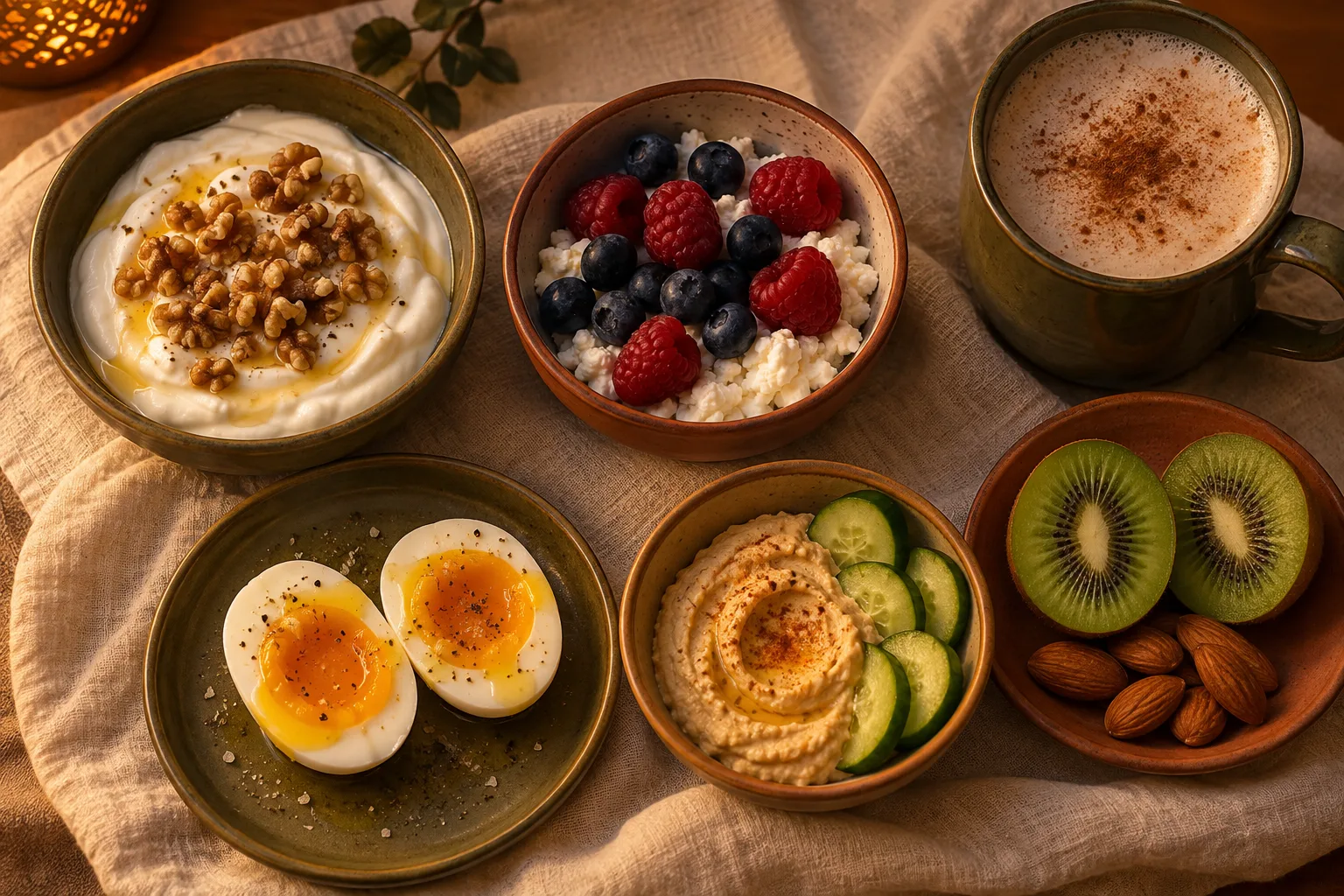
Free printable
Hungry again at 9pm?
Get the free printable Night Hunger Snack List: 10 Mediterranean snacks with exact portions and protein counts, for the evenings when cravings hit. Enter your email and download it instantly.
Free. No spam. Unsubscribe anytime.
The bottom line
The gut health improvement timeline for hunger and cravings is faster than most content in this space communicates because most gut health timelines are written for digestion, not for the hunger hormone and serotonin changes that drive the experiences most people on this site are trying to address. Gut bacteria composition begins shifting within 24 to 48 hours of dietary change. Initial hunger and craving improvements appear between day 3 and day 7. Consistent improvement across both hunger and digestion becomes reliable by weeks 2 to 4. Microbiome stabilization with self-sustaining hunger regulation takes 8 to 12 weeks. Full resilience takes 3 to 6 months.
The single most important variable in the timeline is daily consistency with both probiotic food sources and prebiotic fiber from legumes. The beneficial bacteria that produce the hunger hormone and serotonin improvements build through consistent daily exposure. The timeline described here assumes that consistency. The faster version of the timeline comes from adding a multi-strain probiotic supplement alongside the food approach, hitting 10 grams of prebiotic fiber daily from week 1, and reducing refined sugar and processed food simultaneously rather than sequentially.
I tracked the changes carefully when I started the gut health approach. The first thing I noticed was the afternoon on day 4. The craving that had been a reliable daily event simply did not arrive with its usual urgency. I remember noticing the absence more than any positive change. Something that had been there every day was quieter. By the end of week 2 that quietness was consistent. By week 4 I had largely stopped thinking about cravings as something to manage. The timeline felt faster than I expected. The research explains why: the hunger hormone changes happen before the digestion changes, and those are what you notice first.
Ribert
>> Want a complete gut health meal plan that follows this timeline?
The 7-Day Mediterranean Meal Plan PDF builds every meal around the probiotic and prebiotic combination that produces the fastest possible hunger and craving improvement timeline. $27, instant download. Get the 7-Day Mediterranean Meal Plan for $27
This article shares personal experience and general nutrition information, not medical advice.
About Ribert Rodriguez
Ribert is the founder of EnergiSource Wellness. He built this site to share what actually worked for him after years of struggling with cravings, late-night eating, and low energy. His approach is rooted in the Mediterranean framework and a belief that food is one of the most powerful tools for how you think and feel.